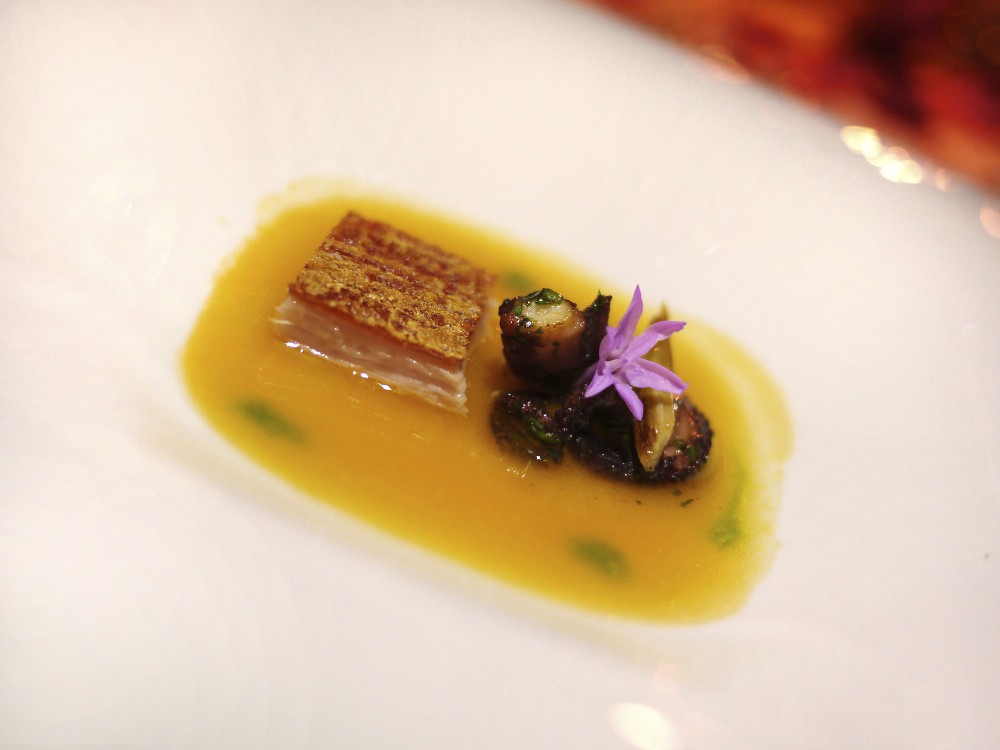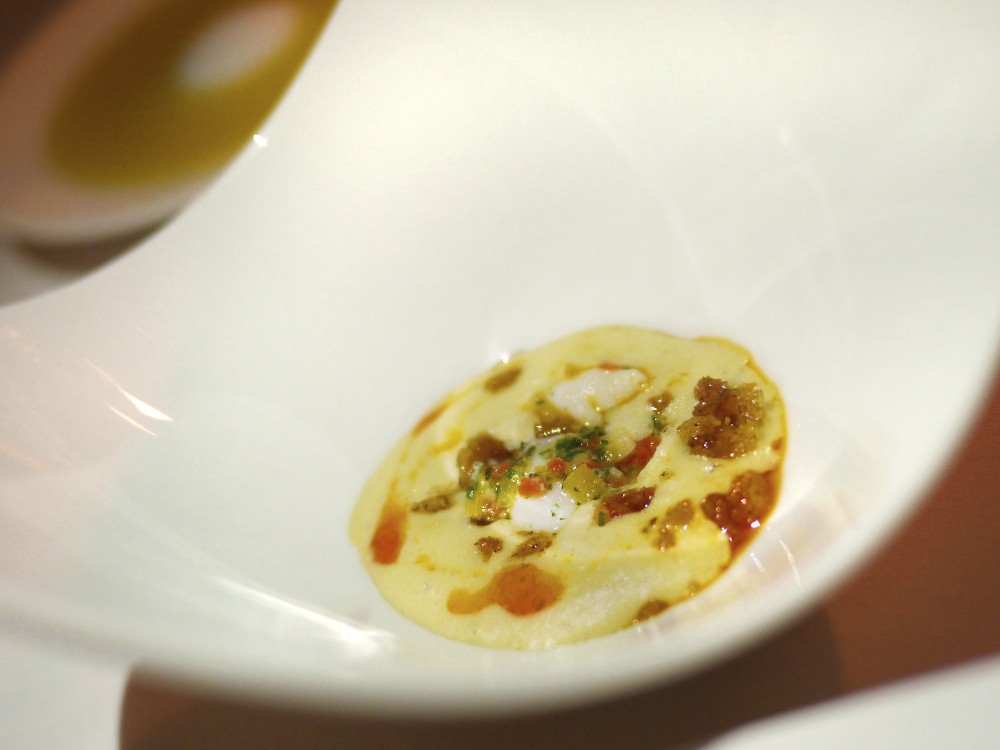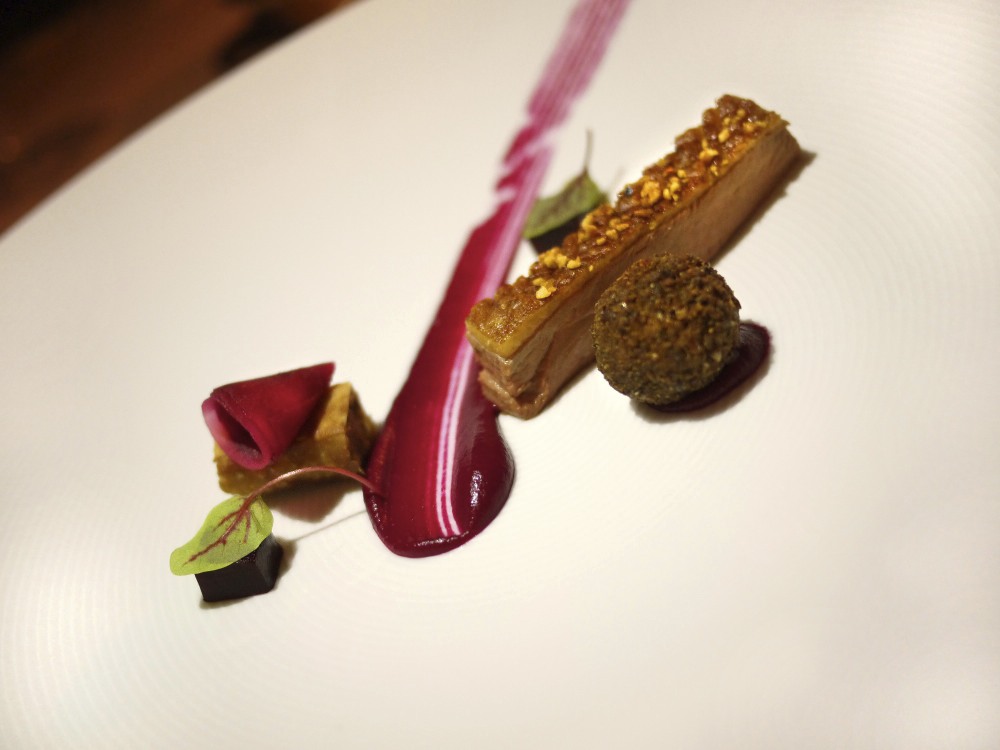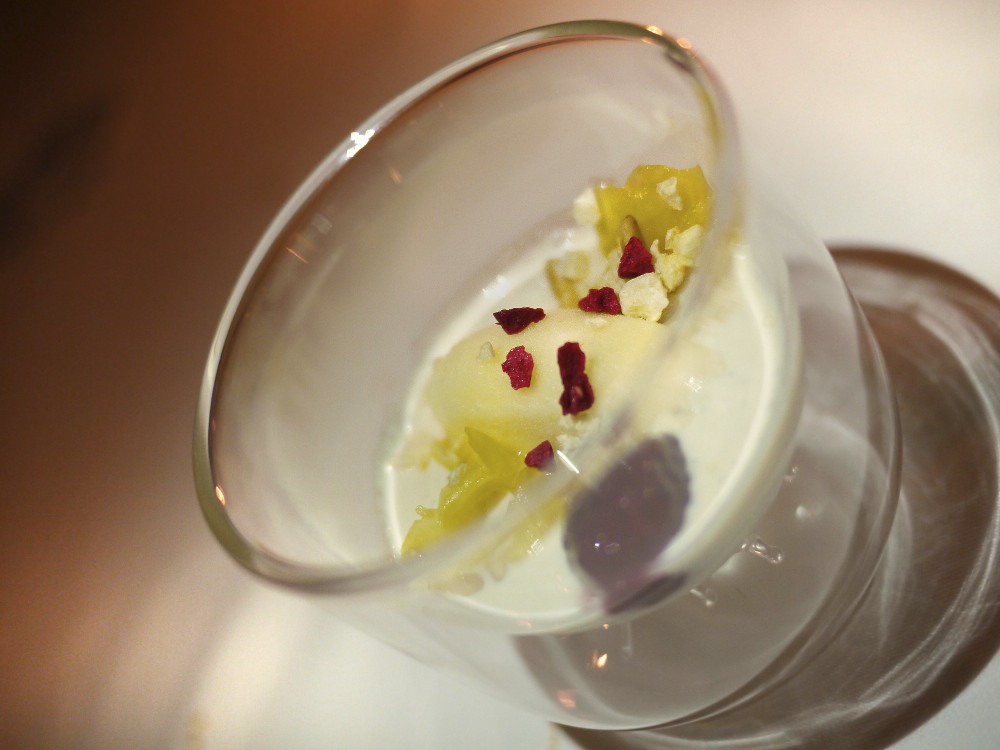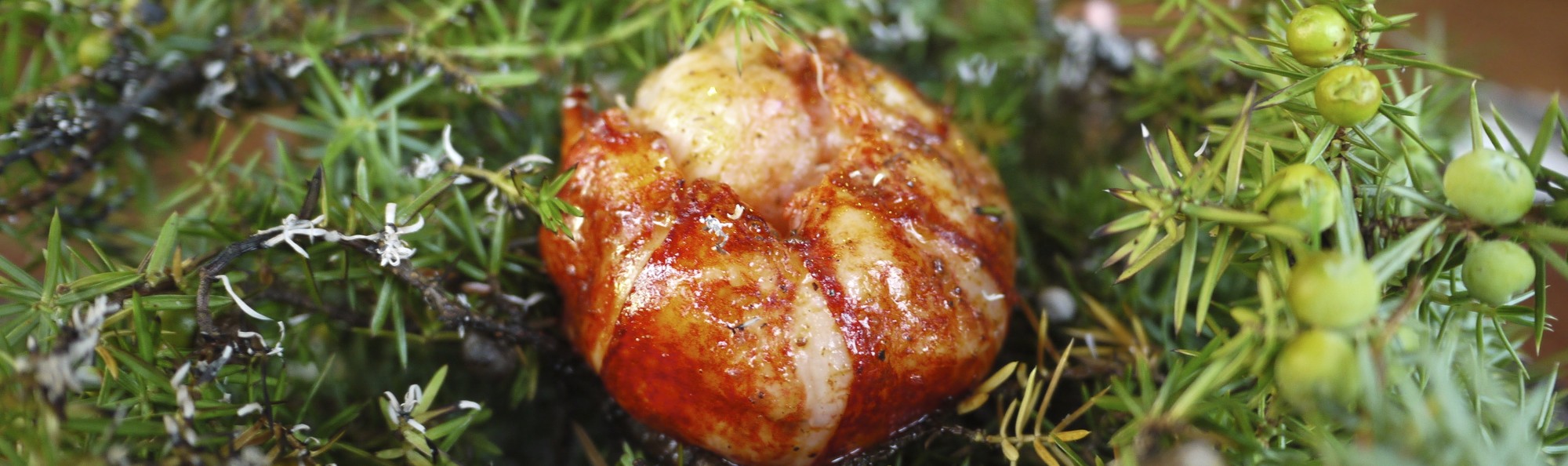
Author Archives: admin

Attica, Melbourne

P1130753

Chef: Ben Shewry        Website: www.attica.com.au        Cuisine: Modern Australian

My first gastronomic trip to Australia back in 2010 was memorable for various reasons. I had an unforgettable meal at Vue de Monde, followed by a shocking experience with a very rude commis sommelier at the Royal Mail Hotel and a rather spectacular view yet mundane meal at Quay. However, there was one place that took me by complete surprise. A friend of mine first spoke of Attica back in early 2009 suggesting I gave it a try on my next trip to Melbourne. As the menu looked quite unique including dishes like “a potato cooked in its own earth”, I gave it a shot and invited my in-laws. Whilst everything was good, my experience that evening didn’t quite blow me away like Vue de Monde had on that trip, but I came away thinking there was something different and interesting about Ben Shewry’s cuisine. His dishes were simple at a time when many chefs preferred over engineering them, so I vowed to return in a couple of years to let the restaurant evolve and grow. After all, Shewry is still very young. Three years on, I returned with my wife and parents. I was excited but equally scared. What if I was wrong? I was deep in thought as I walked down the street, suddenly finding myself in front of the raw brick exterior that is Attica. This was it.

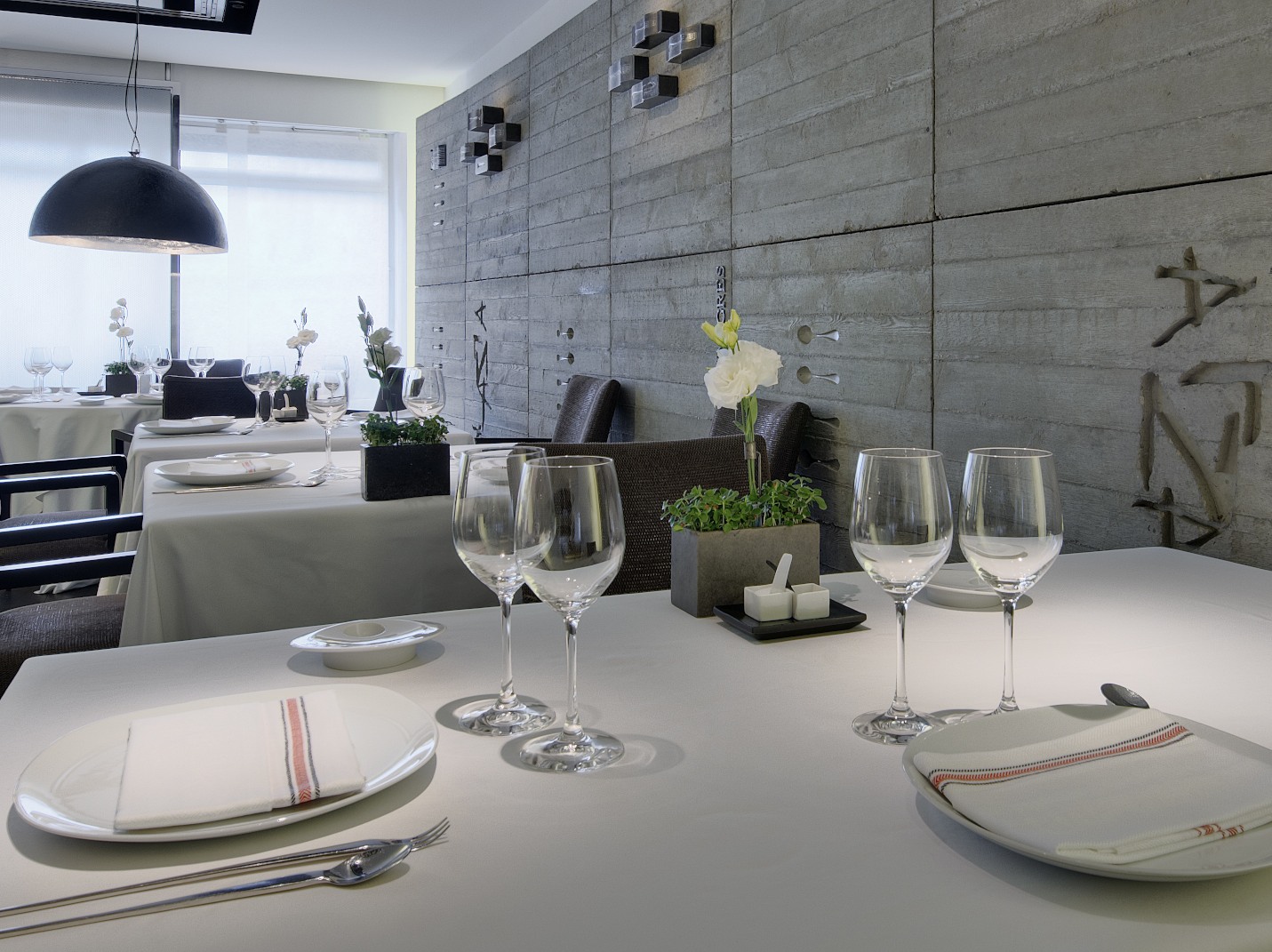
P1130694We must have been the last guests to arrive as the place was absolutely packed, and it was only a Tuesday! The manager, Hannah, gave us a warm welcome and led us to an extension off the main dining room divided by a window. In front of us there were two chef’s working meticulously in a glass sealed room. Since my last visit, Shewry had introduced the concept of an experimental chef’s table on Tuesday evenings, allowing just a handful of diners to observe and sample some of his latest creations. The menu coming in at only $95 AUD was shorter than the normal Tasting Menu. For me, this was the perfect way to see how much Shewry had evolved over the last three years. I handed over my copy of “Origin” for a signature and I was set for the evening. It was show time.
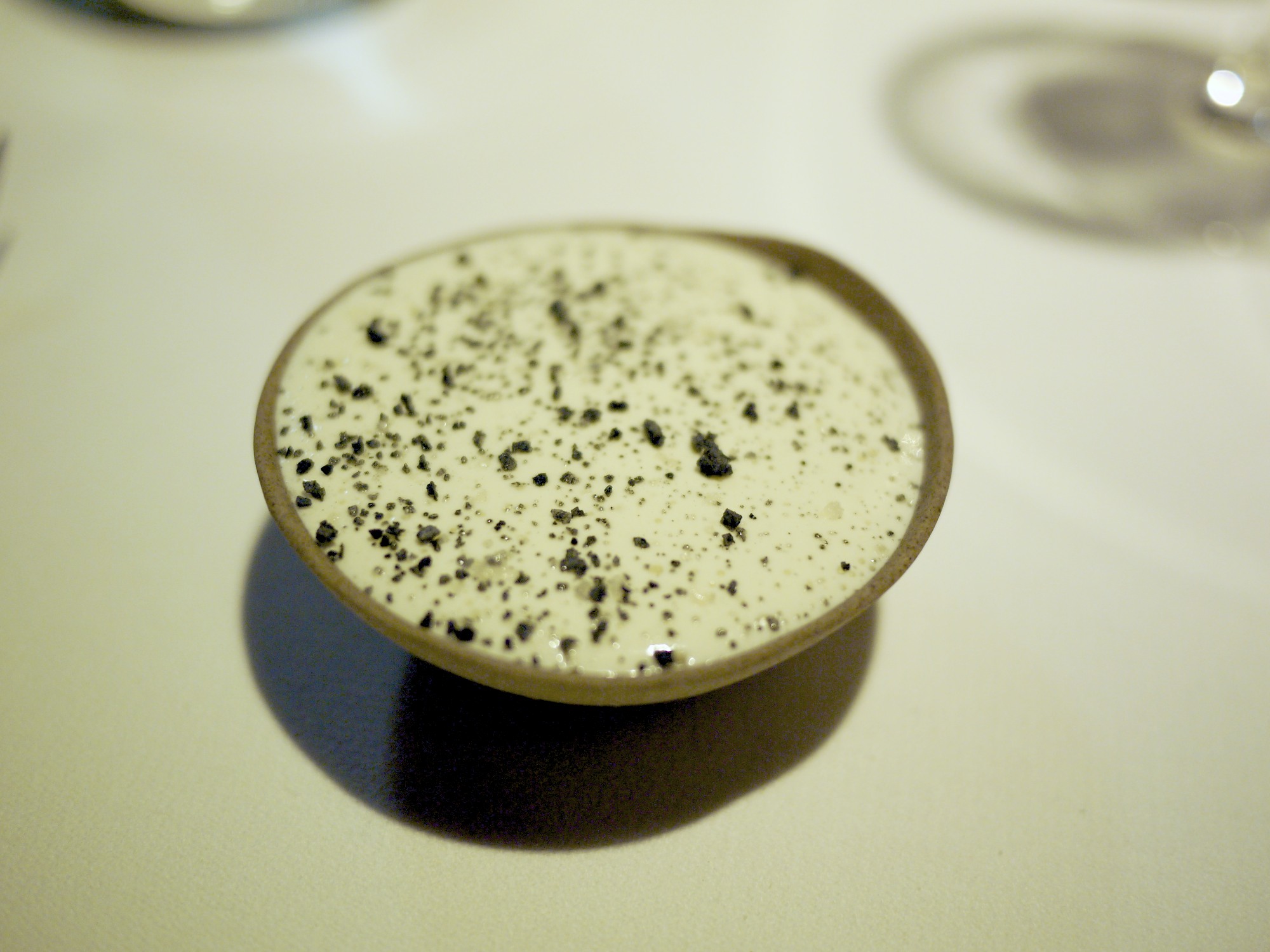
P1130707My wife knew I had been looking forward to this for a while and she graciously offered to be the designated driver for the evening. I had my carte blanche. I could now enjoy the matching wines, and what could be better to start the evening than a glass of the NV J.L Vergnon Conversation Blanc de Blancs. We were simultaneously presented with some whipped olive oil with black sea salt and creamy butter with sea salt to go with the sourdough we all had chosen. It became apparently clear that no one was going to touch the butter after trying the whipped olive oil. The cold smoked olive oil was whipped with gelatin to produce a smokey mousse-like spread which was divine. I may have mentioned this before, I am quite partial to bread and butter.
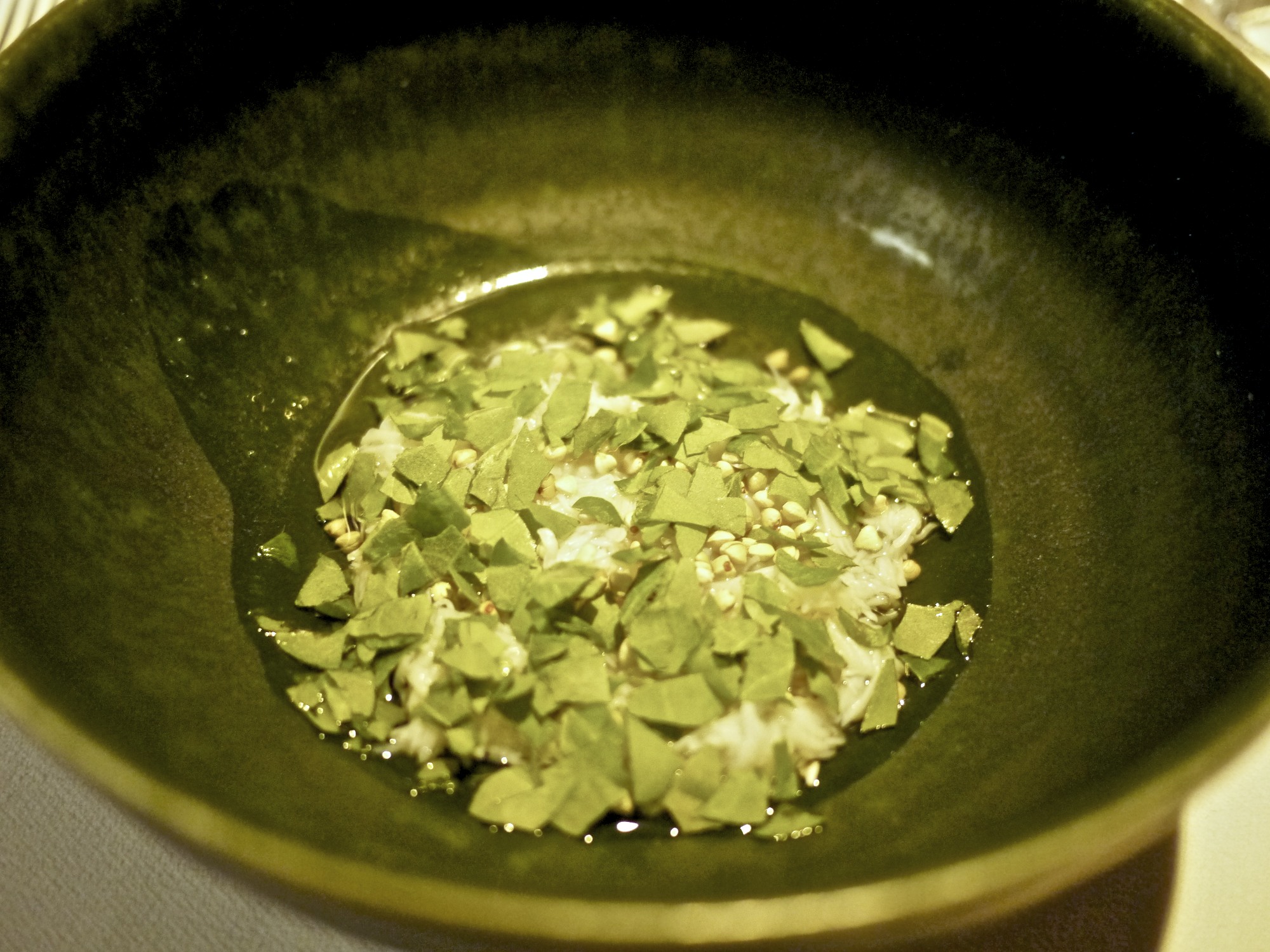
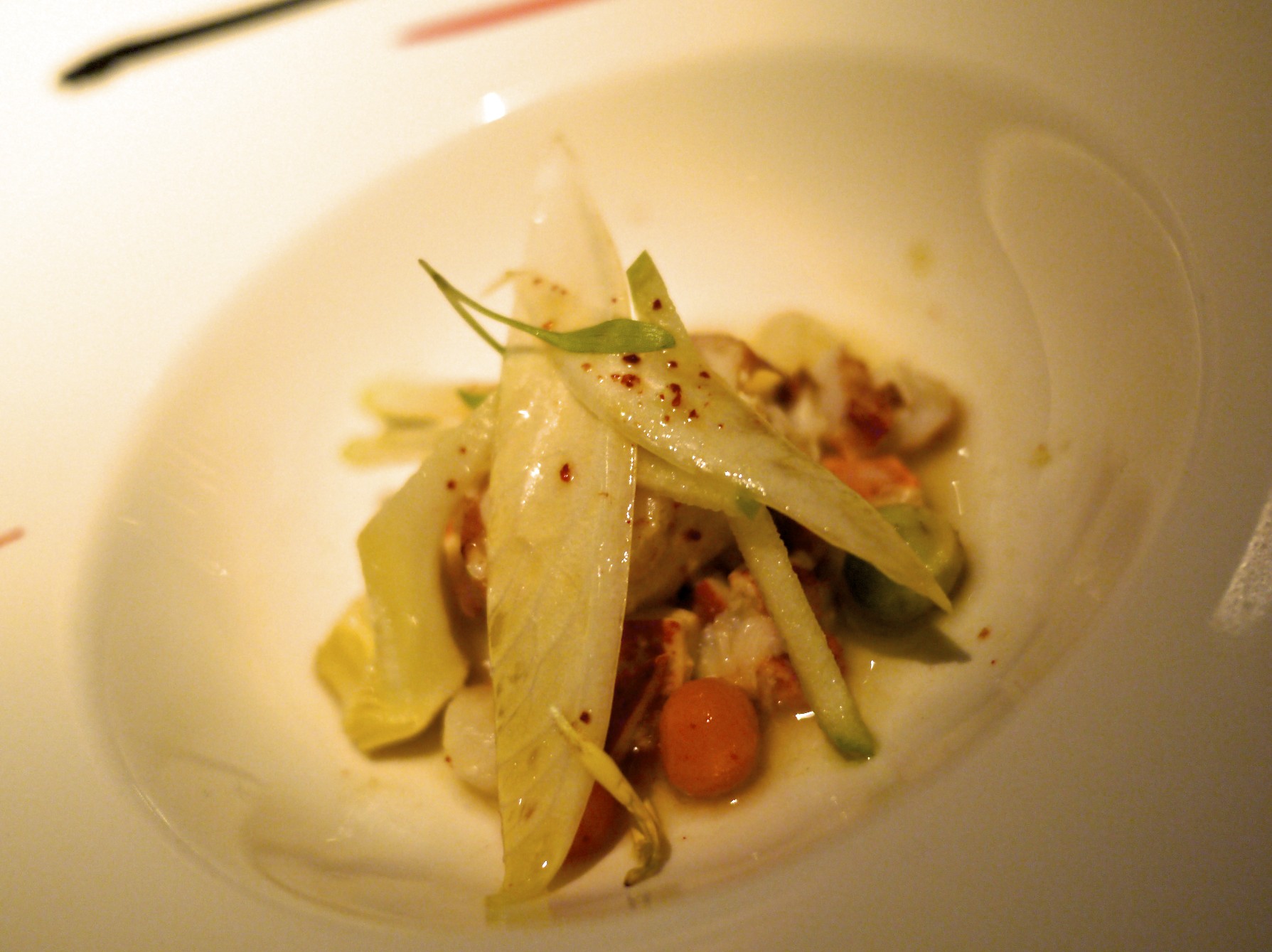
P1130704I wolfed down my second piece of sourdough, mopping up what was left as my wife attempted to fend me off unsuccessfully. Yes, I have no shame. It was that good. As we regained our composure, the sommelier came to pour out our first wine of the evening. The first matching was in fact a sake. The Uehara “Soma no Tengu” Junmai Ginjyo from Saga prefecture was cloudy and had a beautiful creamy aftertaste that went well with the Snow Crab, Sorrel and Buckwheat. The shredded meat of the delicate snow crab from Western Australia was sweet and the sorrel leaf added a lovely citrus note to lift the dish. The buckwheat which had been “activated” or germinated had been immediately dehydrated to give it a delicious crunch and remarkable textural contrast. The dish was completed at the table as the organic chicken infused broth was poured over. It was undeniably a simple looking dish but had a beautiful marriage of flavours and I thought the sweetness of the delicate snow crab was really brought out.
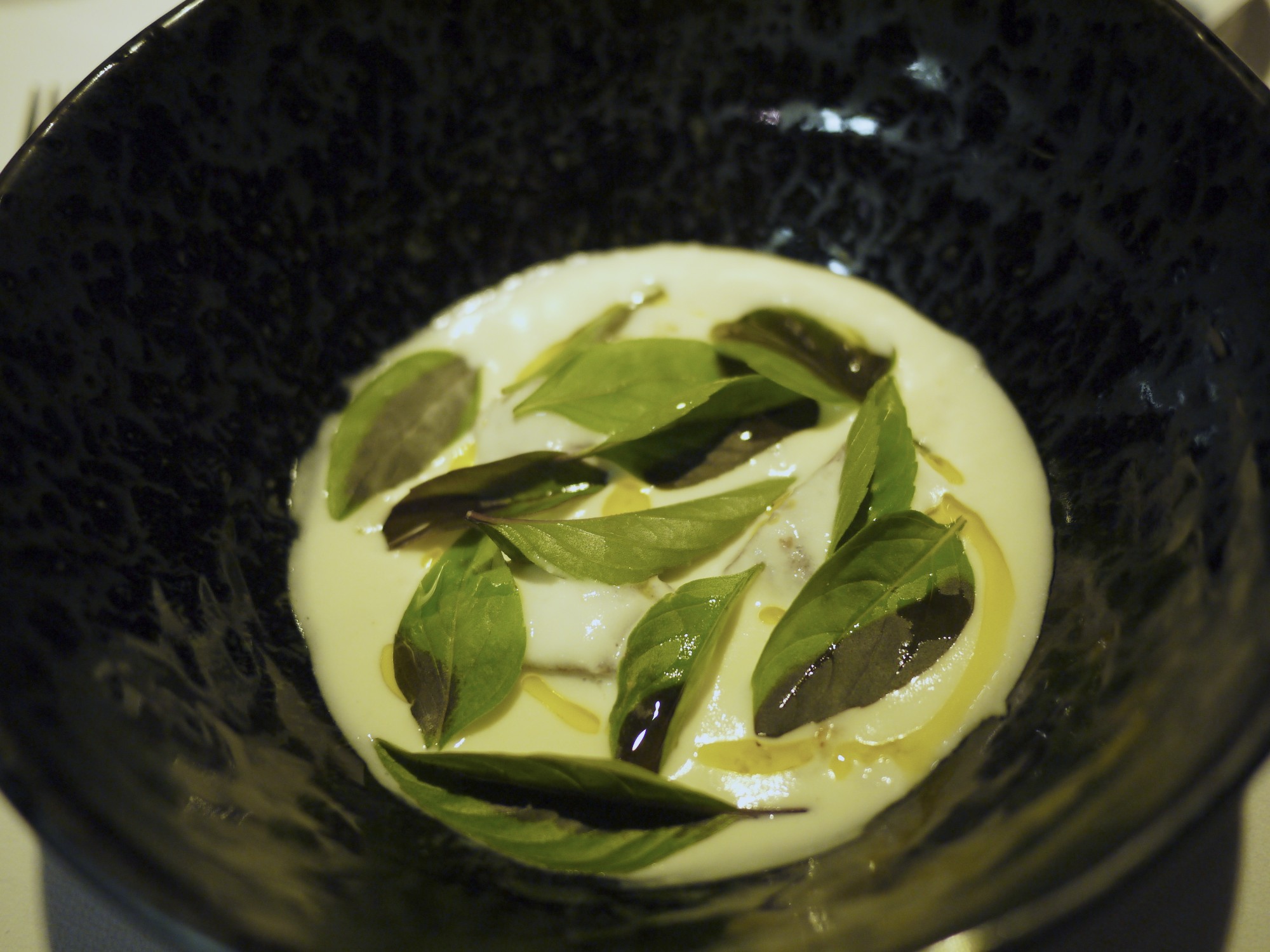
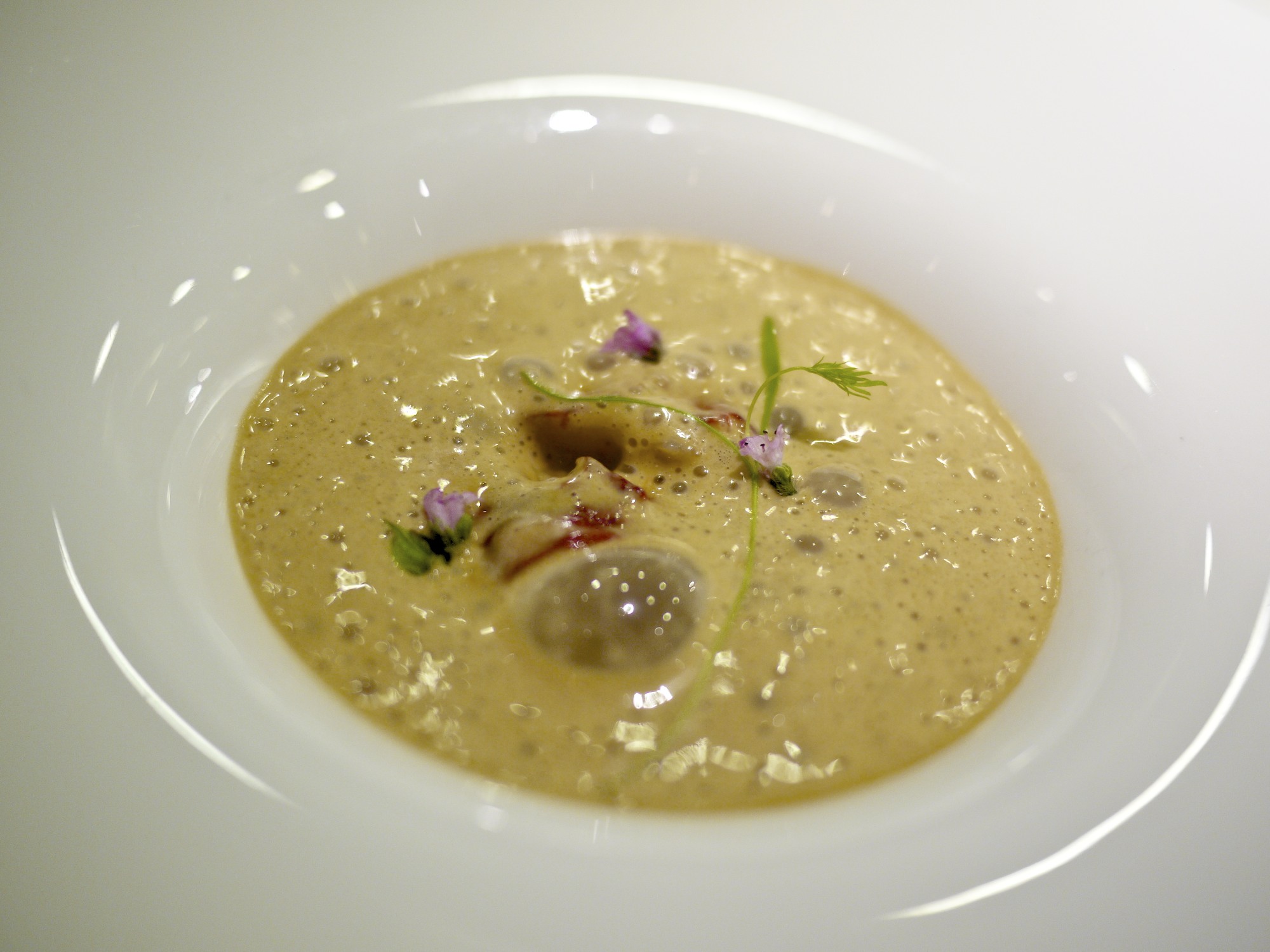
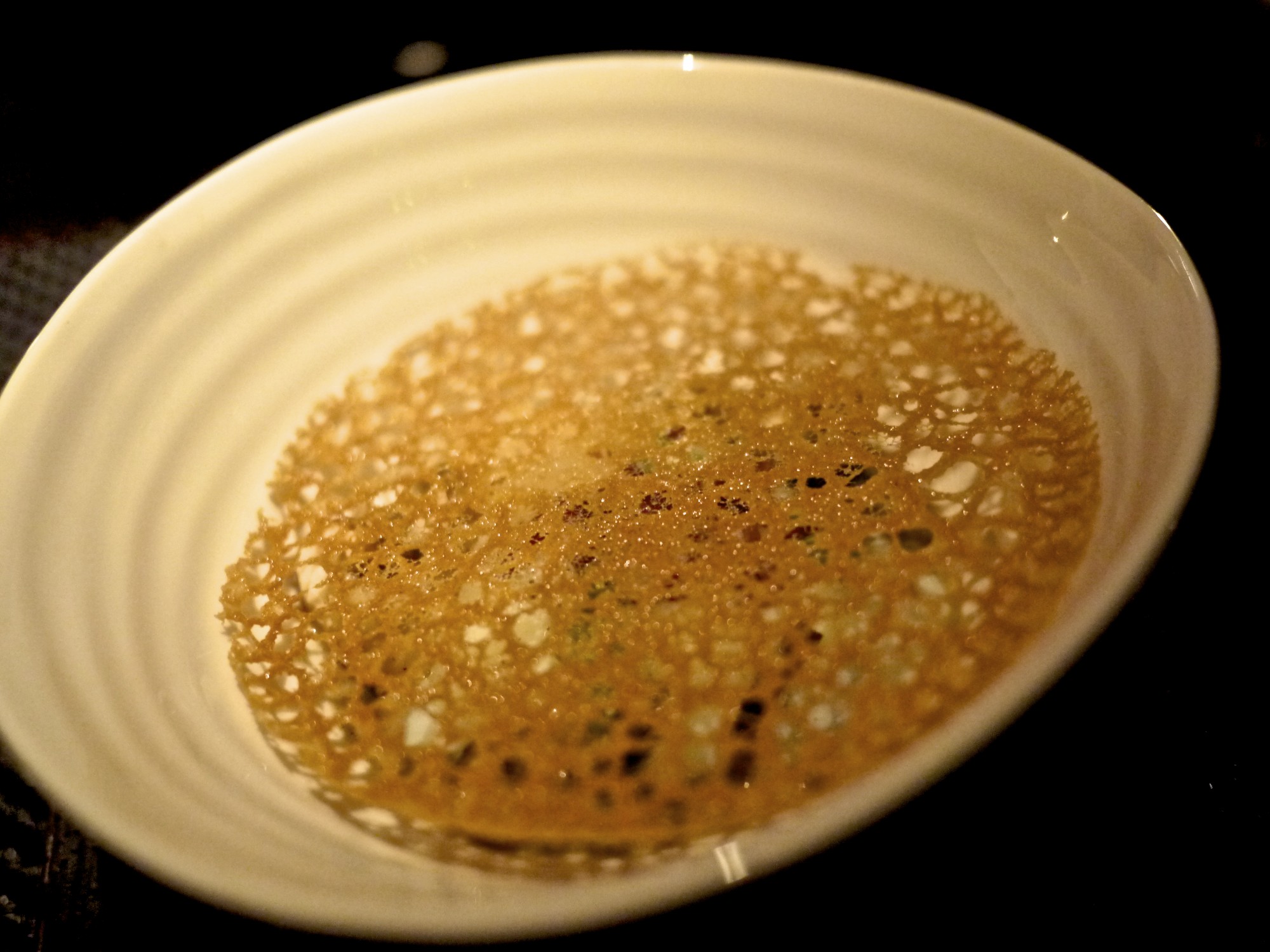
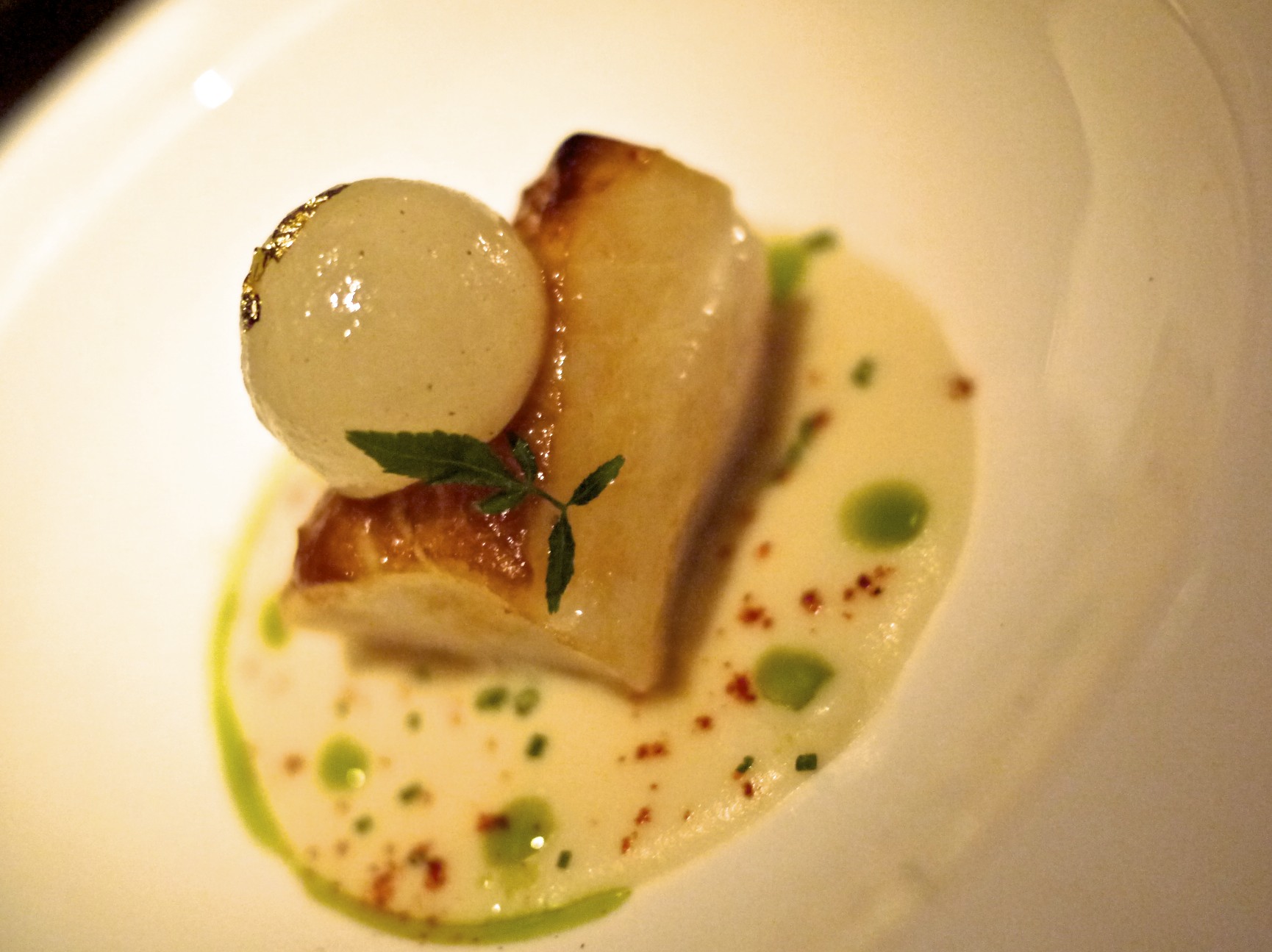
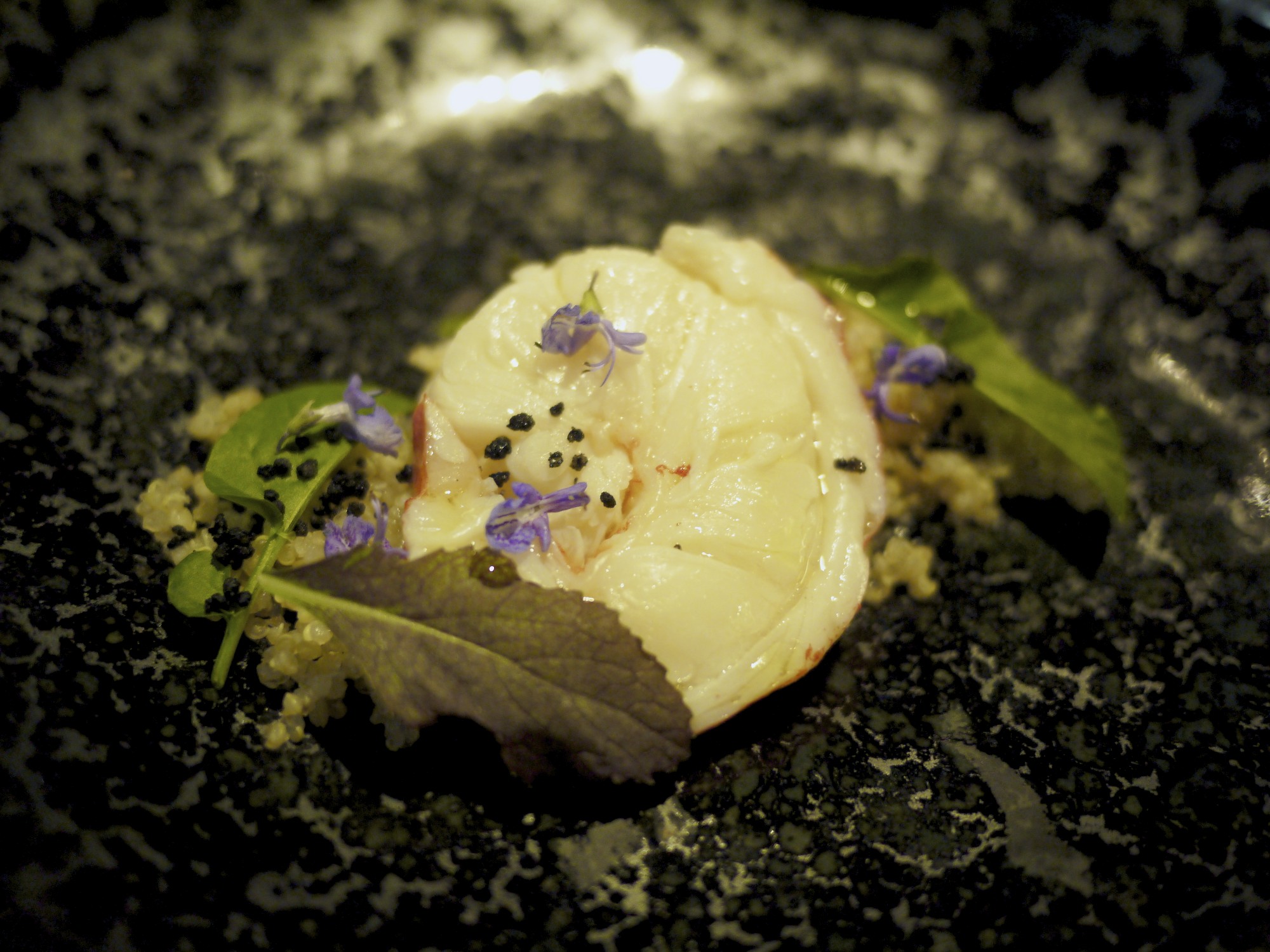
P1130708Carrying on with the theme of unconventional wine matching, the sommelier poured us a glass of beer from one of my favourite Belgian Trappist brewery, Chimay. On this occasion, however, I got to try something new – a Chimay Grande Reserve, which had a rich and lively sweetness with a surprisingly drier finish on the palate. The second dish of Cauliflower Cheese with 11 Basils and Smoked Eel was my absolute favourite of the evening. As the waiter explained, this was Shewry’s take on one of his favourite dish, cauliflower and cheese. There was a bed of roasted and shaved cauliflower incorporated into the goats cheese sauce with mustard oil. The choice of cheese was perfect as it did not overpower the other components of the dish and the mustard oil  cut through the creamy sauce, adding a slight heat to liven the dish. There were also pieces of delicious smoked eel and the finishing touch of the eleven leaves of basil, all with different flavours ranging from aniseed and verbena to orange and lime, was ingenious. Each spoonful had a slightly different refreshing flavour. I could have easily done with a whole pot of this!P1130716The third course of the evening was the Marron, Quinoa, Sauce of Cured Pork Fat and Onion. The West Australian marron was juicy and perfectly cooked as expected at this calibre of restaurant. The Tasmanian quiona had absorbed the pork fat and onion sauce, releasing bags of flavour. The black flecks were couscous cooked in squid ink which was subsequently dried, adding a delicious and crunchy component to the dish. Again, the dish went very well with the sommelier’s recommended matching glass of Bobar Chardonnay 2012, Yarra Valley, which was  fruity with a distinct green apple taste. I was seriously impressed with everything so far!
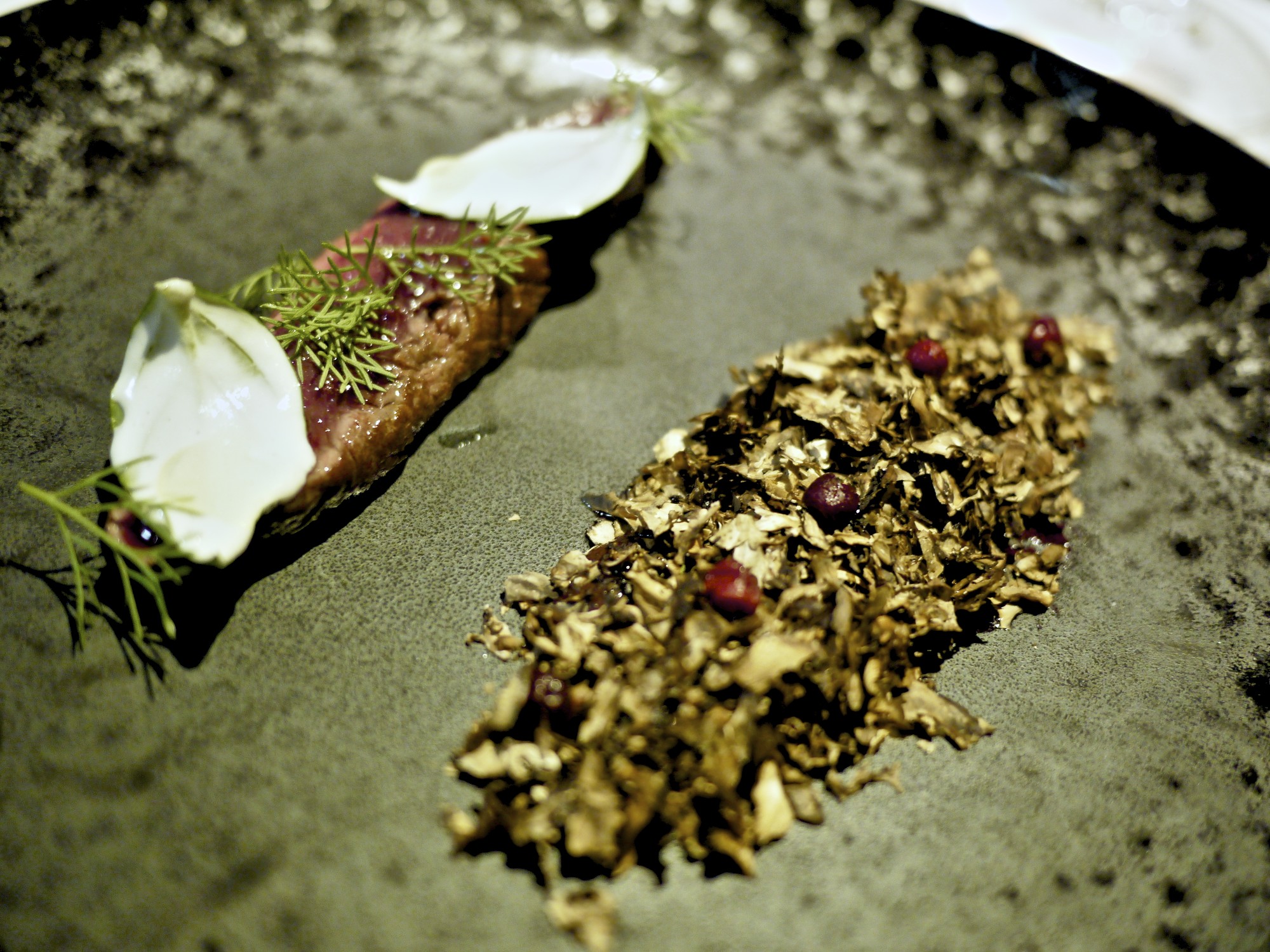
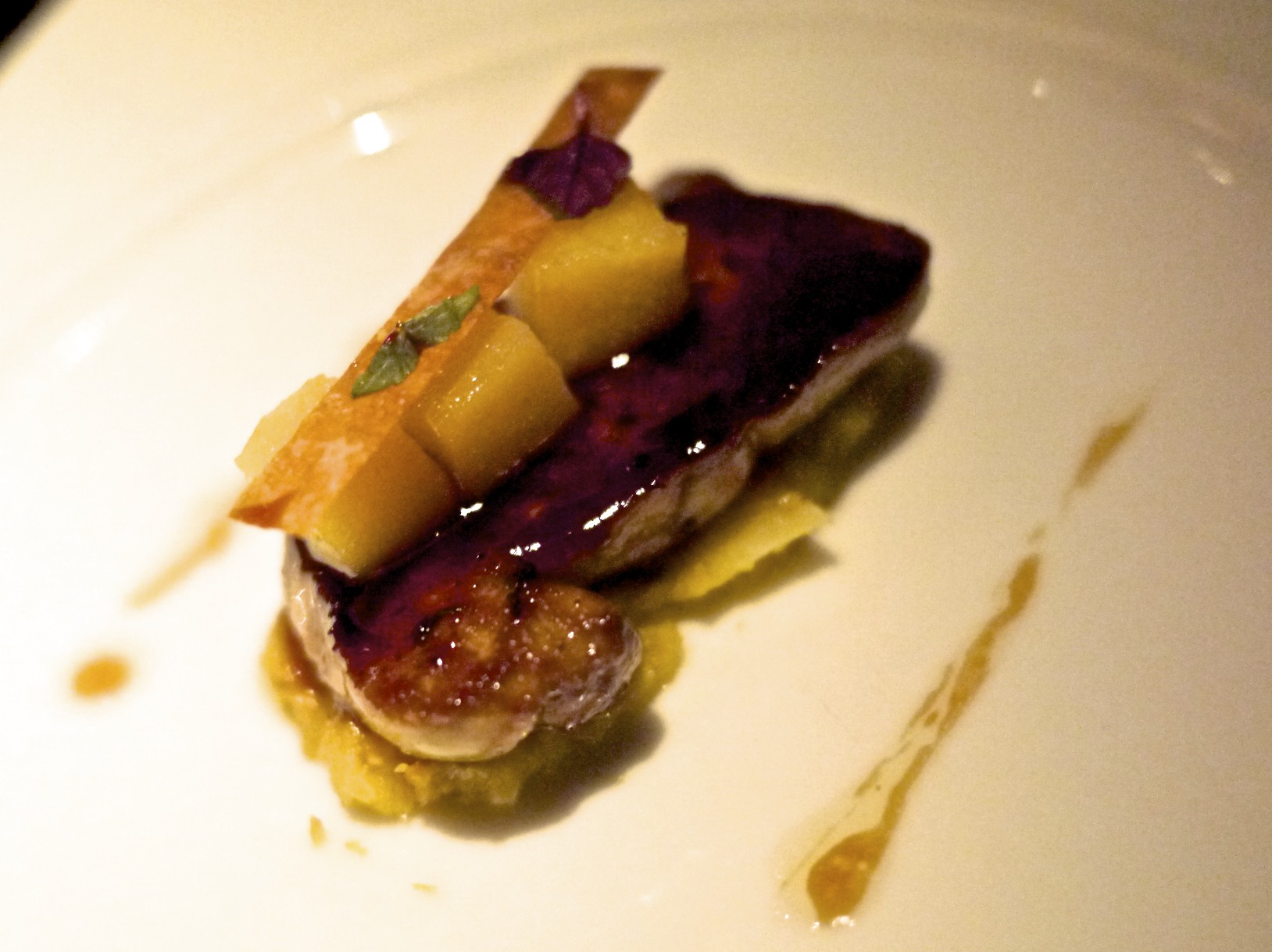
P1130723The finale of the Wallaby, Dried Mushrooms and Sea Wormwood was an explosion of big bold flavours in my mouth. The sirloin of the wallaby, sourced from Flinders Island, was seared lightly and served rare with mushroom leaves (not to be mistaken with a fungi) that had been brushed with macadamia nut puree, a drizzle of sweet rosella syrup (wild hibiscus) and sea wormwood that was grown in their own garden. The sea wormwood was a novelty for me as I had never tasted a herb that tasted like… coca-cola! The combination of the sweet syrup, slightly bitter sea wormwood and the sweet and buttery texture of this particular wallaby went perfectly with the foliage on the side which was wallaby black pudding topped with dried portobello mushrooms, swiss brown mushrooms and red currants. The matching glass of Ar Pe Pe Rosso di Valtellina 2009, Lombardy was my favourite wine of the evening, displaying typical elegant character of a decent nebbiolo.
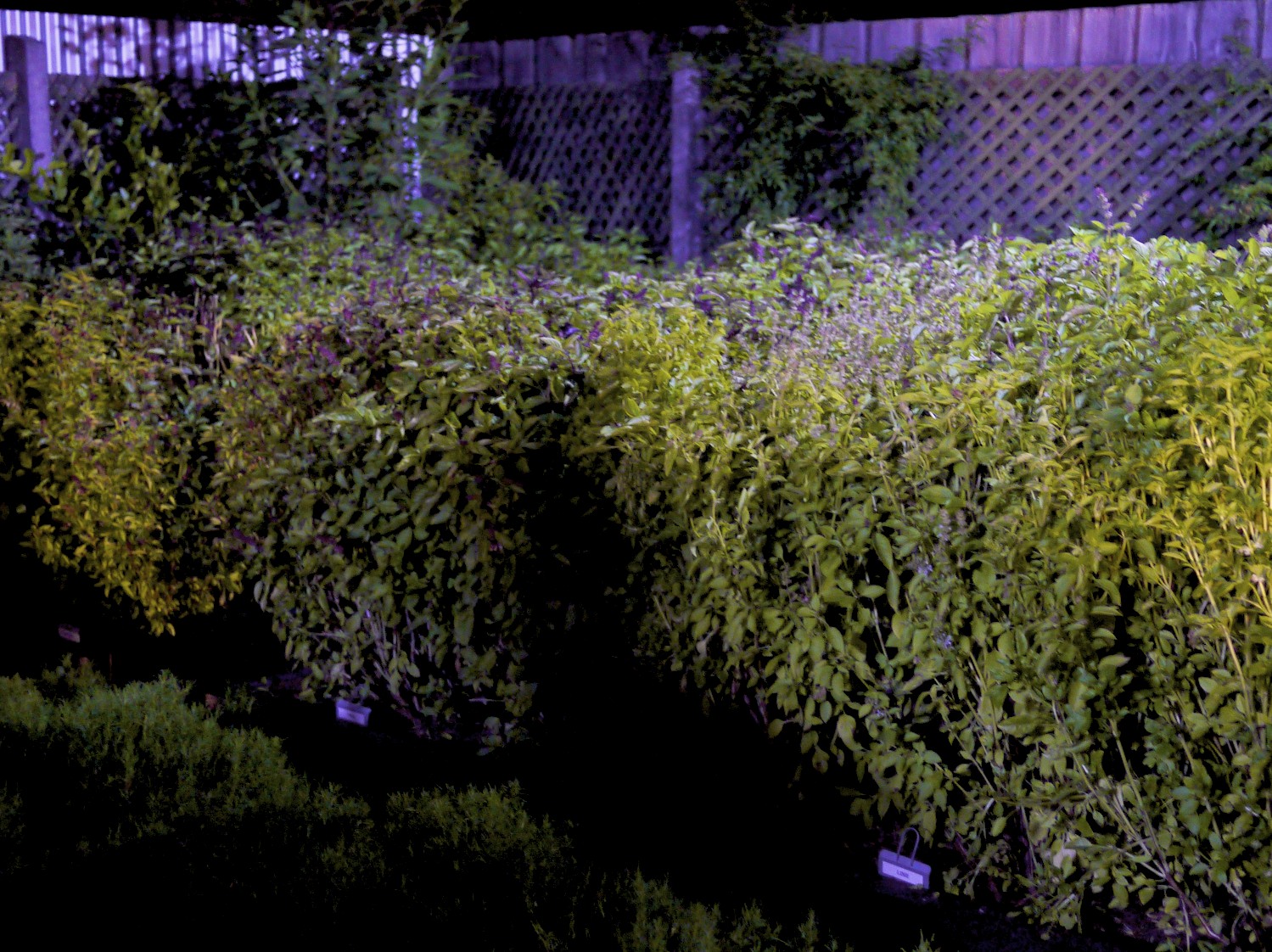
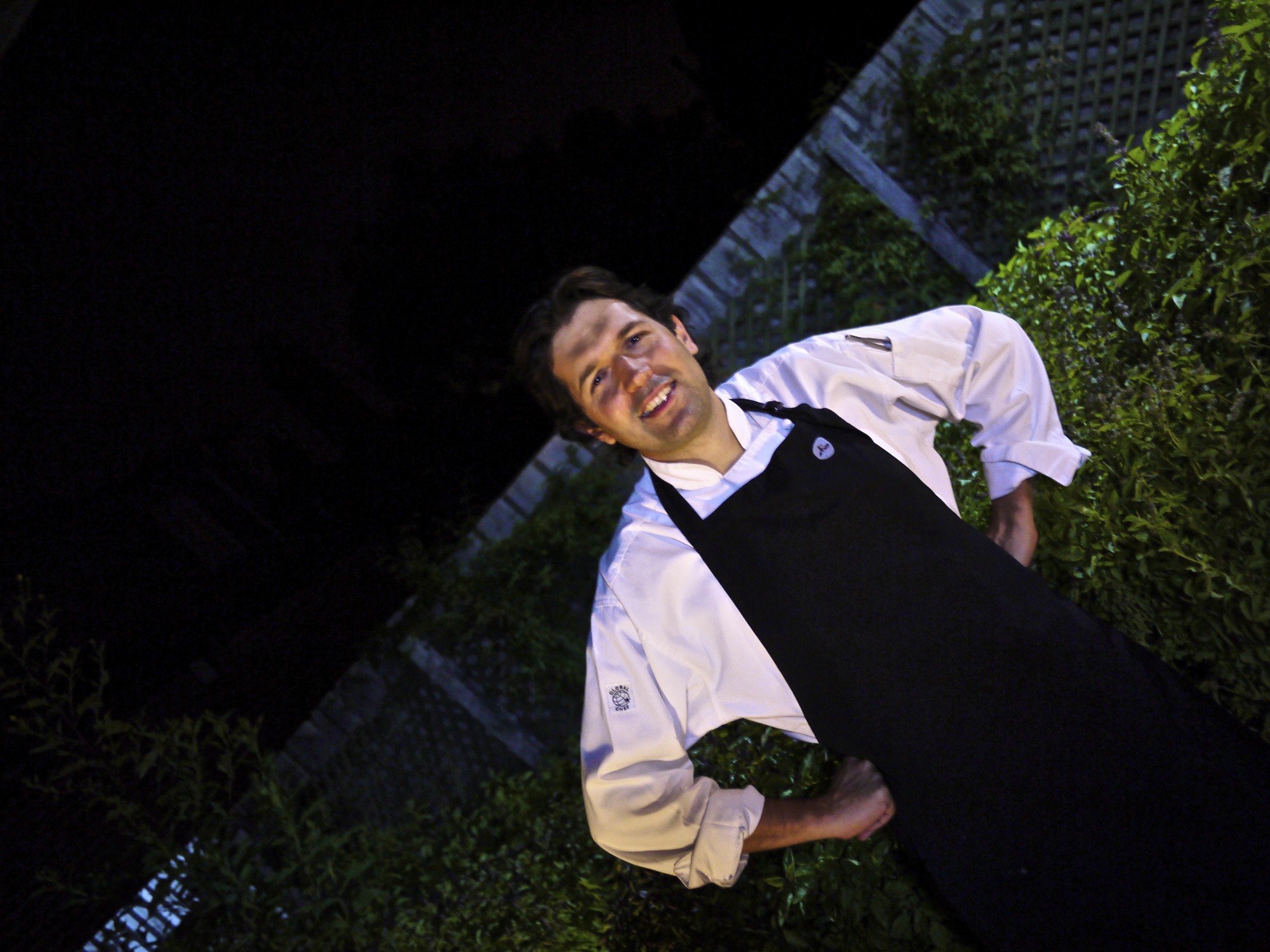
P1130728As we were discussing over our favourite courses, Hannah popped out again to invite us to the garden at the rear of the restaurant, which Shewry had converted from a parking space. The smell emanating from the various herbs was very inviting, and out of nowhere the great chef himself popped out to say hello. Despite our best efforts at talking over each other to complement his dishes, Shewry was very composed, humble and modest in receiving them. What a legend.
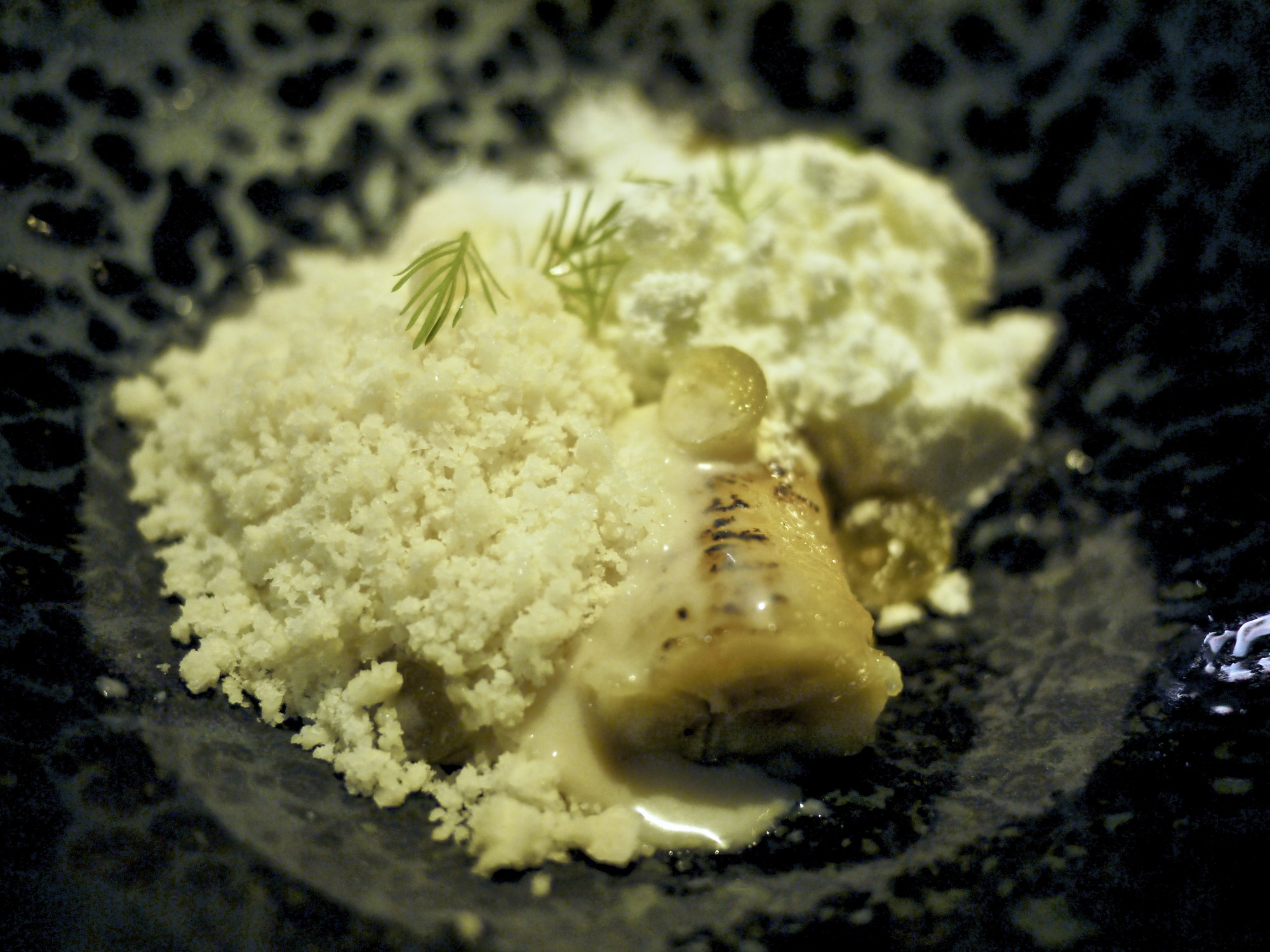
P1130735After our fairly long chat we decided to give the chef a break from our over enthusiasm and head back to our table for the grand finale, the dessert. I was particularly impressed with the dessert on my previous visit so I was looking forward to the Banana, Caramel, Kaffir and Native Lime. The caramlised banana was topped with honey from Otago, New Zealand, with a fluffy banana powder, kaffir lime powder and liquorice leaf from the garden. The balance between the fragrance, sweetness and contrasting temperatures was spot on making this a light but complex dish on the palate. The dessert was again washed down perfectly with a fairly dry and fruity glass of Immich-Batterieberg Enkircher Batterieberg Auslese 1991, Mosel.
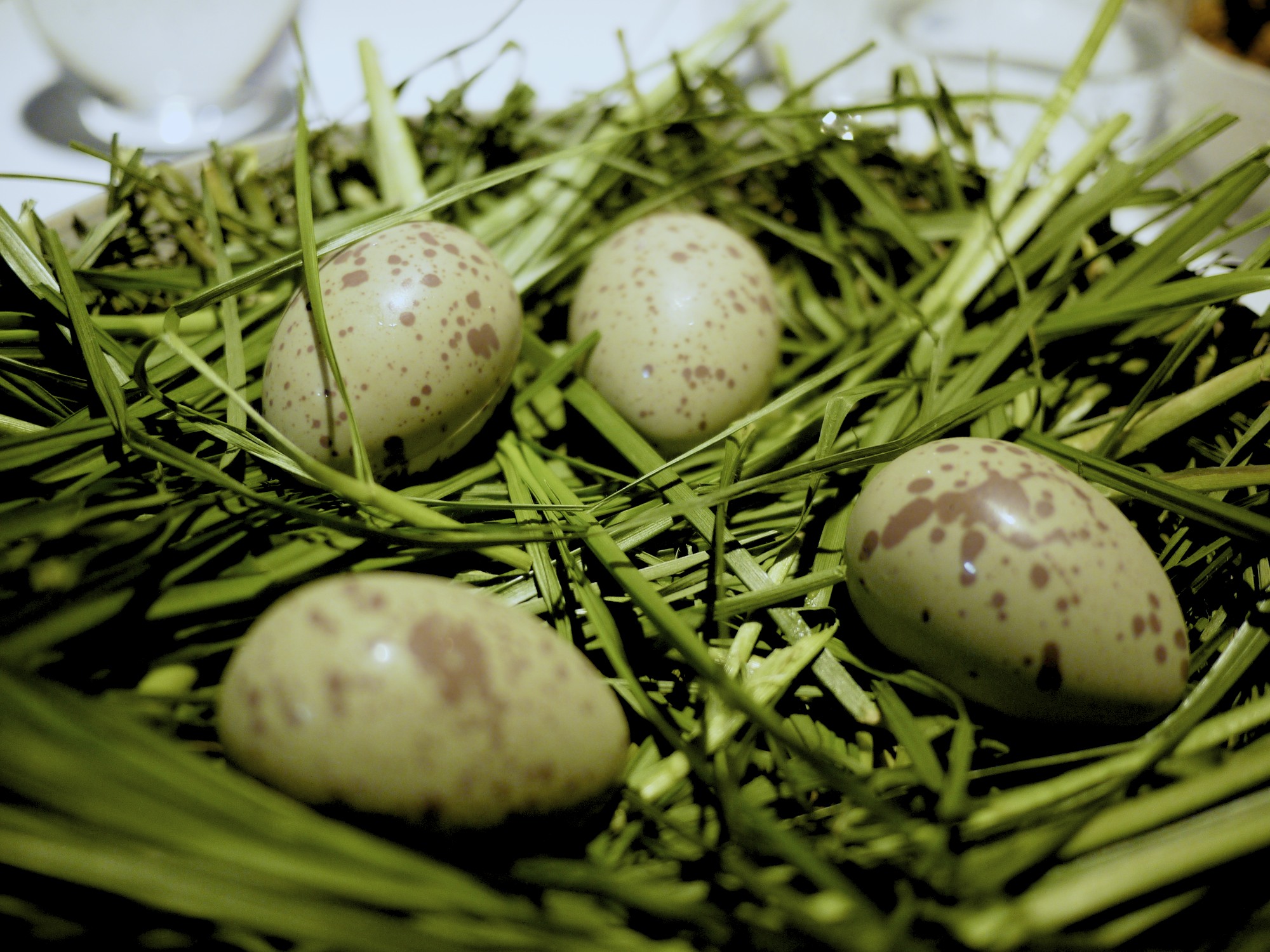
P1130743Given the absence of an amuse bouche at the start of the meal, I had assumed that we would literally just get coffee when we ordered them. Fortunately we were presented with a bowl containing a chocolate and salted caramel Pukeko egg with a story card that essentially explained Shewry’s admiration and respect to nature and its habitat.
P1130734

It is unprecedented for me to call out a restaurant as being the best in a country over one meal, particularly when it consisted only of five courses but that was the reality. Attica was superb. It was imaginative yet familiar and comforting, but most of all it was the best meal I had to date in Australia and definitely in my top ten. Unlike other fine dining restaurants I’d been to with theatrical elements or spectacular views, the wizardry and magic happened in the kitchen here. It was all about the food and there was no pretense in the service or decor. Behind the comforting flavours of the dishes were a brigade of humble chef’s and front of house who all displayed such genuine pride and joy to be working here. Having been able to chat to Shewry for a few minutes during our break in the garden, I also came to admire the man who has taken foraging to another level. Perhaps it’s a given in Australia, but I personally haven’t heard of other chef’s paying much attention to minimising disruption to the eco-system for species that are also dependent on the same sources which they forage. I guess with great dishes comes great responsibility?

The moderate price tag also makes Attica affordable and attractive for passionate diners who want to revisit more frequently. I for one would be enraged with jealousy of Melbournians had it not been for the fact that I was moving to Melbourne shortly afterwards myself. The only obstacle left now is the long waiting list following the recent announcement of Attica being voted 21st Best Restaurant in the 2013 San Pellegrino 50 Best Award. Luckily for me I have another table booked in the near future and I can’t wait to go back.
Arzak, San Sebastian

P1120508

Chef: Juan Mari & Elena Arzak    Website: www.arzak.es    Cuisine: Modern Basque

I think it’s fair to say that any food enthusiast or chef would have made a pilgrimage to the city of San Sebastian at least once in their lifetime. The culinary Mecca of Europe has continued to cater for foreigners and locals alike with their abundant numbers of taverns serving delicious morsels of pintxos and, in the last two decades, an array of restaurants whose chefs have stood at the forefront of culinary excellence in the world. It is no surprise that the city has the highest concentration of Michelin stars per capita in the world. Amongst these fine establishments there is one that has stood out as the epitome of the evolution of Basque cuisine. That place is Arzak.

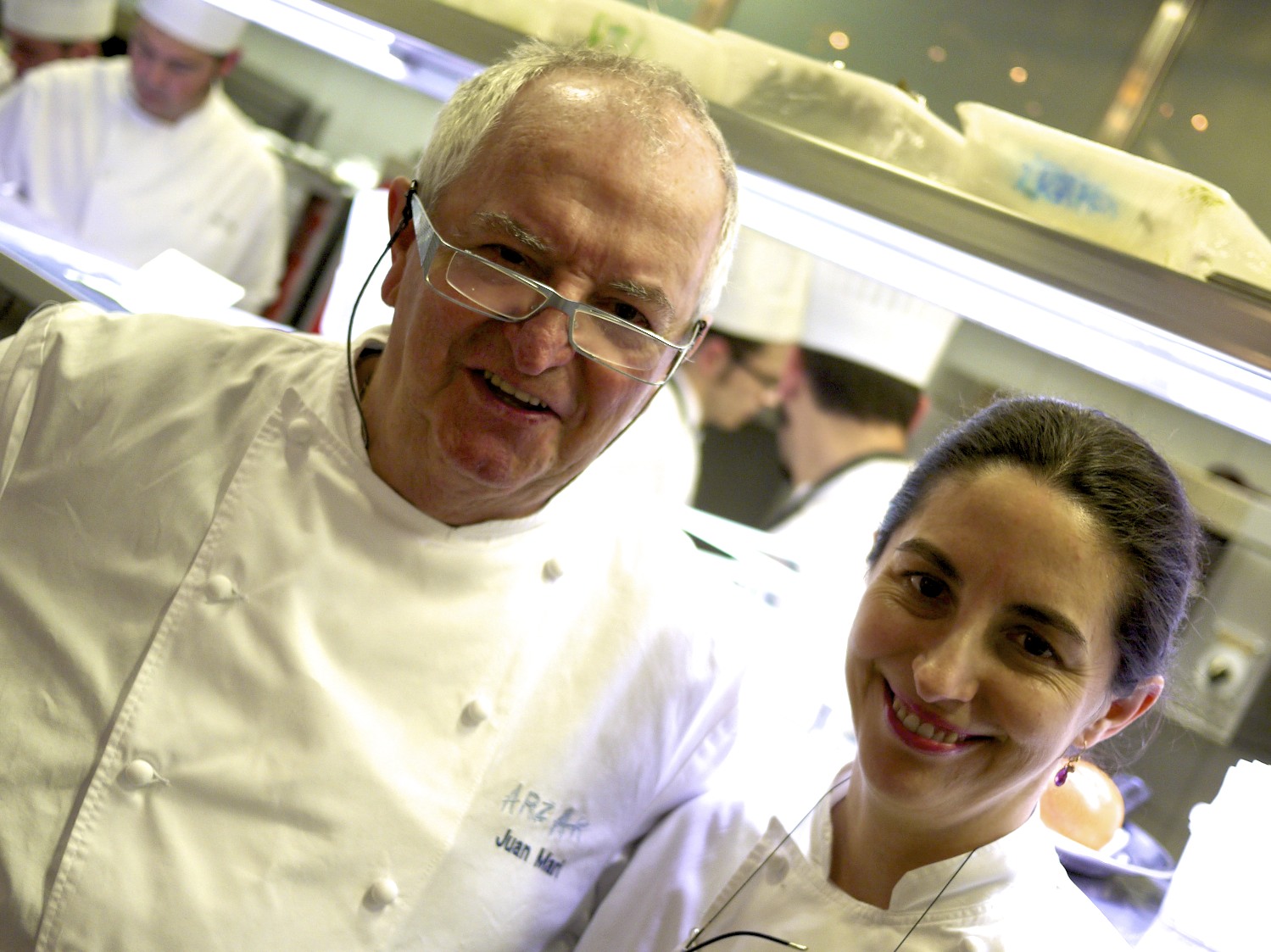
From humble beginnings as the village tavern dating back to 1897, Arzak transformed itself through three talented generations into a world class dining destination. Under the direction of Juan Mari from 1966, the restaurant, in collaboration with Pedro Subijana from Akelare, became synonymous with the New Basque cuisine movement. Juan Mari is also well known for another reason. He was the first, and continues to be, the longest holder of three prestigious Michelin stars in Spain. First awarded three stars in 1989, today he continues to push the culinary boundaries with his daughter and co-head of Arzak, Elena. Elena herself also won the title of Best Female Chef award in 2012, clearly this is an overachieving family.

P1120517

Since I was making a long journey for this meal, I was curious to meet the chefs but never in my wildest dream did I expect to be able to grab the father and daughter for over an hour before our lunch service! You can appreciate my nervousness facing a legendary chef and the best female chef in the world but their smiles, humour and humility immediately dispelled my unfounded anxiety. 

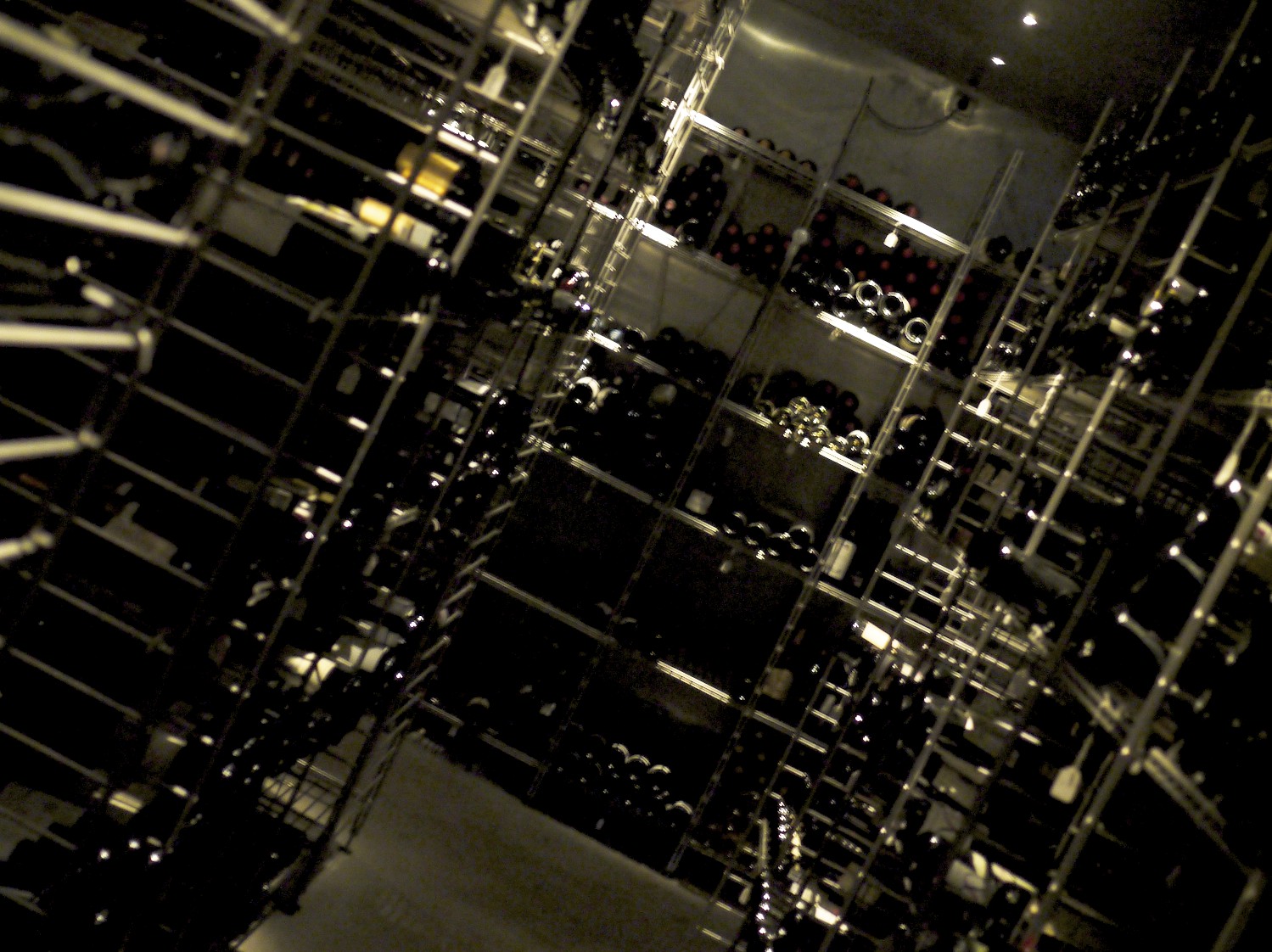
During the course of our conversation we found ourselves continuously coming back to one fundamental point: the roots and tradition of Basque cuisine was always at the heart of everything they did. It was their identity and soul, a raison d’être, and whilst a chef must have a solid foundation, he needs to be modest, inspired, hard working and above all born to cook. The culmination of these elements are essentially what have made and evolved Arzak into the entity is has become today. After our discussion, Elena arranged for her sous chef Igor Zalakain to show us around the premise before seating down. The impressive wine celler upstairs stocked about 100,000 bottles of wine, the oldest dating back to 1897, the date Arzak was opened!

P1120521

This was followed by another flight of stairs up to the spice room that contained more than 1,400 varieties – all for the purpose of experimenting to create new dishes and flavours. Right next door was the experimental lab which was in full swing.

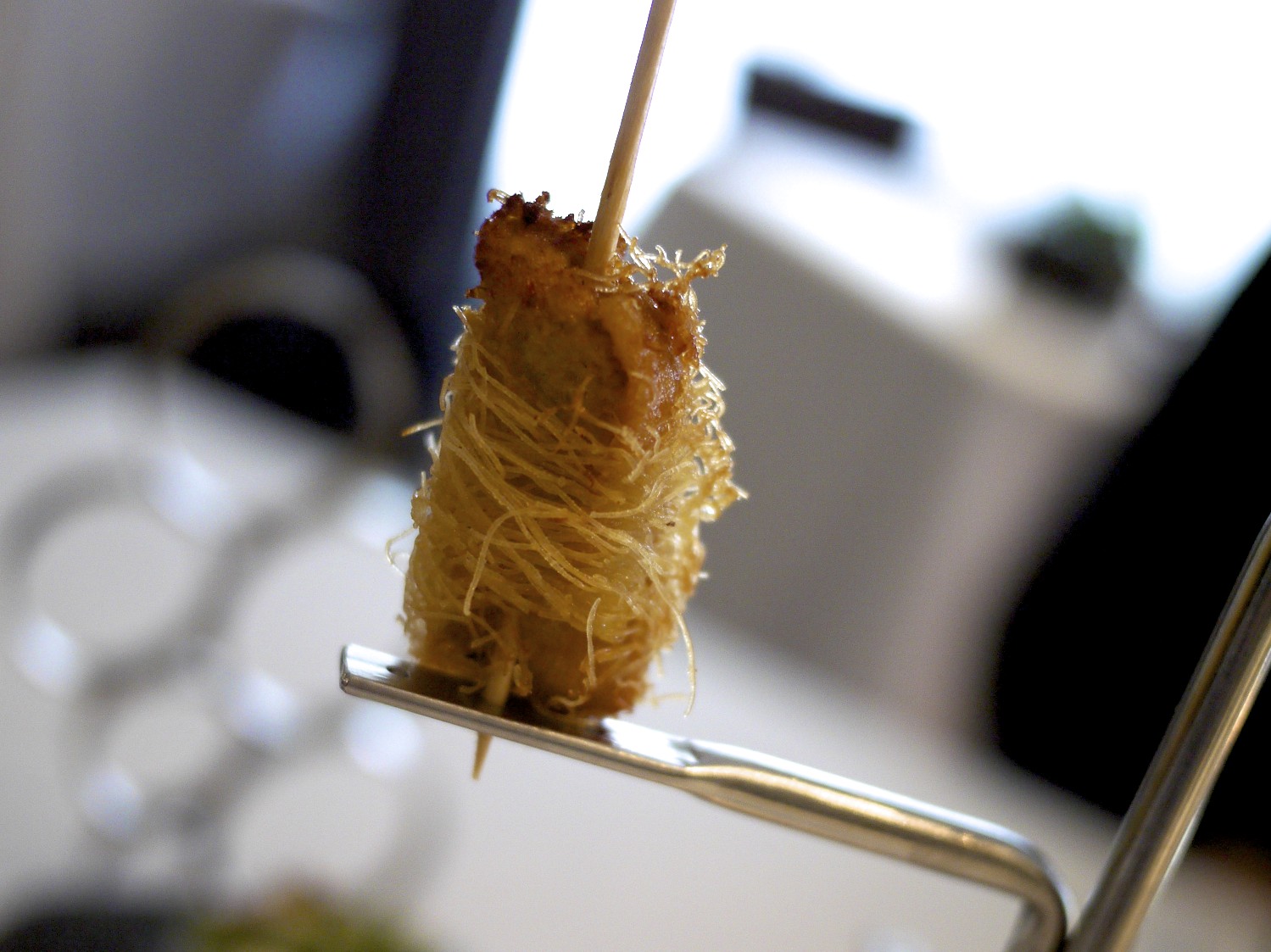
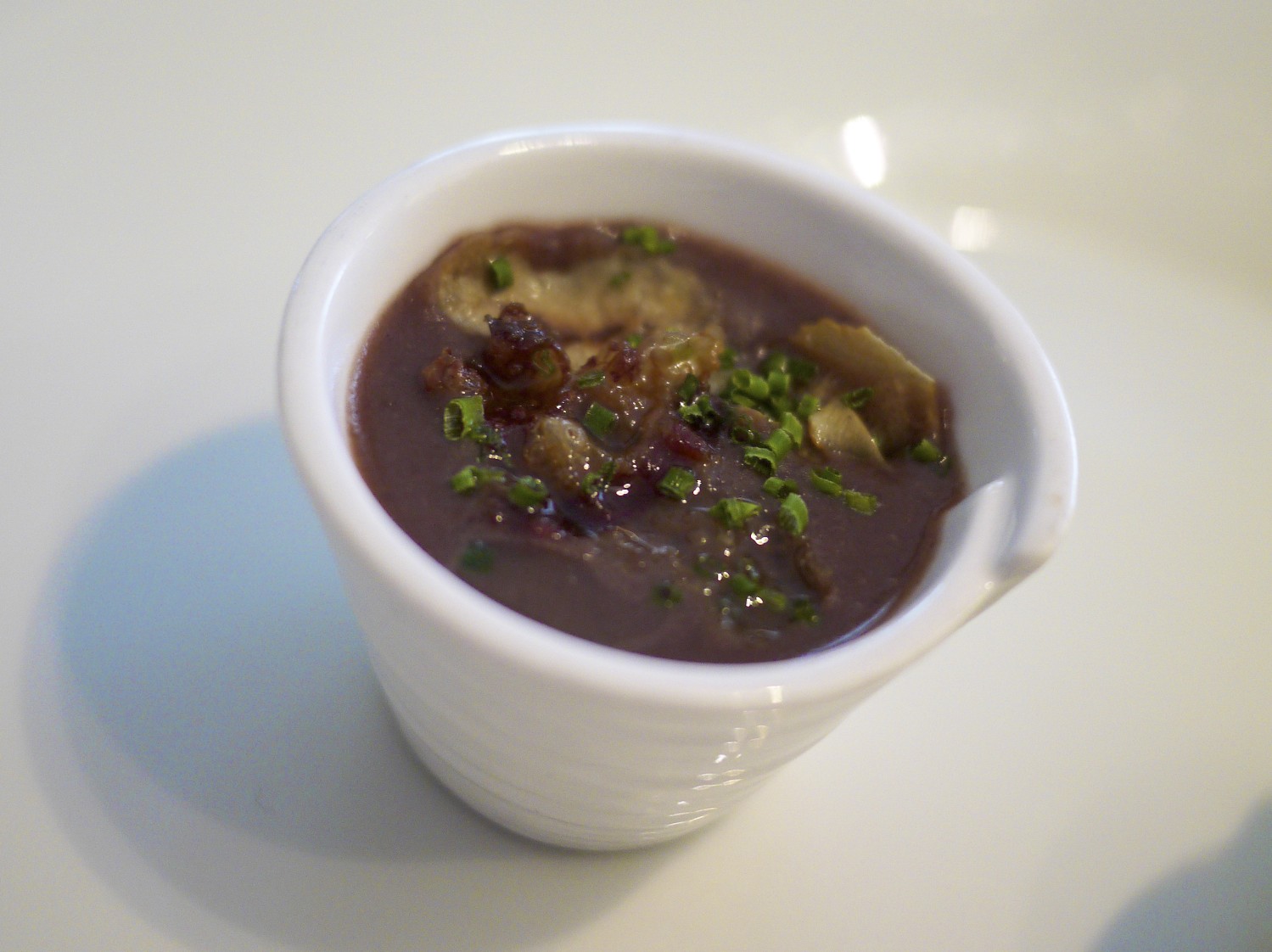
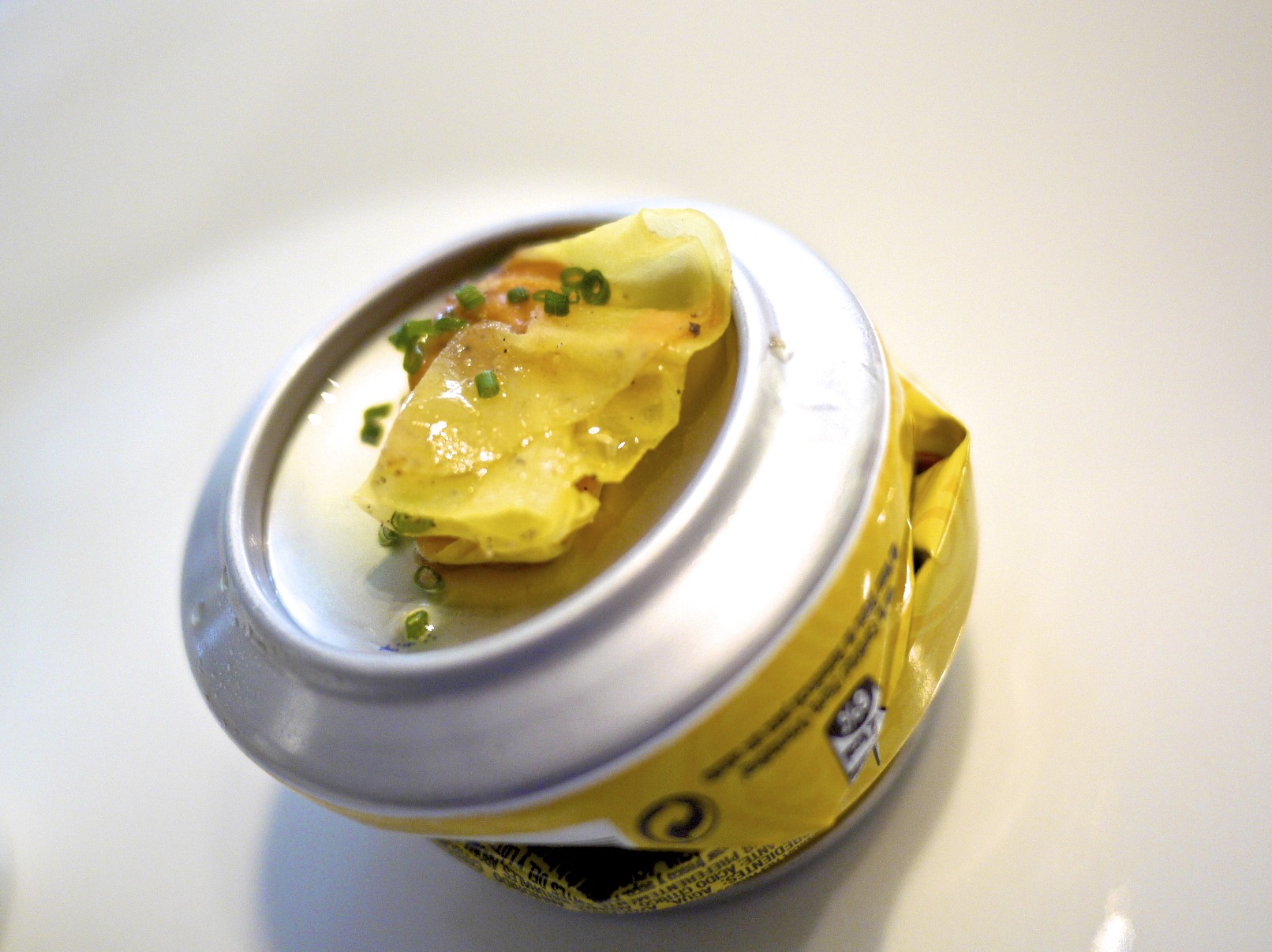
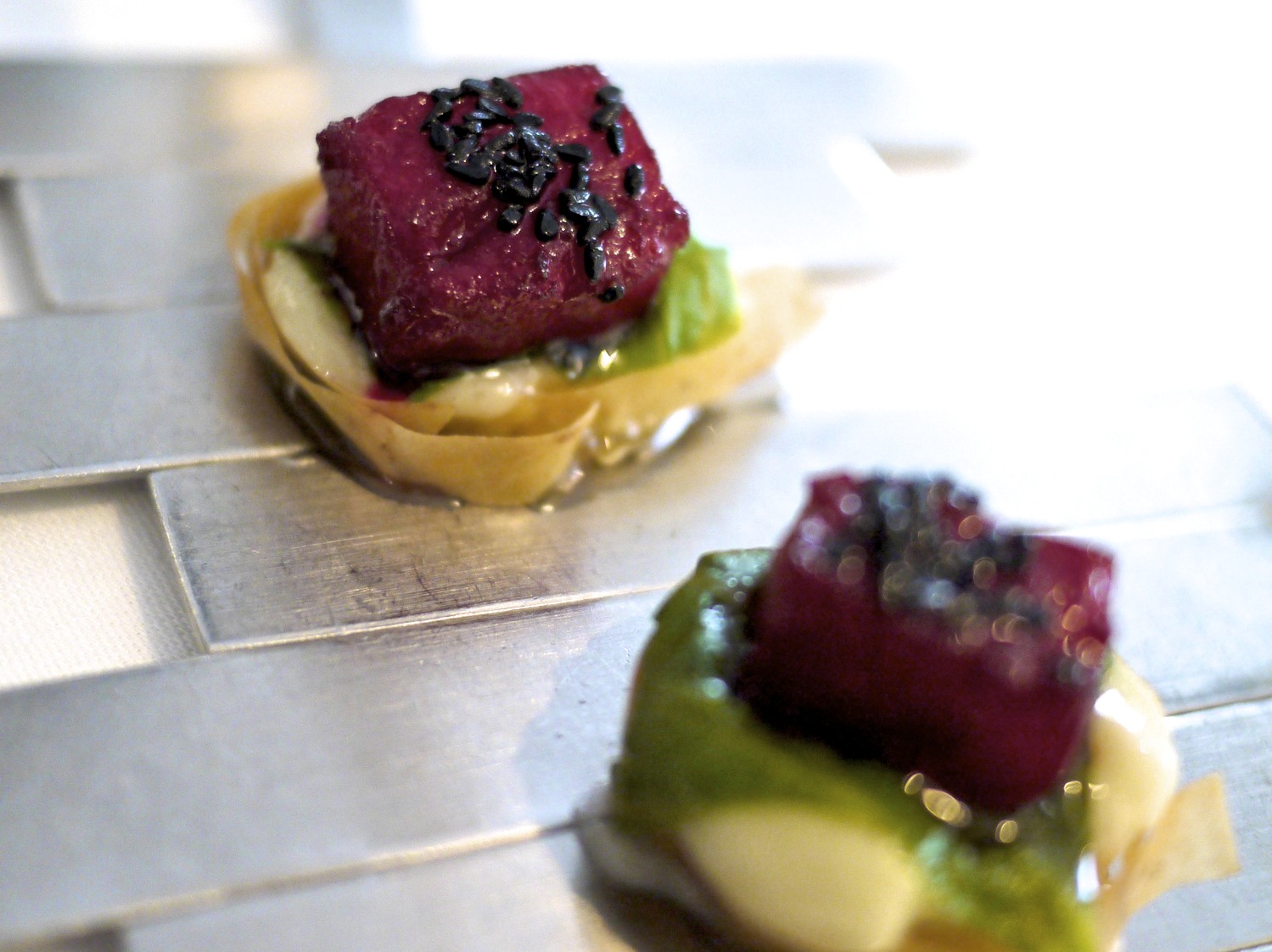
Comedor Arzak 4 JLAs we came back downstairs, Elena directed us to our dining table and explained how the menu worked. There was one tasting menu and a few of the courses had two choices. After explaining we had no allergies or dislikes, we left Elena to make the decision of what we should order. After scribbling a few things down, she disappeared for a brief moment to let the sommelier pour us a glass of cava and serve the arrays of delicious amuse bouches.P1120533Elena came back to take us through some of the dishes. I had explained that I was curious to pick up any subtle references to Basque cuisine that may not have been as obvious to foreigners, and she made sure no questions were left unanswered. The first amuse bouche was the Kabrarroka pudding with kataifi which was essentially scorpion fish pudding that had been wrapped in a threaded pastry commonly used in the Middle East. The fish was delicious and creamy, and a lovely contrast to the crispy coating.P1120535Followed by a sweet and salty combination of Beans, bacon and chestnut. It was a good progression of flavours.P1120537A rather refreshing and unique combination of Chorizo and Tonic served on a squashed can of tonic. The chorizo was wrapped in a thin sheet of mango and the oiliness was washed away by the tonic. Simple but spectacular!P1120538Red Codfish on a crispy pastry and brandade. I particularly enjoyed the saltiness from the brandade and the contrasting textures.P1120544The last of the amuse bouche was Sunflower seed with arraitxiki. Arraitxiki is a local bony rock fish and it was my first time trying it. It had a very deep flavour with a long aftertaste and went well with the toasted sunflower seed. It was a great way to set the scene for the main segment of the meal.P1120546

After a brief moment to take in all the flavours from the amuse bouches, we were ready for the first course of the evening, Cromelech, manioc and huitlacoche. The Cromelech (monolithic structure in Welsh) symbolised the relationship and marriage of the land and sea of the region. The crispy manioc (better known as cassava) casing, hydrated with huitlacoche (a corn fungus used in Mexican cuisine with smokey and earthy flavour), puffed up when added into hot oil. The casing was then stuffed with a preparation of poached onion, green tea and foie gras cream. We were advised to flip it upside down and eat it like an ice cream cone. It was fun but more importantly delicious and creamy inside!

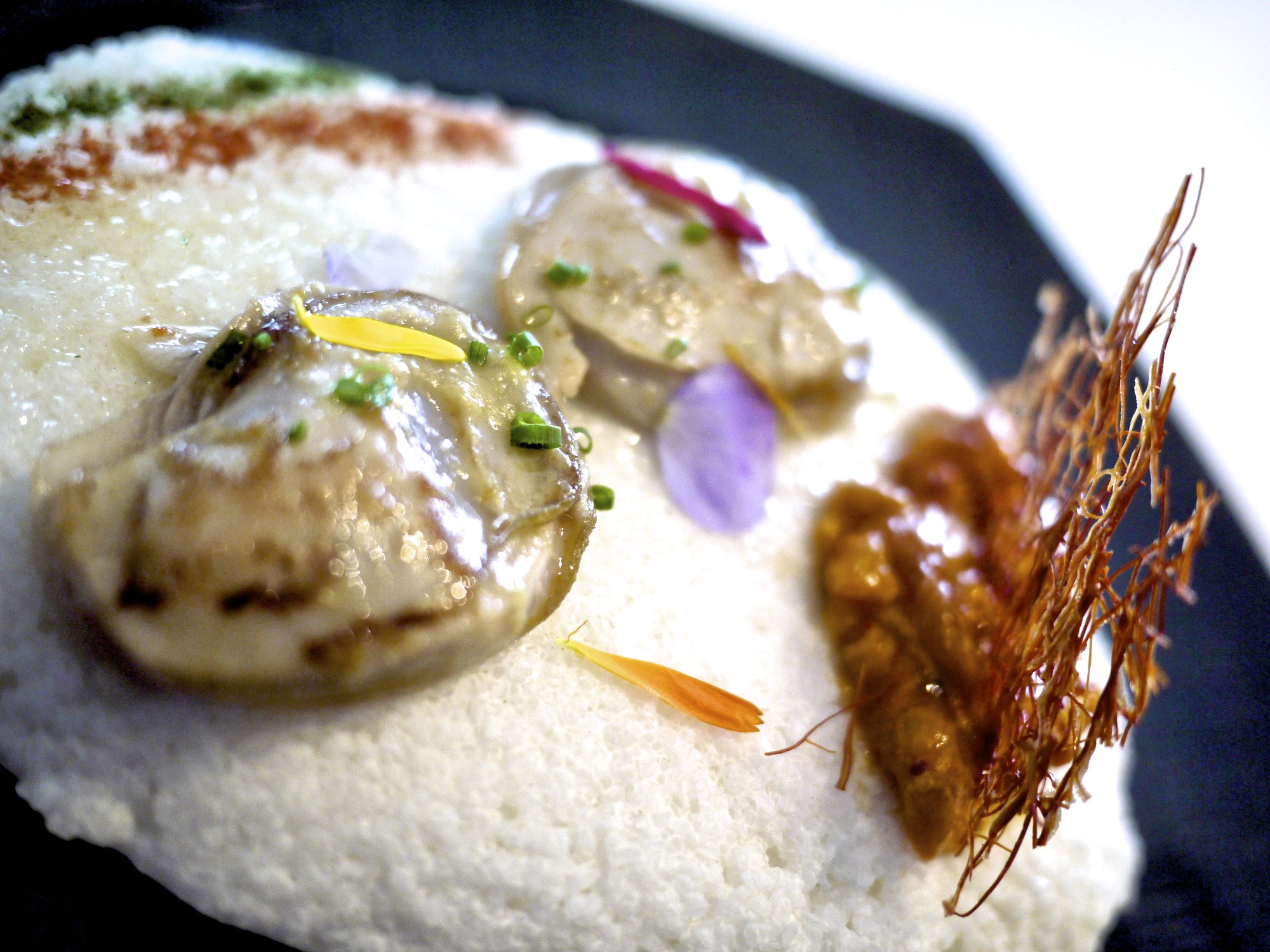
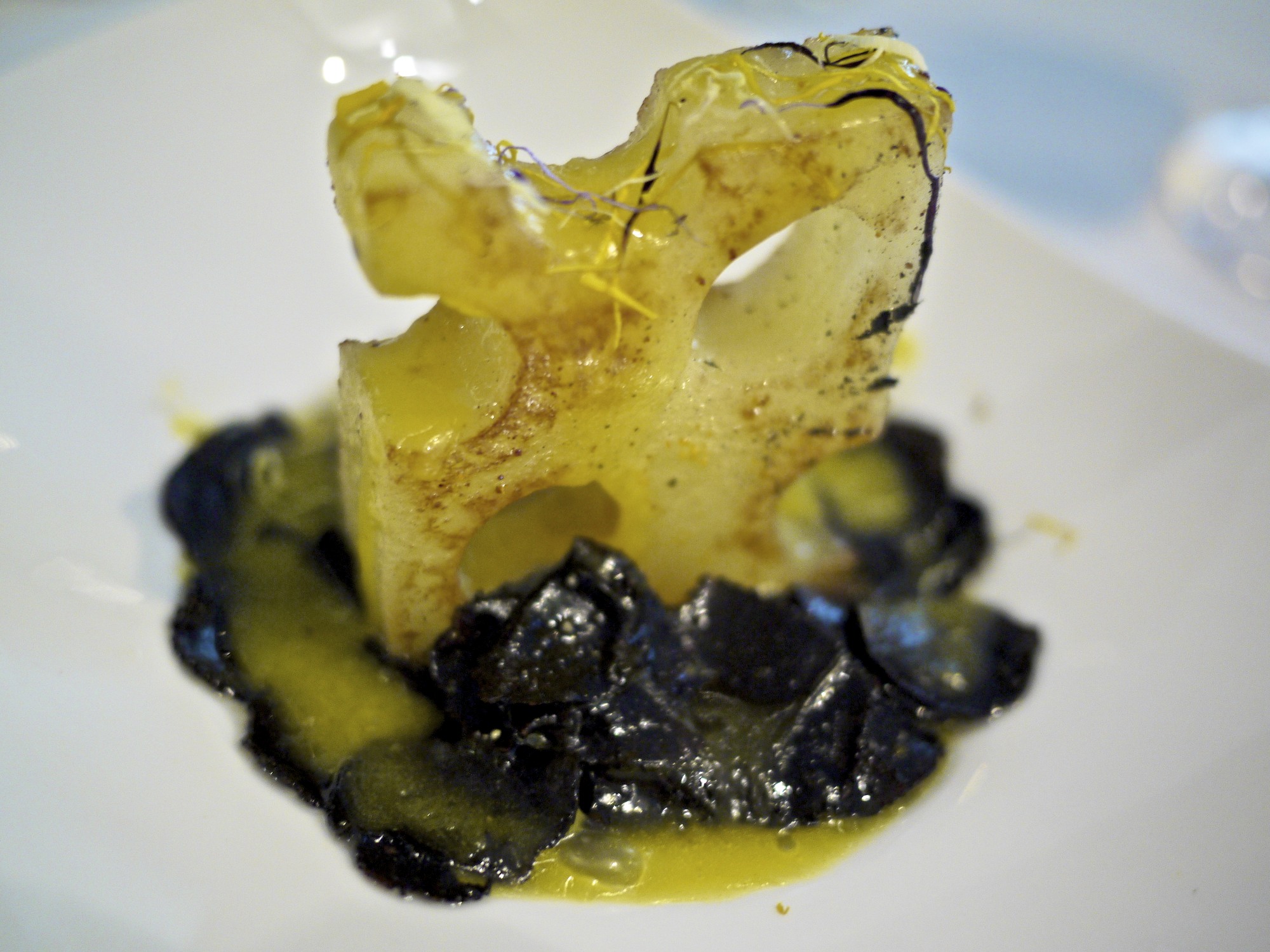
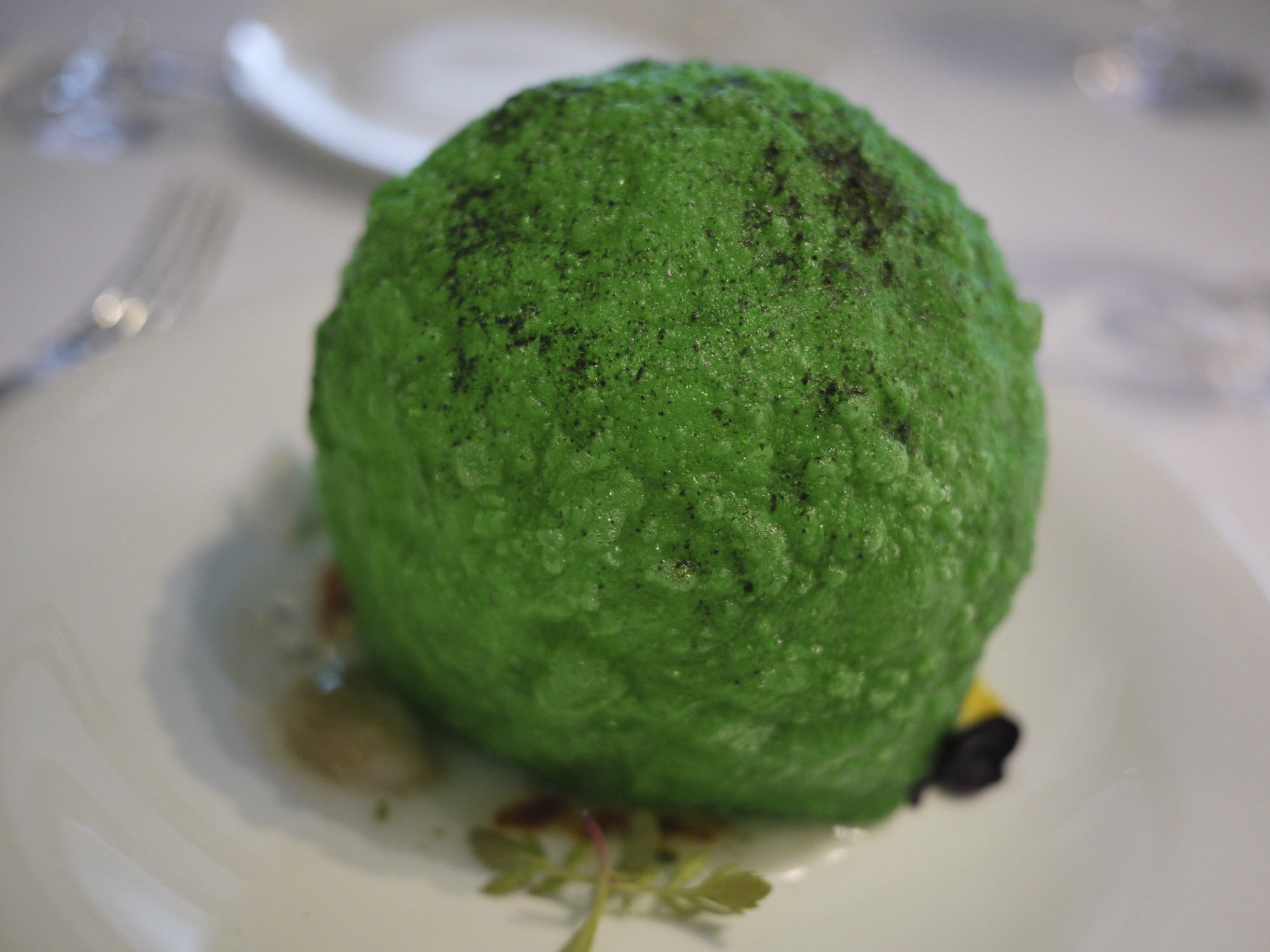
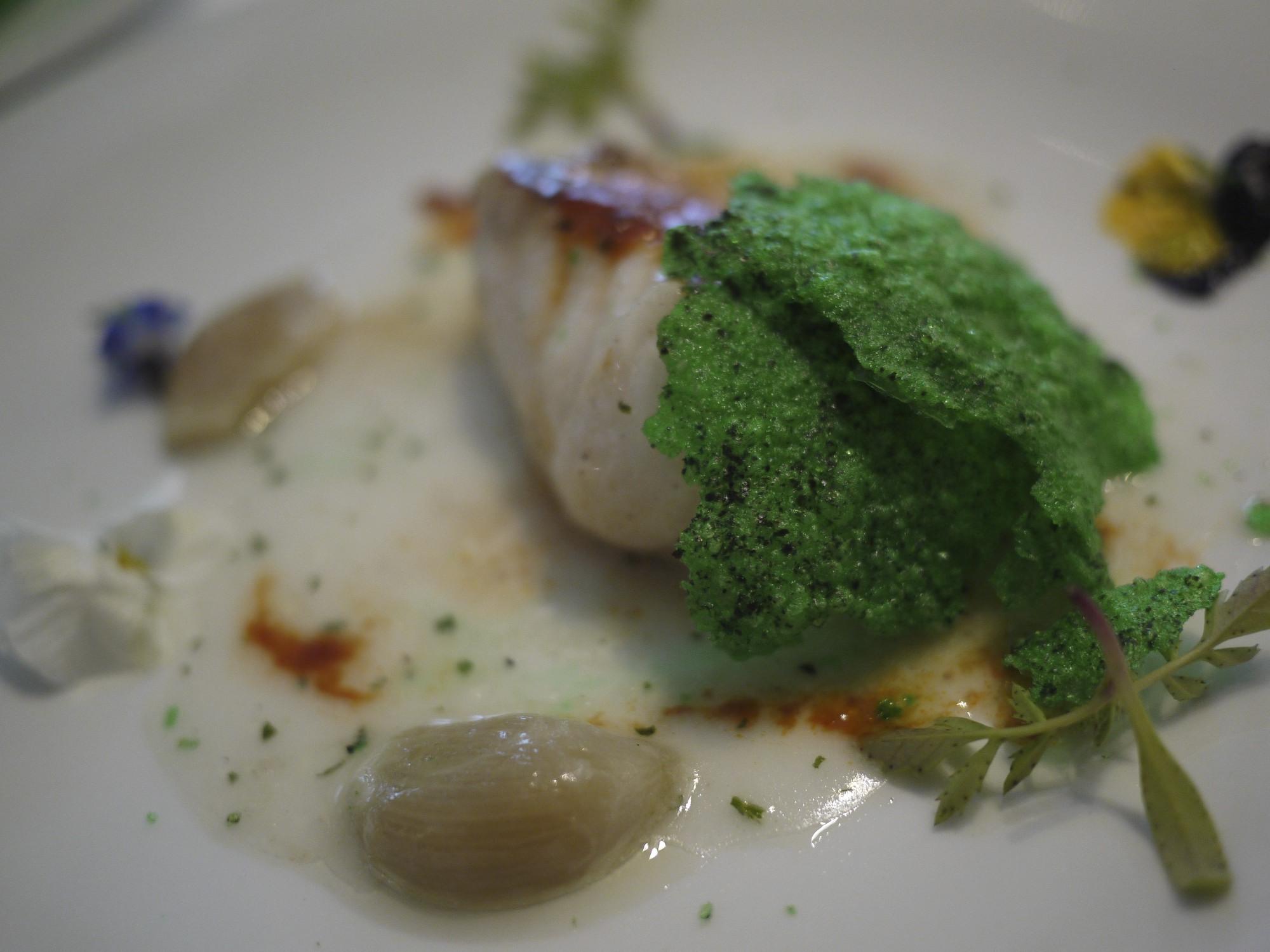
P1120551I particularly enjoyed the next course of the Oyster with sea crust, essentially warm oysters with sea urchin and a salty crust. It was a very clever dish as the oyster quickly cooked on one side could be left on the salt plate to suit each customer’s preference of seasoning. I had my second one after another couple of minutes and found it just perfect. To top it off, the sea urchin served fresh and dried complemented the oyster both in texture and flavour, and reminded me a bit of katsuobushi (or bonito flakes).P1120561As my companion enjoyed another fish course, I was served with the Potato cube with fresh truffle, egg yolk and orange zestThe black truffle was sourced from the region and the eggs were fresh from the day. The components altogether almost gave a sensation of eating a creamy tortilla but with black truffles. The orange zest provided some acidity to lift the dish, perfectly matched with a glass of Riesling.P1120566For my main fish course I had the Monkfish green witch. The green sphere itself was made from reduced fish stock and parsley sprayed onto an inflated balloon with several layers of obulato sheets (transparent edible gluten free sheets) in between. The balloon was then popped and removed, and the remaining shell fried before plating up.P1120574The balloon was cracked and then partly removed from the plate, uncovering the monkfish with confit garlic. The lard wrapping of the monkfish kept it moist and juicy. The gooseberry was very subtle. The green fragments were deceivingly tasty so I ate the bits that were removed to a side plate as well!P1120587

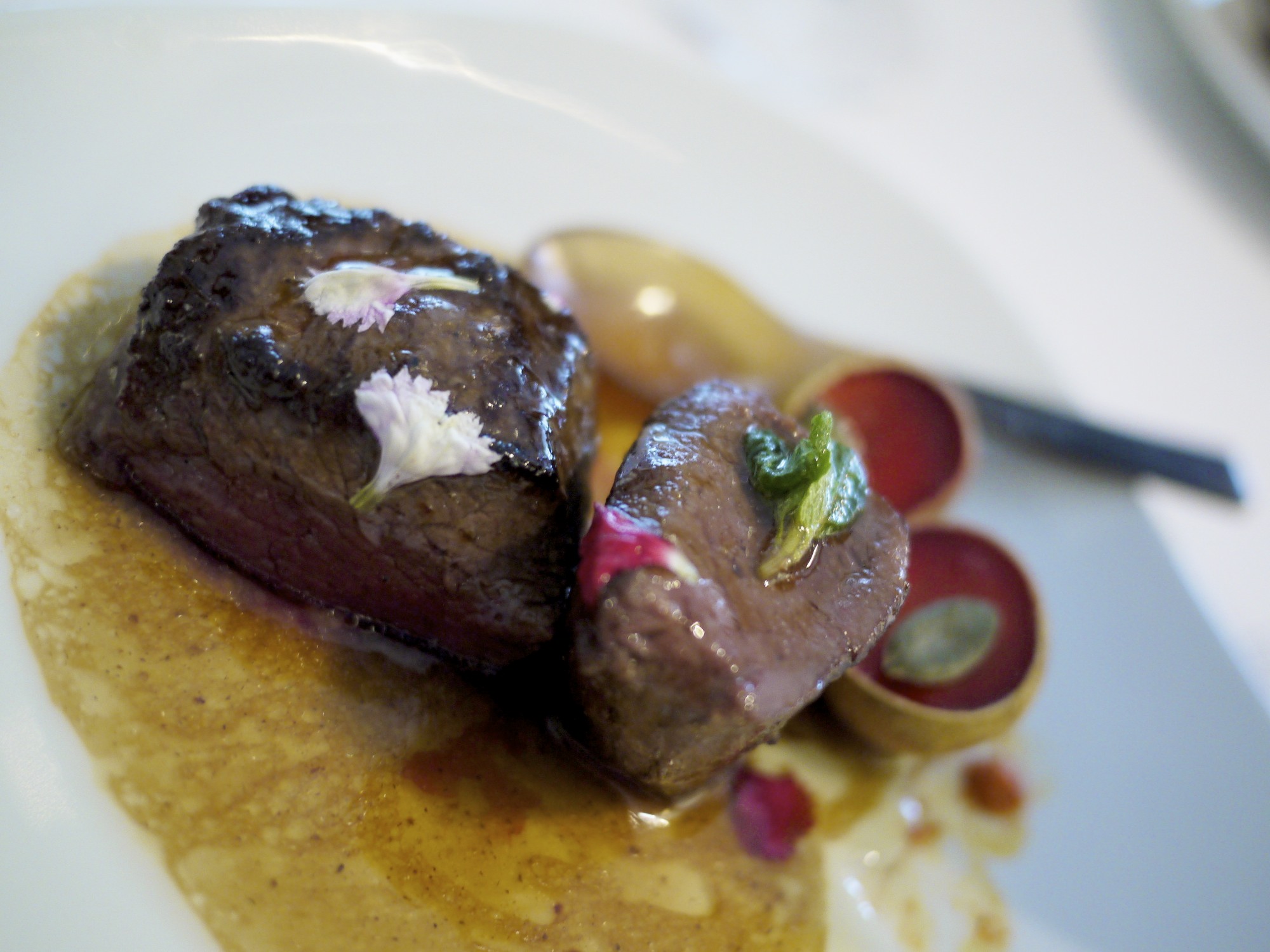
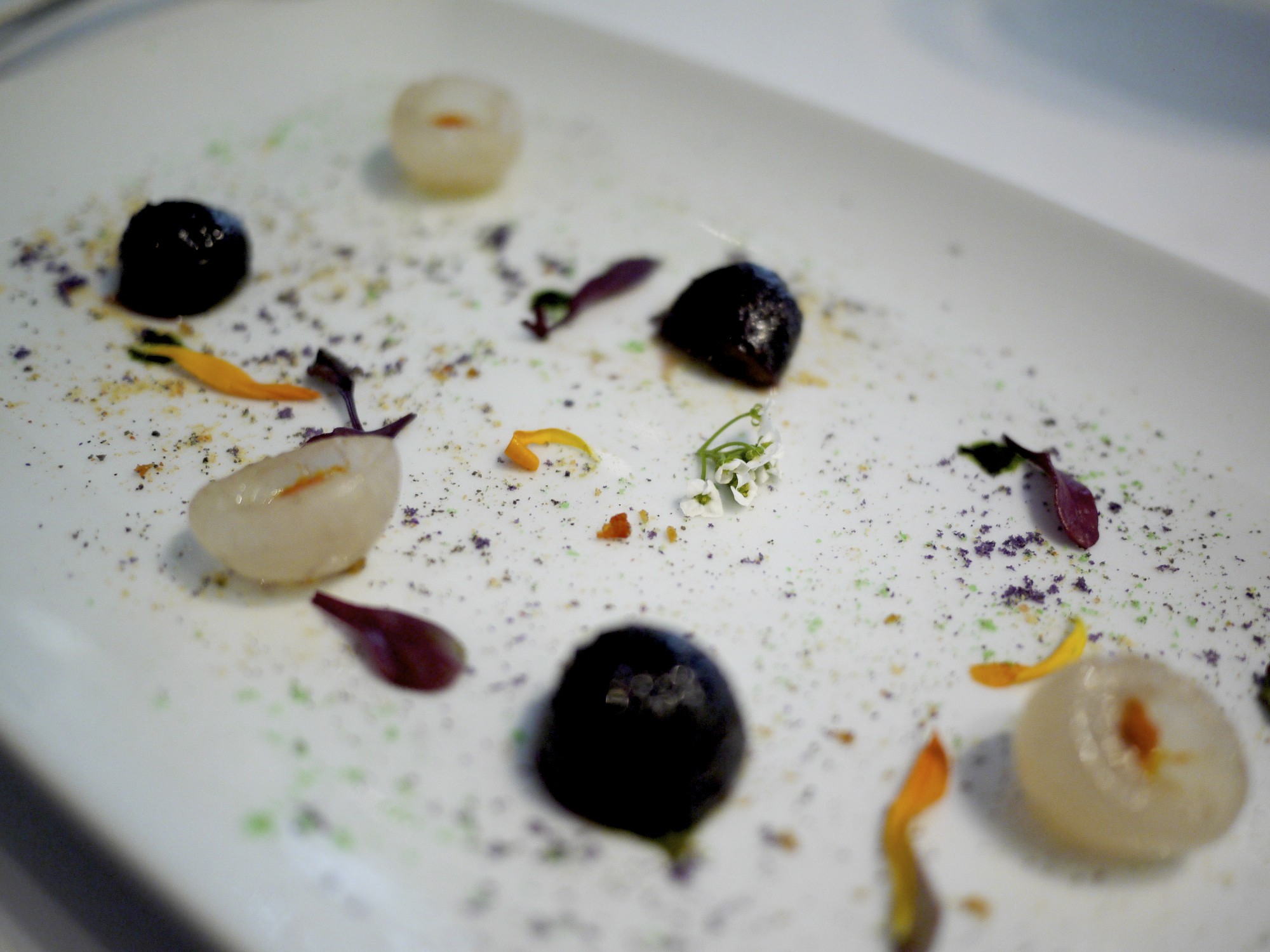
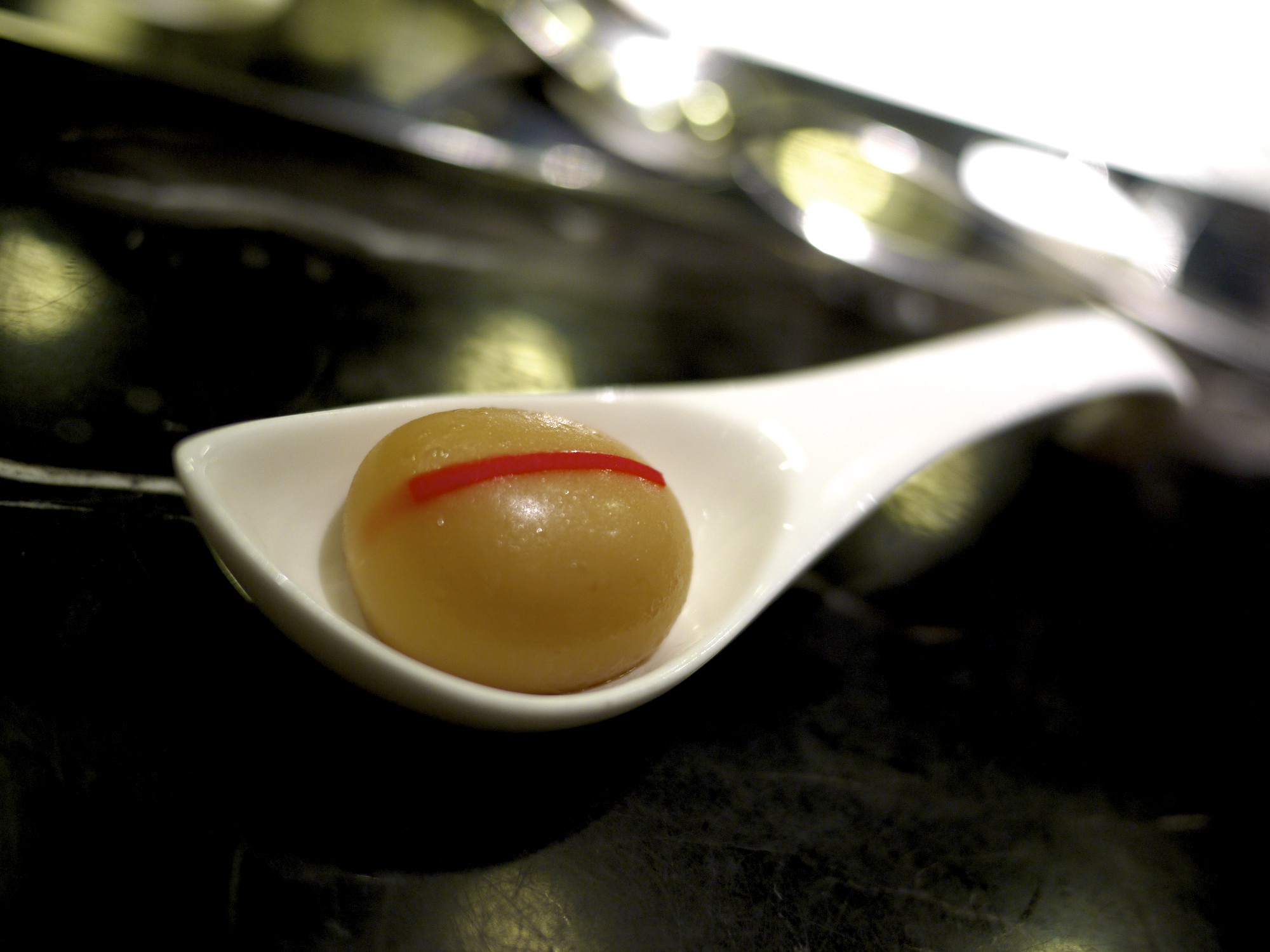
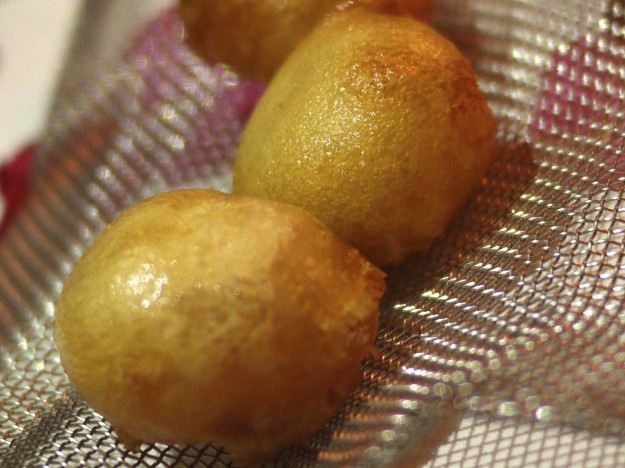
Elena came out to serve the next dish to explain that meat on the Longan, deer and roe deer was the side dish, and that the longan and fried grape garnish (below) was the main component. The “garnish” also contained red pepper sauce in the shell of the longan.

P1120579

Although this was a somewhat unexpected approach to a main dish, the powdered ingredients dusted across the plate were composed of various flavoursome herbs which were very worthy of being the main component of the dish! I really enjoyed the two cuts of meat, served almost rare just the way I like it, but I thought the dish could have done without the longan.

P1120597

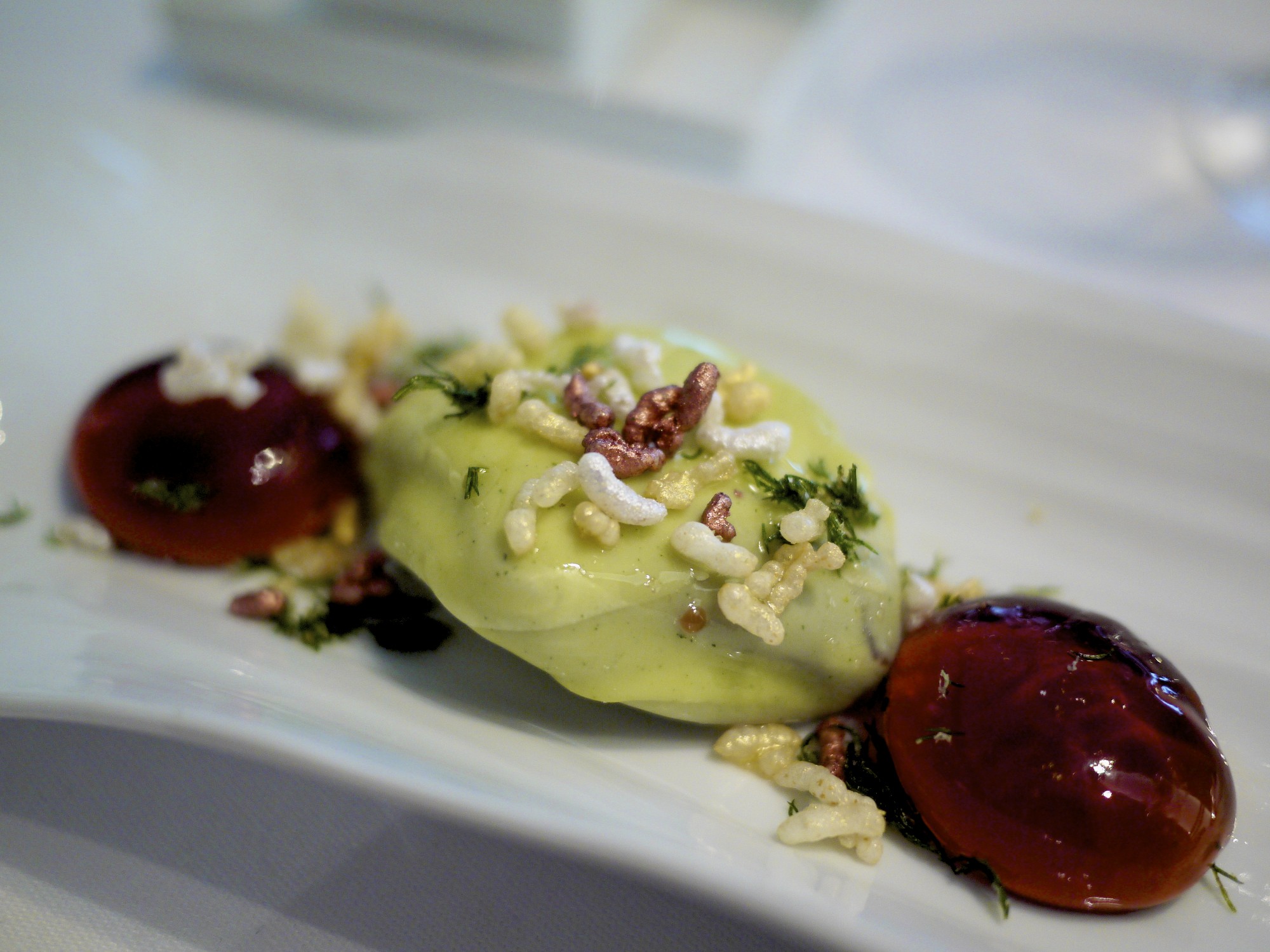
As we ended the main act of the meal I thought the portion sizes were spot on. I was neither too full nor hungry and definitely ready for some sweet treats at this point. I was curious to see what Juan Mari and Elena were going to pull out of the bag given the high calibre of food so far. The first dessert was Roots, fruits and seeds, where a thin layer of white chocolate flavoured with parsley and filled with black chocolate emulsified with kuzu and lime flavour. This was served with Frangelico and Aperol balls. A scoop of pineapple sorbet was presented separately which balanced the sweet dish.

P1120607

The second dessert and grand finale was the Golden footprint and ladybird. The caramalised fruits served under black sesame bread (the footprint) was delicious and I particularly liked the peach which was extremely sweet and melted in your mouth, almost like a mango purée. Additionally, there was a pepper and liquorice ladybird filled with vanilla yoghurt pannacotta and olive oil cristal. I must admit that whilst it didn’t visually capture me although I did find this humorous, I enjoyed the flavour combination of the components coming together. The accompanying passion fruit and banana ice cream was the icing on the cake.

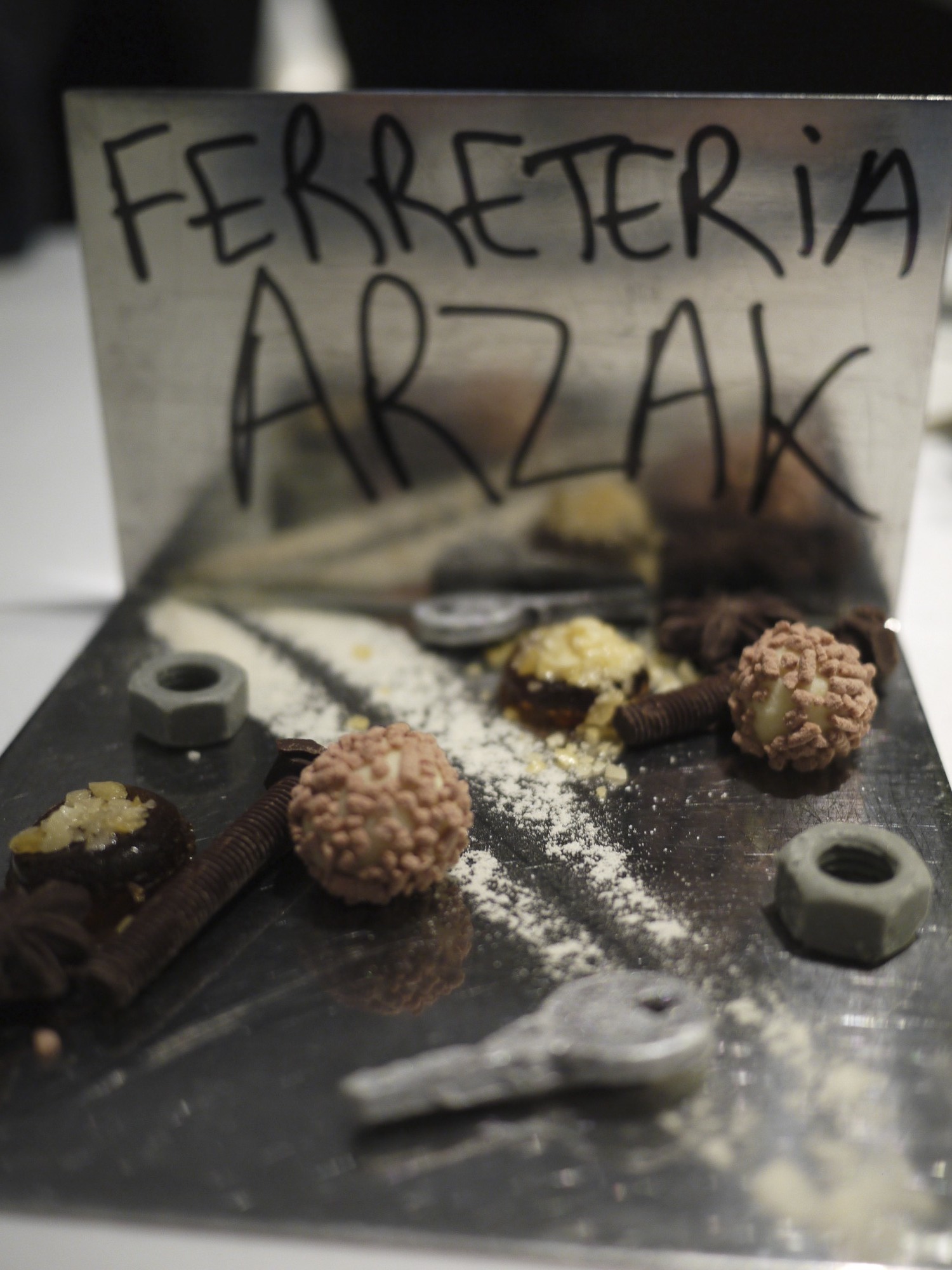
P1120618At first glance I didn’t know what was being served with our coffee but I soon realised that they were petit fours. A bit more humour to finish the meal with chocolates from the Ferreteria (Spanish word for hardware store), which consisted of keys, bolts and screws!P1120588

My mind drifted back to the earlier conversation I had with Elena and Juan Mari as I reflected on the meal over my coffee. The cooking here was undoubtedly deeply rooted to the Basque heritage and they were rightfully proud of it. Without roots, Arzak could not exist. It was equally true that the quality and choice of ingredients available in the region puts restaurants like Arzak at a head start to produce great dishes like the ones I had for lunch. However, with an inquisitive mind that constantly strives for inspiration from beyond their native land, Juan Mari and Elena are a cut above the rest. It is the application of this curiosity and creativity into the deep roots of the Basque cuisine that make Arzak unique.

The food for me was delicious. Some of the flavours I encountered were completely alien to me, yet I also found some dishes to be familiar and comforting. Dishes like the ladybird brought out Juan Mari and Elena’s humour, but admittedly, without the detailed explanation from Elena, I’m not sure whether I would have captured some of the subtle cultural reference only a local would have picked up. One thing for certain however was that everyone around us, young or old, local or foreign, looked undeniably as happy as a kid in a candy shop. I know it’s selfish of me but a big part of me hopes that Elena will be joined in the kitchen by her kids in the future, just as she did with Juan Mari to maintain the roots and tradition of Arzak.

Bo Innovation, Hong Kong

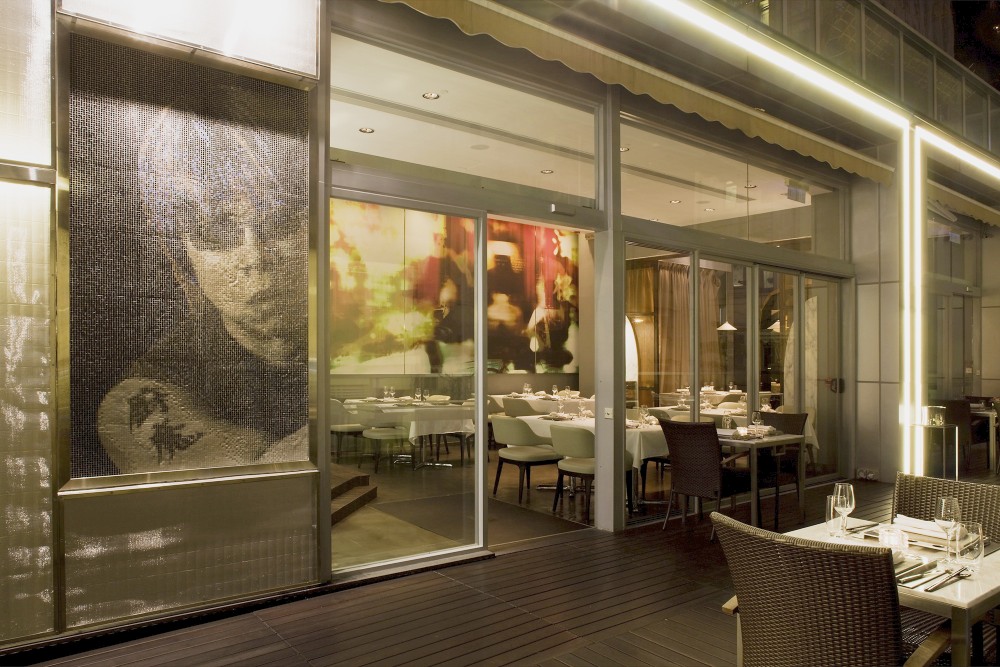
431693735_bo_interiors_06_udenChef: Alvin Leung         Website: www.boinnovation.com          Cuisine: Molecular Chinese

Little introduction is needed to Alvin Leung and his ‘X-Treme’ Chinese cuisine at his two Michelin starred restaurant, Bo Innovation, in Hong Kong. Leung is known for being one of only handful of chefs in Asia who looked to molecular cuisine, when it was starting to take off in the west, and applied its technique to their local cuisine. I’ve had my fair share of good Chinese food throughout my childhood having lived in Hong Kong and Singapore for a good part of my youth. I had also discovered molecular cuisine through elBulli and the Fat Duck. I must admit, however, that I lacked the imagination to envisage what the culmination of the combined elements would look like. More importantly, I wondered whether it would be another case of style over substance, compromising the all important taste.
P1120966

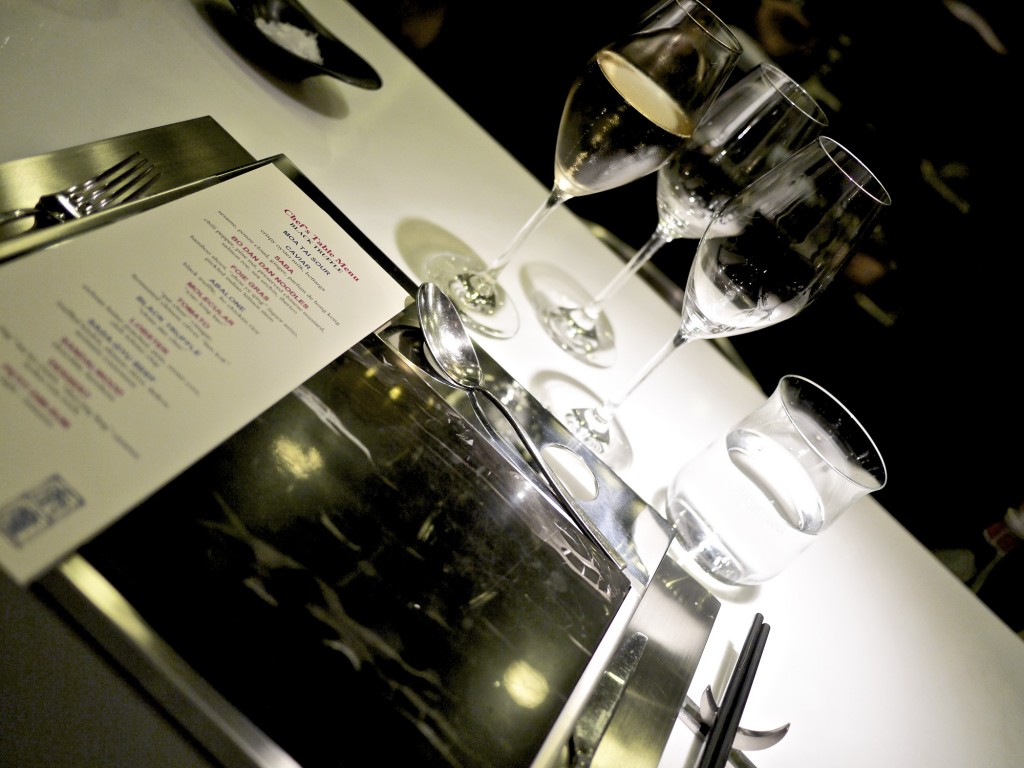
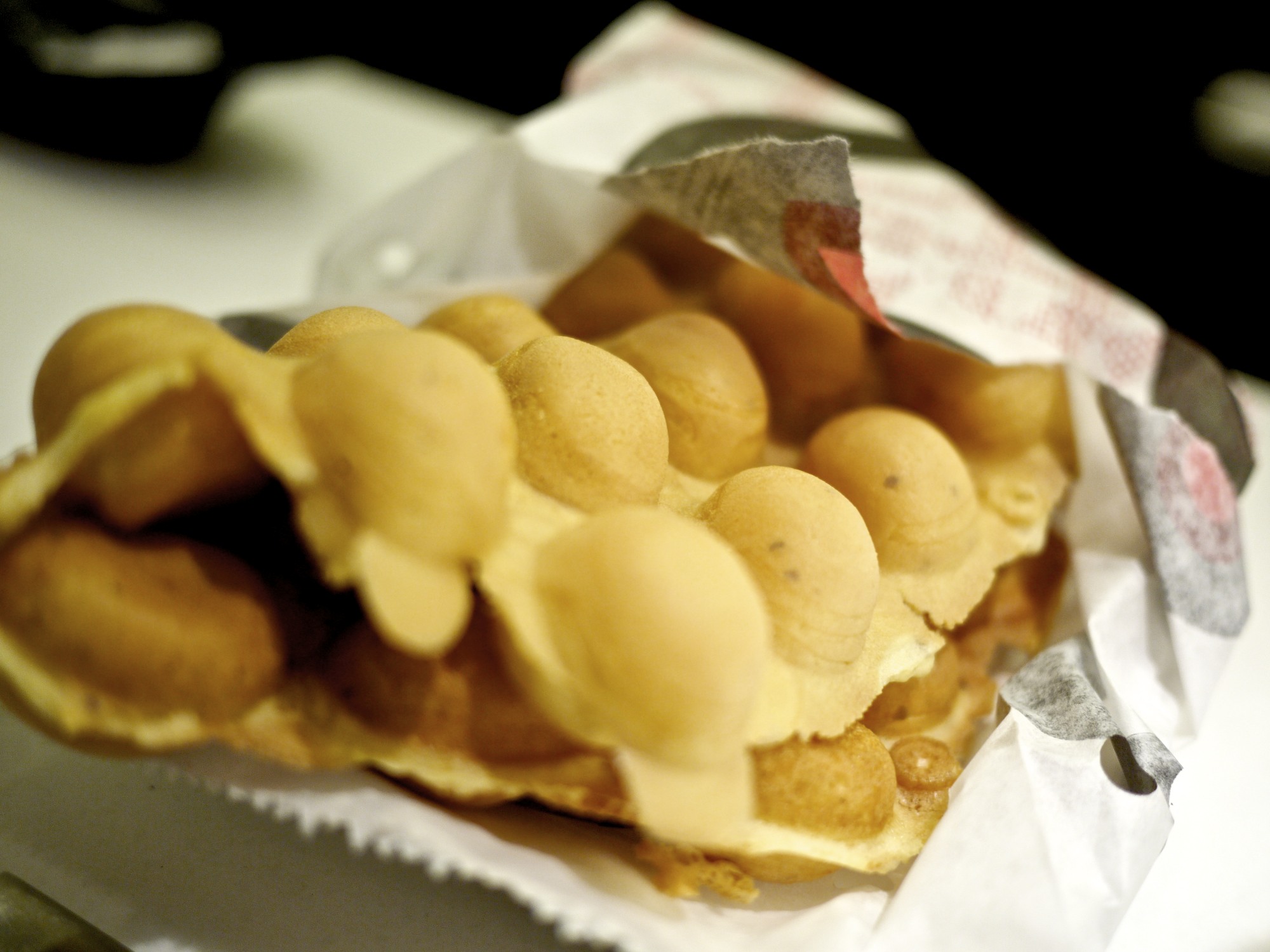
Following a swift journey to my hotel from the airport, I immediately set off for my old neighborhood of Wan Chai. Despite my previous knowledge of Hong Kong, I had some difficulty in locating the restaurant. Luckily, I managed to get some help from a local and, after a brisk walk to a side street and up an inconspicuous lift, I was finally there! I must confess by the time I found my way I was a little flustered. I would therefore advise most people to take a cab. On entering the lift, and after having caught my breath, I left behind the hustle and bustle of the city. I was fortunate enough to have been one of only three people occupying the Chef’s Table that evening, which normally had enough room and space for six. I assume it was a last minute cancellation as the place was packed all night!P1120971As the sommelier poured my glass of champagne, one of the chef’s behind the counter explained to me that bread was not typically served with a Chinese meal. I frowned a bit, I am a bit partial to bread, but before I could interrupt they offered one of Hong Kong’s iconic street foods, “egg waffles”, as a substitute. Of course, this was not an ordinary egg waffle. This one contained Iberico ham and English custard. The sweetness of the dough married well with the salty Iberico ham and it was difficult to set them aside to avoid filling my stomach before the meal.

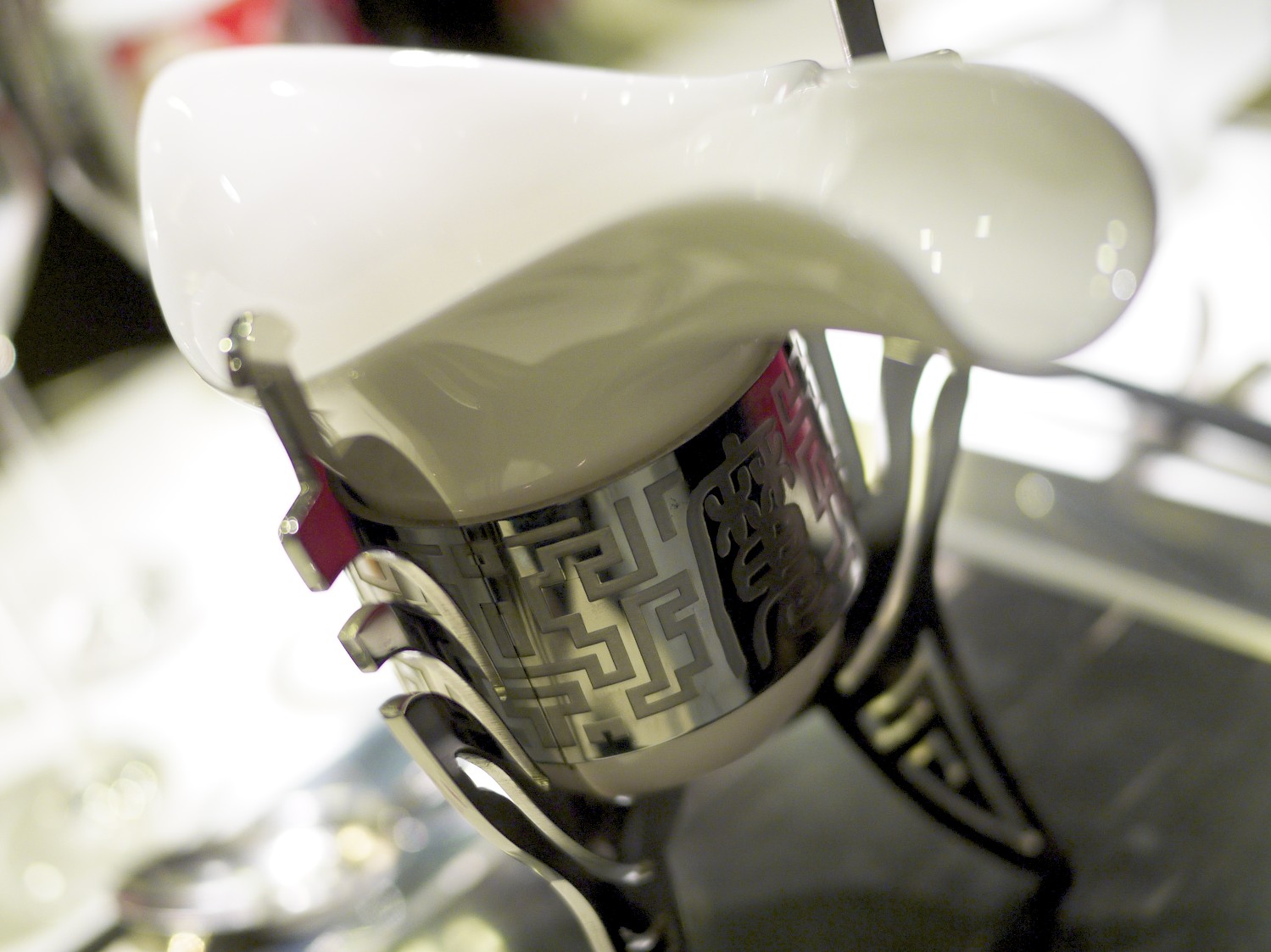
P1120976Almost immediately after the explanation, a beautiful vessel containing the amuse bouche of a Maotai (local Chinese liquor) sour was brought over to me. This particular one was made from Kweichow Maotai, one of the most revered of its kind where the tastes were reminiscent of pear, walnut and almond. The addition of the lime, egg white and grenadine made this an extremely refreshing palate cleanser.

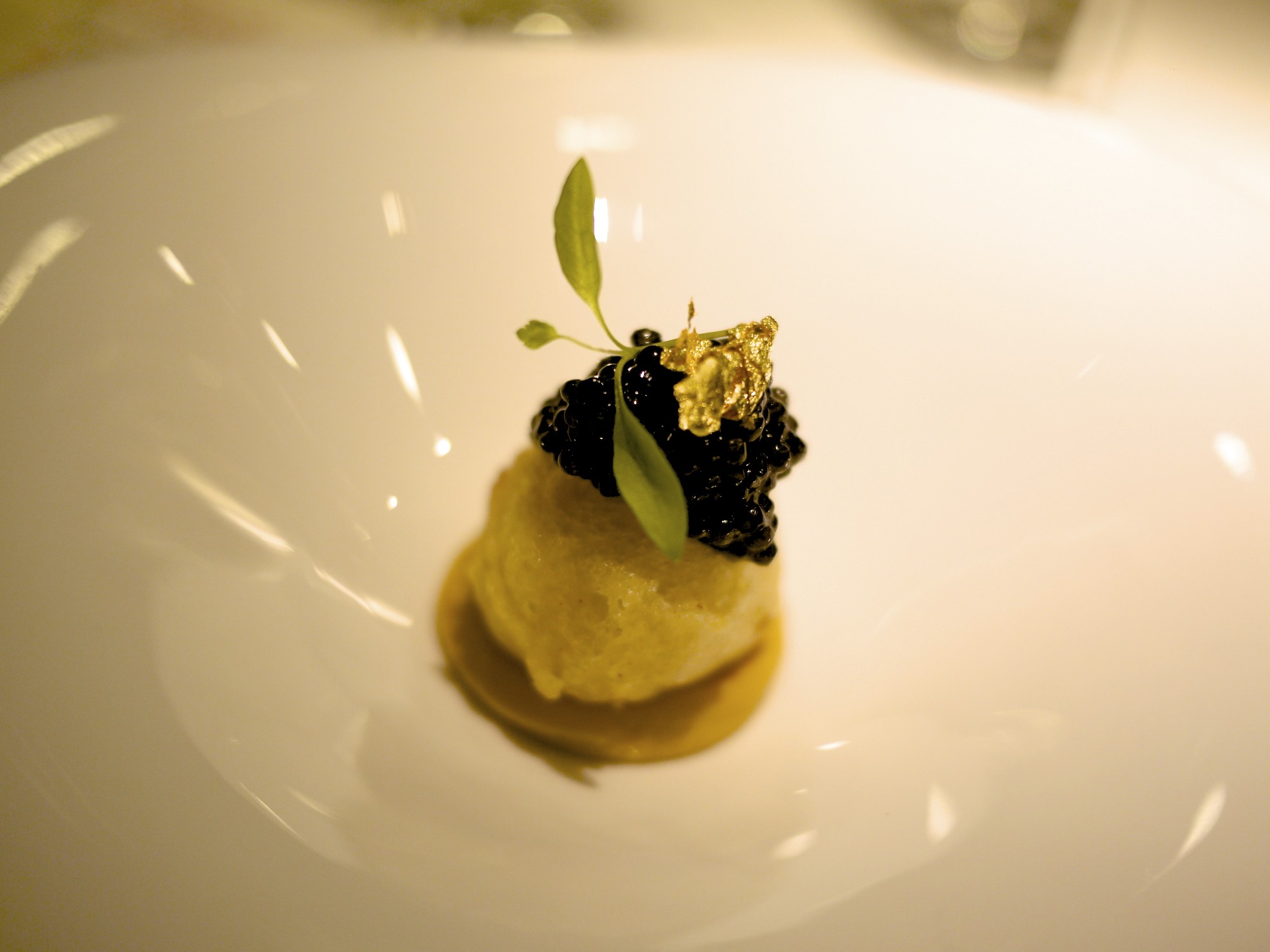
P1120979On to the first solid course of the evening and the caviar, crispy oyster milk and bottarga was an immediate success. I was not aware that China produced black caviar and this particular one was sourced from Heilongjian in the Northeastern region. The bite size morsel was beautiful in flavour and the tuna bottarga (cured roe of the tuna) inside the creamy base was not overpowering despite bringing a distinct note to the dish. Combined with the crispy texture and flavour of the oyster milk, this dish had a lasting aftertaste of the sea, washed down perfectly with a glass of the Domaine J Laurens NV.

P1120985

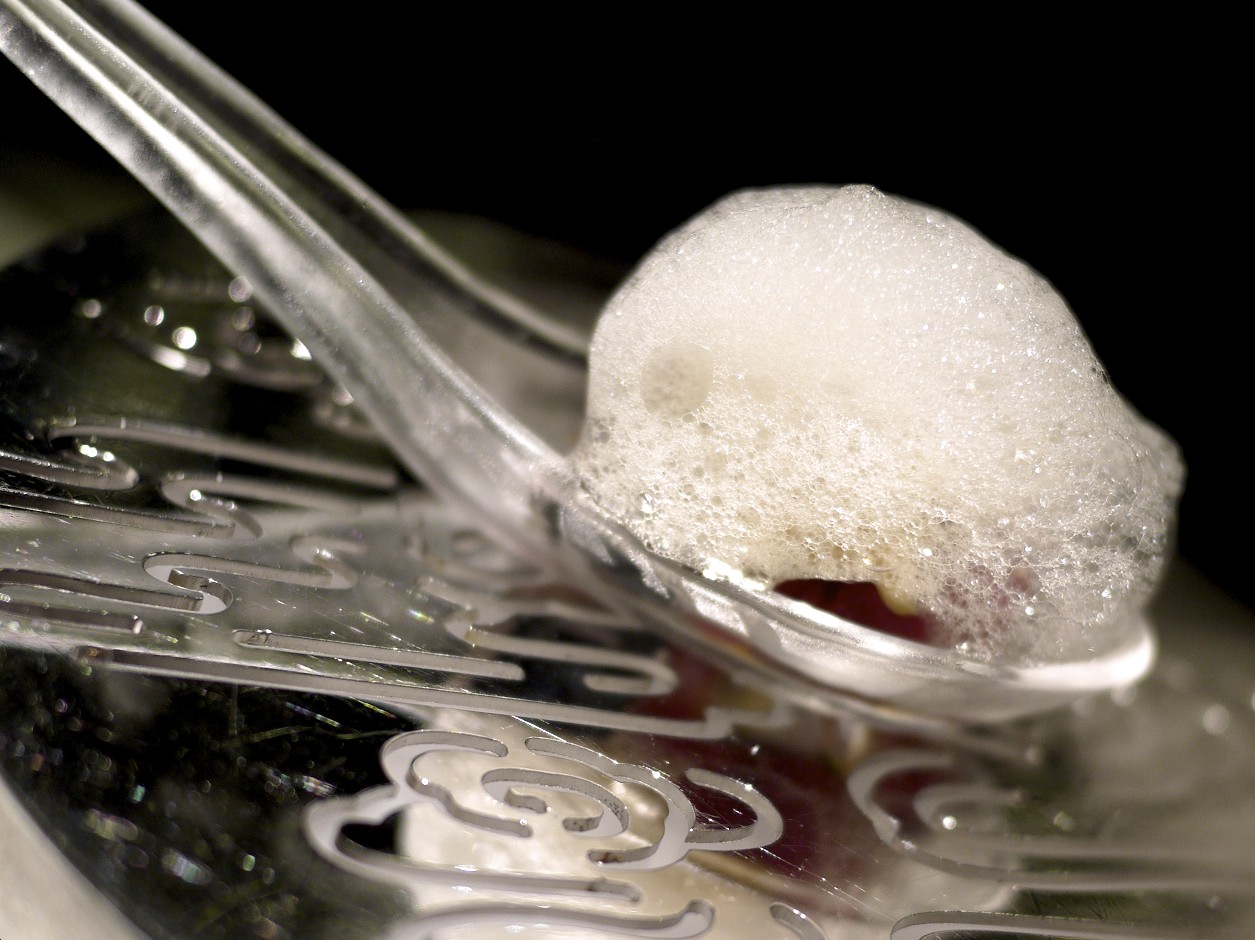
The next course of the Saba, sesame, ponzu cloud and ginger was served on a metal bowl that produced a rose aroma of “parfum de Hong Kong” through the use of dry ice. The oily fish married well with the sesame and melted in your mouth. Ponzu of course is a tried and tested combination that works well with fish and the ginger removed the slight fishiness leaving a clean taste on the palate.

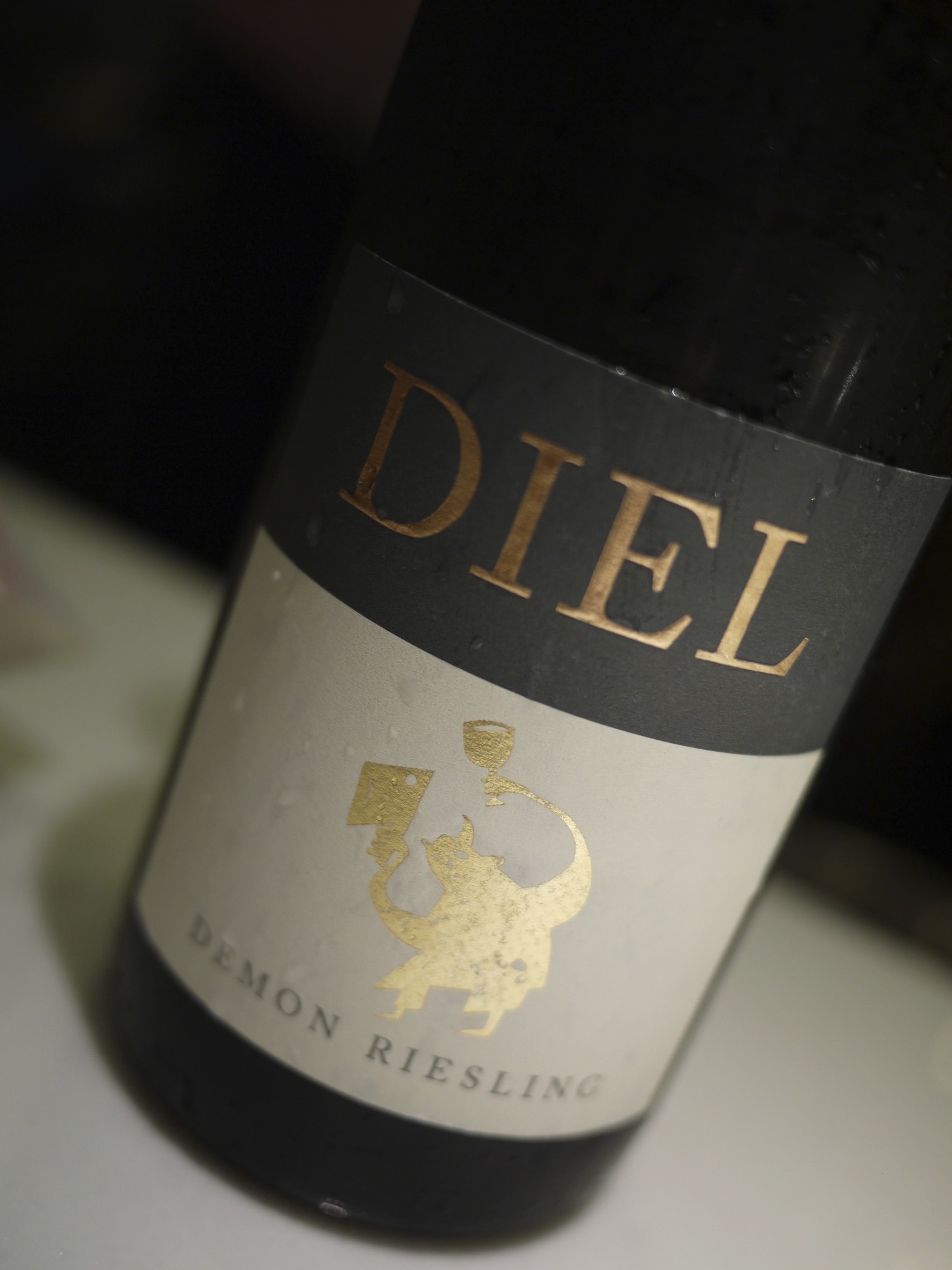
P1120989A refreshing glass of Schlossgut Diel – Demon Riesling – Nahe 2010 was then poured for the next two courses. I noticed the logo and immediately realised this was bottled for the Demon Chef!

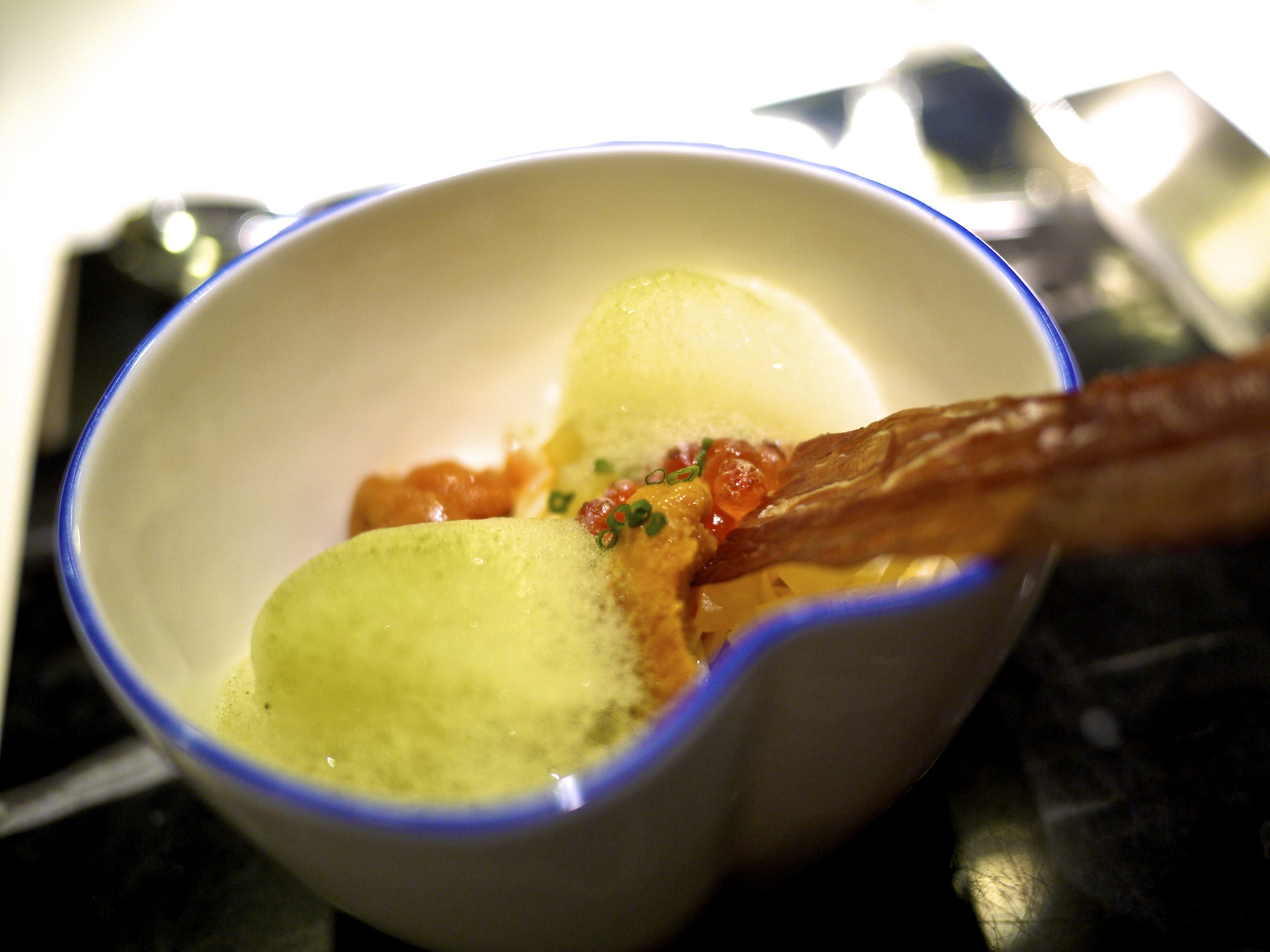
P1120995Next up was the Bo Dan Dan Noodles, chilli pepper, pine nut, preserved Chinese mustard, salmon roe, sea urchin, Iberico. The sea urchin from Hokkaido was delicate but not lost in the heat of the chilli. The salmon roe didn’t add much to the dish as it was surprisingly unsalty. The only seasoning component to the dish was the Iberico ham which I probably would have incorporated in smaller portions to spread across the dish. Whilst the flavours were delicate and beautiful, I thought there was a lack of seasoning overall.

P1130002Slightly better was the foie gras, bamboo shoot, “zhou ye qing” liquor miso, pickled Indian lettuce stem. It was a generally sweet dish and the marinade of the liquor infused miso was quite pleasant. The bamboo shoot and pickle added the textural element to the soft foie.

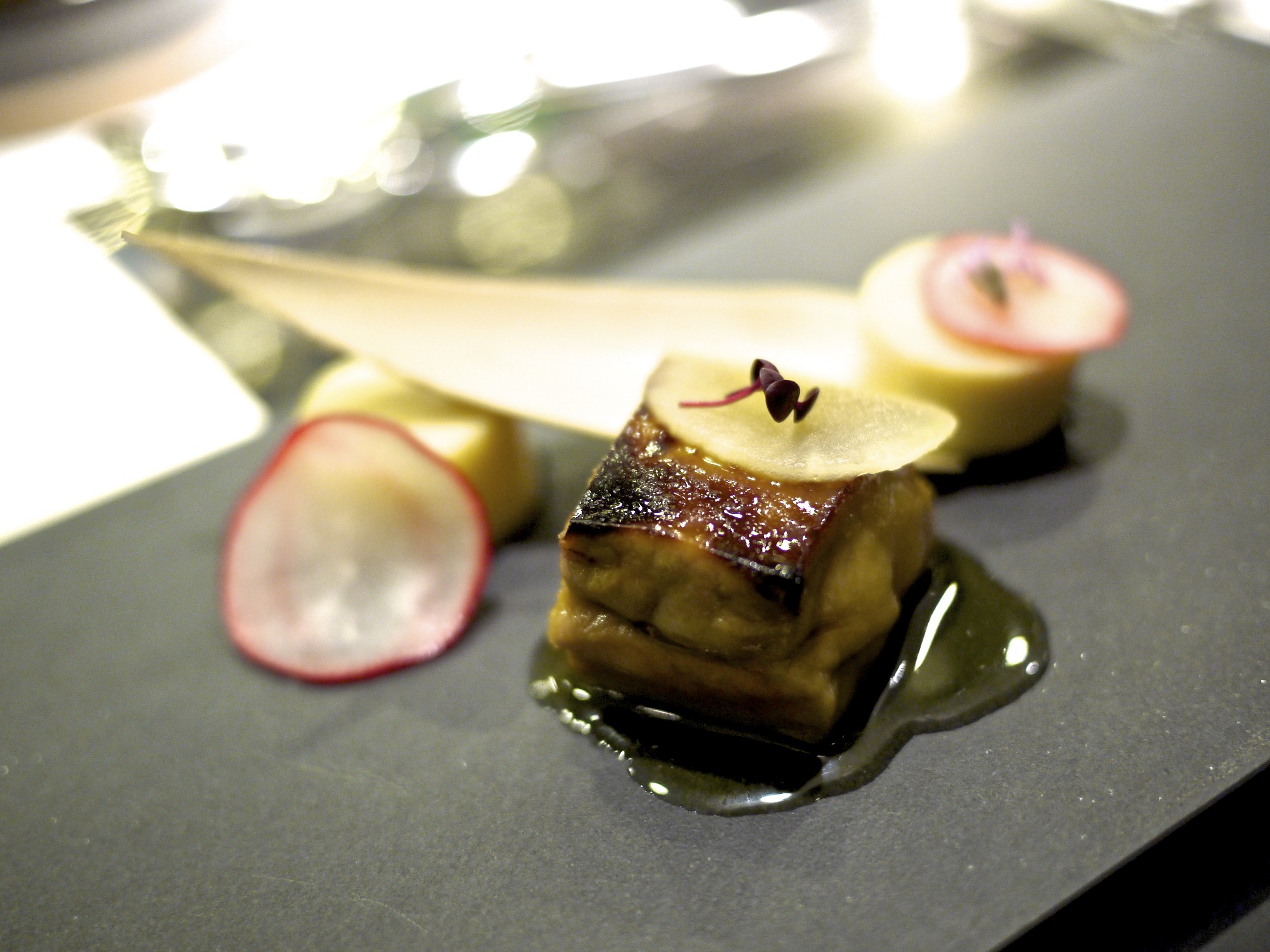
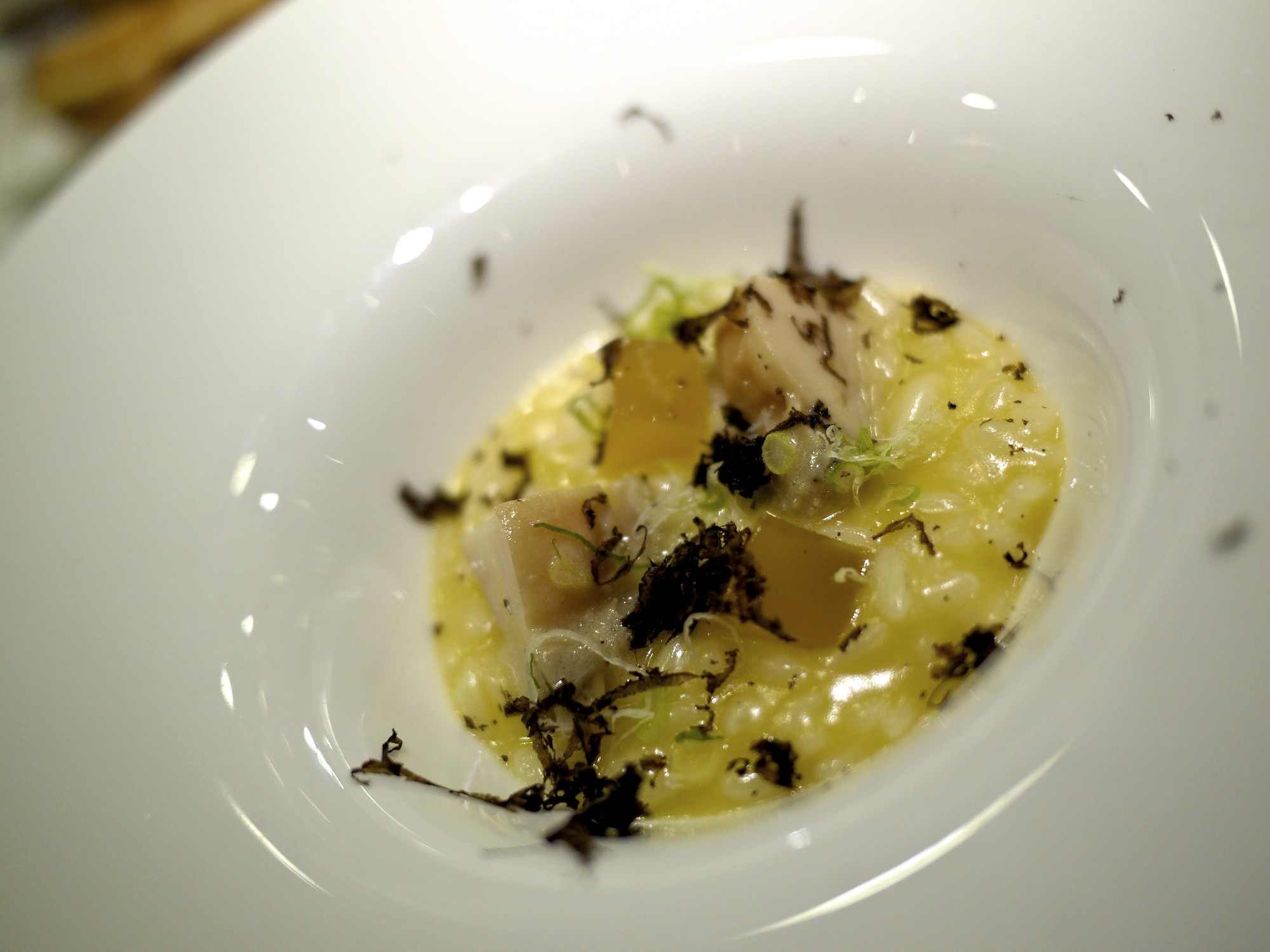
P1130004One of the highlights of the meal, with perhaps less visual impact than some of the previous dishes was the Abalone, black truffle and Bo chicken rice. The rice was cooked in a stock containing chicken and Japanese sake and served al dente. The flavour of the South African abalone was further magnified with the accompanying abalone jelly. To top it off, the Perigord black truffle added an earthy canvass to the rice making it a marriage of flavour in heaven! This was indeed ‘X-Treme’ Chinese cuisine without a shadow of a doubt.

P1130008I had heard many people talk about Chef Leung’s signature dish of Molecular “xiao long bao”. I tasted some of the finest xiao long bao’s during my ten day trip to China two years ago so I was curious to see whether Leung had compromised the dish for the sake of style. I was advised to eat this in one bite as it would literally fall apart after the first bite. Sure enough, there was an explosion in my mouth! It was bizarre to have the flavour of xiao long bao with no texture at all but it was sticky and delicious with a long and rich aftertaste in my mouth. P1130013A very refreshing course following the rich xiao long bao was the Tomato, “pat chun” Chinese vinegar, fermented Chinese olives “lam kok”. The tomato on the right was cooked in a sweetened black Chinese vinegar “pat chun”, followed by tomato wrapped in Chinese pastry which was then deep fried with fermented Chinese olives “lam kok”  from Chiu Chow, followed by an airy tomato consommé tower which incorporated gelatin to keep its shape.

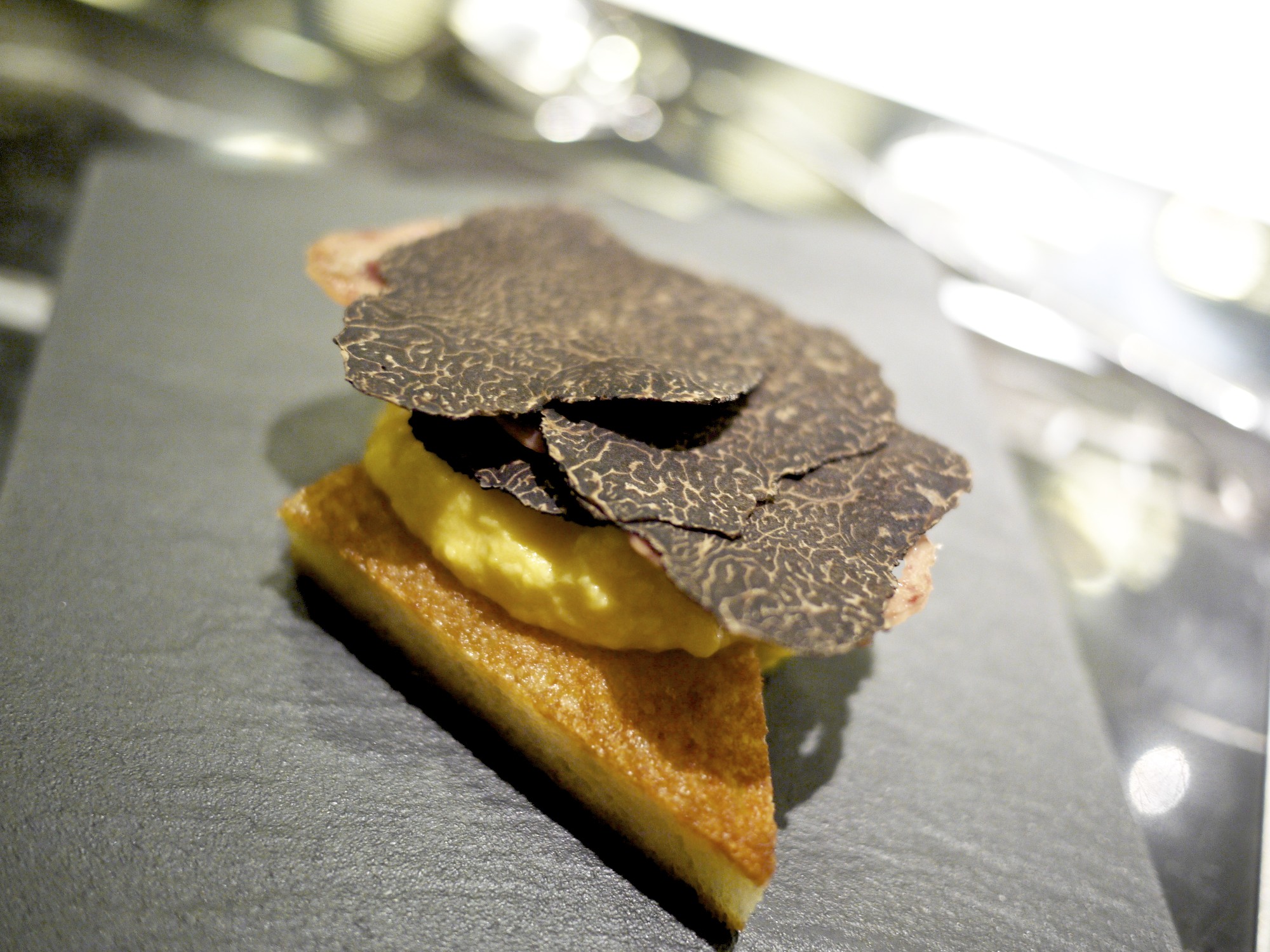
P1130018Continuing with the theme of black truffles, the next course was the Black truffle “chian dan chee”. The toast had been cooked in wagyu beef fat which was then layered with truffled scramble egg, dehydrated ham and of course a very generous shaving of Perigord black truffle! The intensity of the truffled scrambled egg and black truffle was very enjoyable and the saltiness of the dehydrated ham was the perfect finish to the dish.

P1130023I was much more taken by the next knockout dish, Lobster Sichuan butter poached, peas, sweet corn and chili lobster chips. The juicy Boston lobster had been cooked sous-vide with Sichuan pepper and butter. I loved the moderated spiciness from the Sichuan pepper and the sweetness of the corn and peas, both adding depth and complexity. I’m not good with extremely spicey food like authentic Sichuan cuisine but this had just the right amount of heat for me.

P1130025The chili lobster chips reminded me of concentrated lobster bisque. Overall, this was my favourite dish of the evening and this alone was worth the fight against my jetlag during my meal.

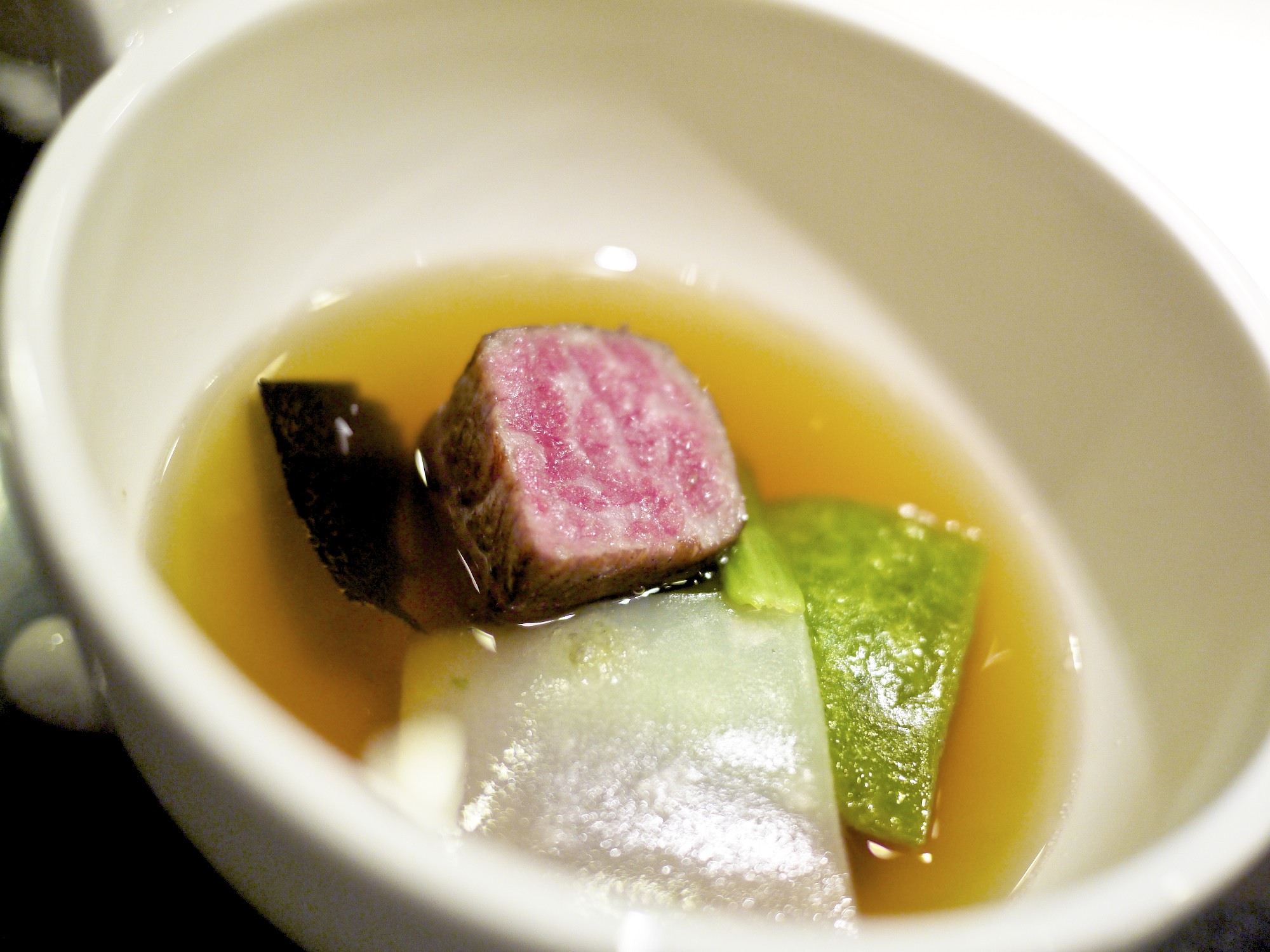
P1130029I thought it would be a hard act to follow the lobster dish but I wasn’t let down by Chef Leung on the subsequent meat course. The star component of the Saga-gyu beef, truffled tendon, Chinese chive, daikon and aromatic consommé was however a surprise. The tendon was beautifully infused and cooked with black truffles for three hours, while the white and green noodles on the side turned out to be daikon and Chinese chives, which worked harmoniously with the dish. The texture and flavour of the saga-gyu beef was very good and perhaps the easiest of the components, but it was the deep and rich soup that stole the show. It took 48 hours to prepare this soup, incorporating a good balance of spices including cardamom, bay leaf, aniseed, and cinnamon. This deconstruction of the classic humble Chinese Beef Noodles was the perfect way to end the meal before indulging in dessert.

P1130036The first of the dessert was the Sandalwood, chocolate and hawthorn. Sandalwood is more commonly used for its fragrance for cosmetic products but in this case its smoke was sealed in a glass tub containing chocolate mousse and dry iced hawthorn. The smoke infused in the chocolate was certainly unique although I wasn’t a particular fan, and I felt the hawthorn was overpowered by the smoke.

P1130040The trio of ‘lung jing’ tea ice cream, ‘shui jing fang’ caramel and lychee rose icicle were unlike other Chinese desserts I had ever tasted and highly original. The ice cream resembled that of macha green tea on a bed of dried white chocolate powder and the caramel had been infused with Chinese spirit that retained a significant sweetness. The icicle exerted a beautiful perfume of rose and lychee flavour, completing the trifecta of flavour, aroma and temperature. This dessert was superb and a great way to finish the meal!

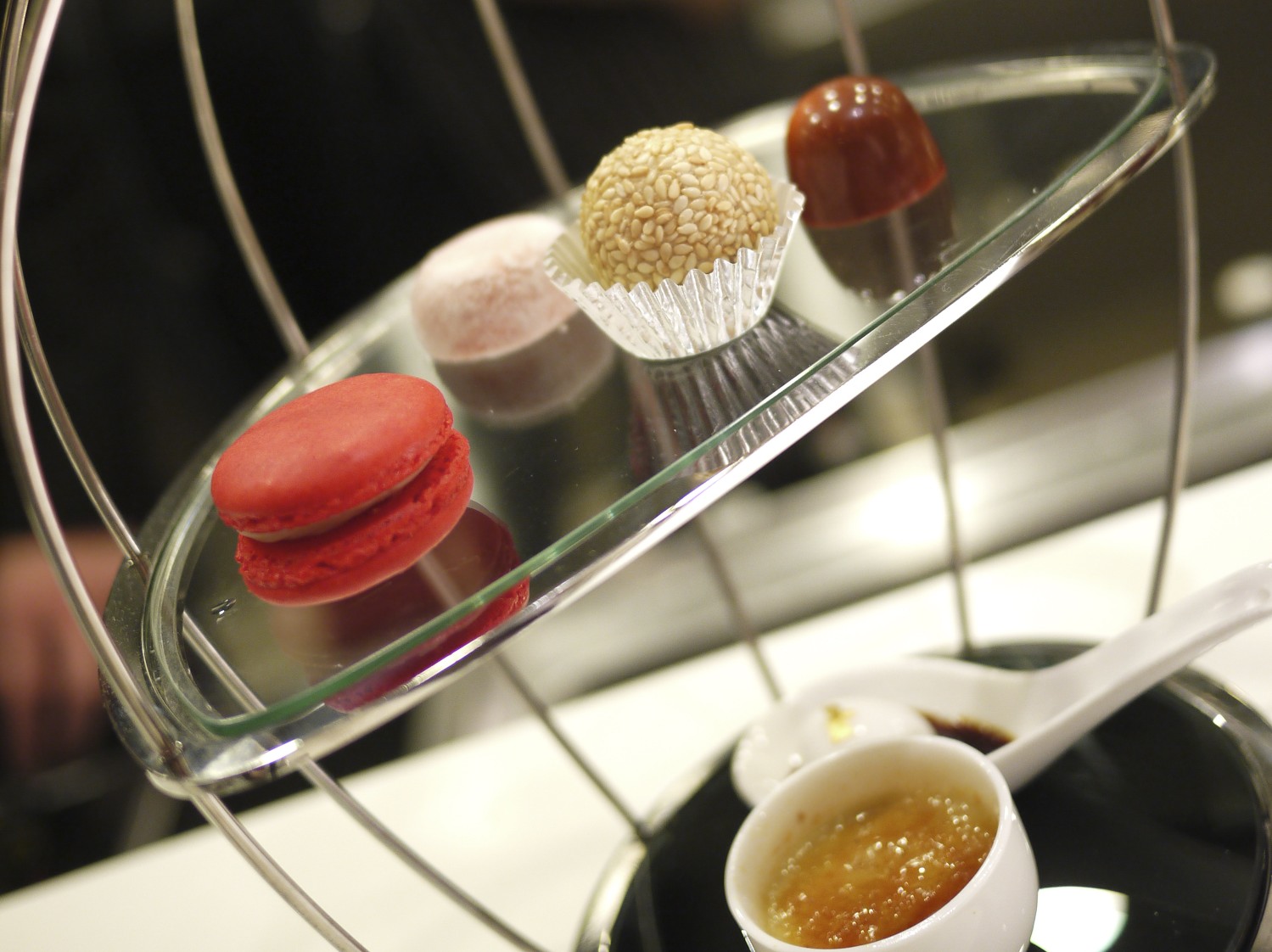
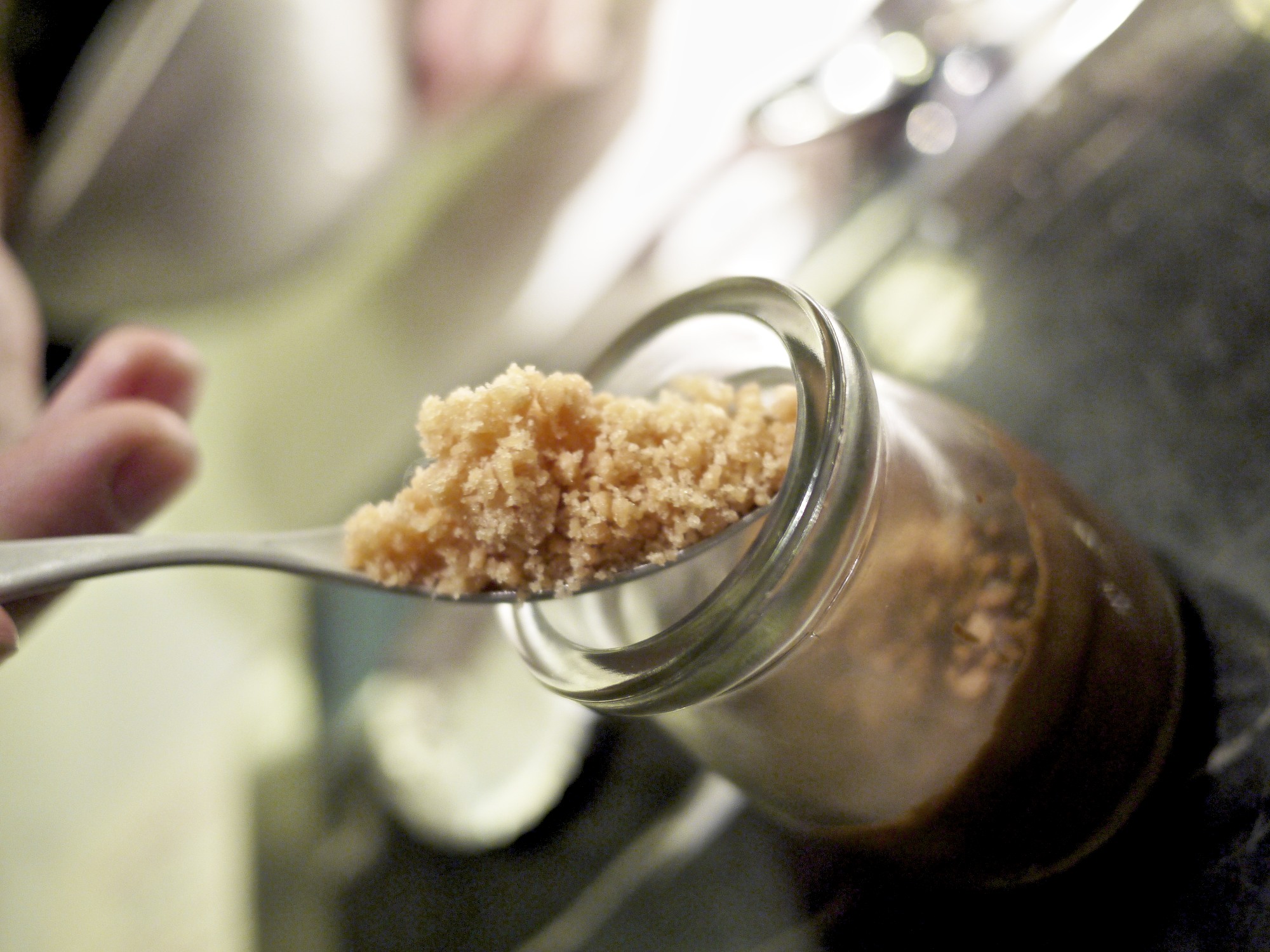
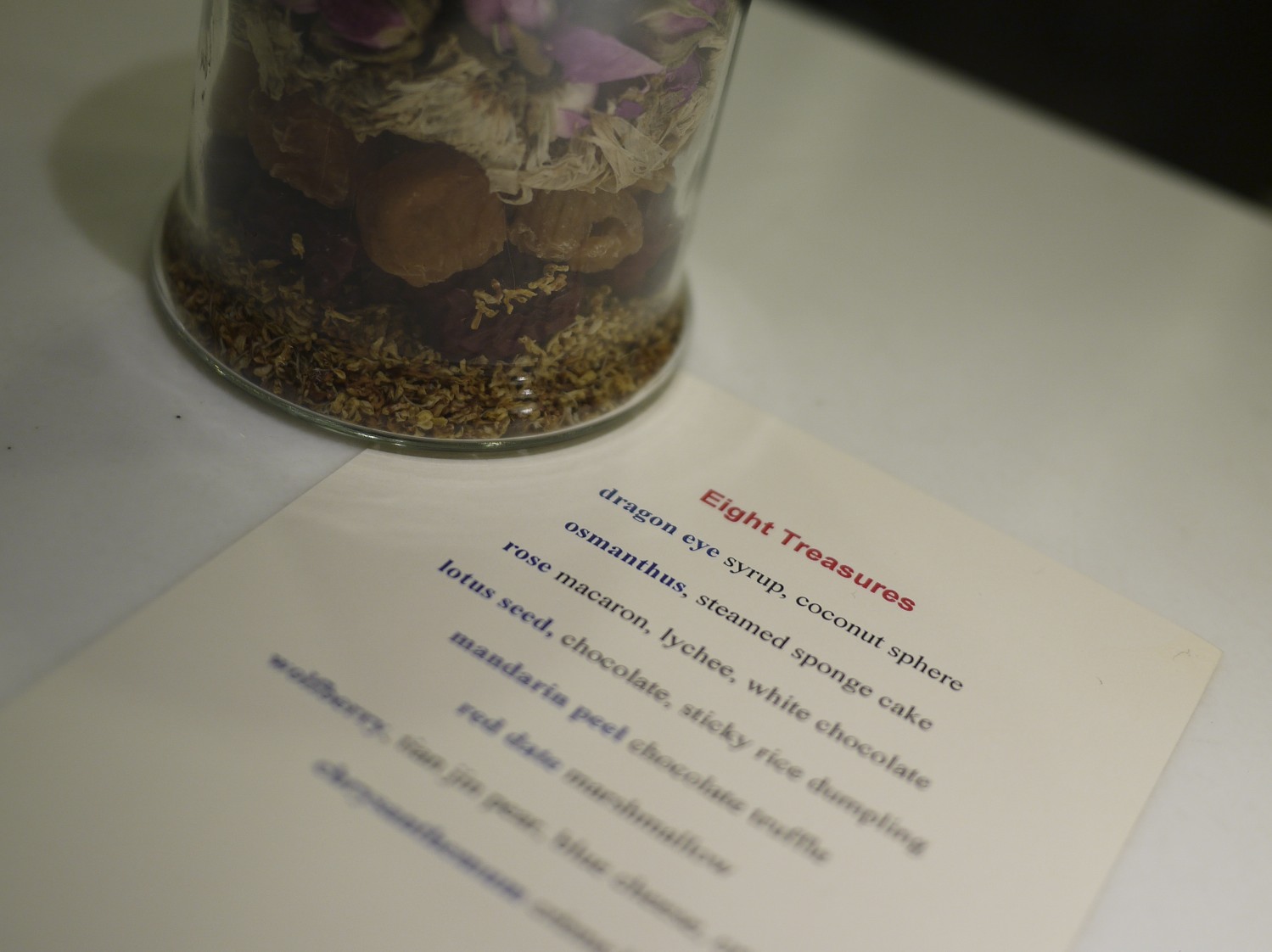
P1130044As I nibbled on the petit fours of the eight treasures, I finally succumbed to fatigue. It was quite comforting to end the meal on a familiar sight of miniature delights but with distinct Asian flavours. In particular, I really enjoyed the lotus seed, chocolate and stick rice dumpling and the mandarin peel chocolate truffle.

P1130055

There’s no doubt that the cooking in Bo Innovation was very sound, and I was blown away by most of their dishes. If you took away the Chinese element, the molecular component of the dish was perhaps less dramatic than other places I’ve been to. However, in absence of any gimmicks, the food here is unquestionably serious, real and most importantly delicious. The seamless integration of modern techniques to traditional Chinese dishes using quality seasonal produce has resulted in an unprecedented modern interpretation of Chinese cuisine.

I also couldn’t recommend the Chef’s Table any more highly and I enjoyed the ongoing banter with one of the chef de cuisine, David. I personally found in my journeys across China a lack of interest and discord with the front of house and chefs in fine dining establishments. I was comfortable here dining alone and did not at one point feel either bored or awkward. What Asian cities like Hong Kong need right now are more chefs like Leung and restaurants like Bo Innovation to showcase their diverse cuisine and produce in a much more engaging and personable environment. I look forward to comparing this with the tasting menu in Bo London very soon!

Mt William Winery, Macedon Ranges

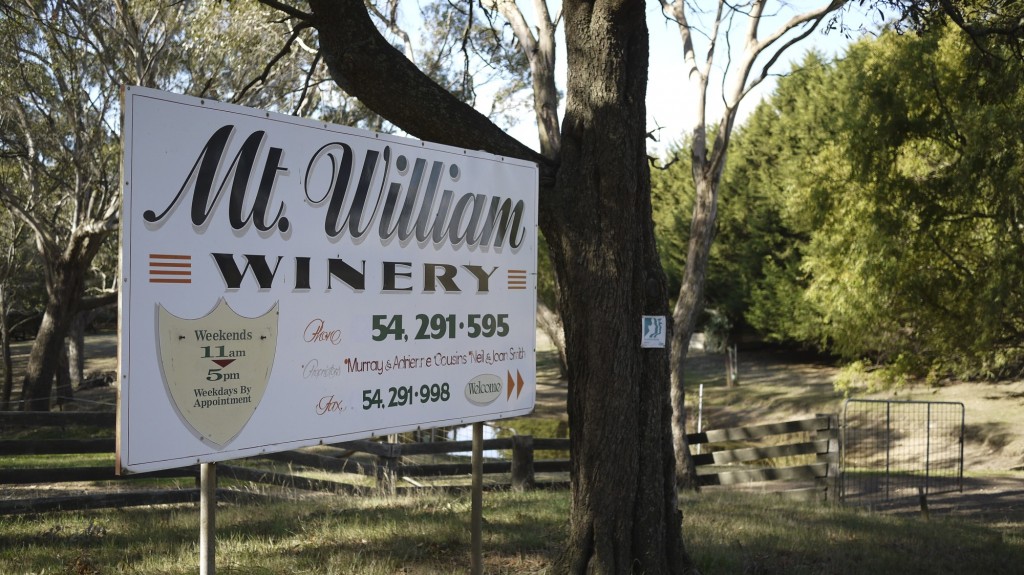
picnic_rock_macedon

Winery: Mt William Winery       Website: www.mtwilliamwinery.com.au        Region: Victoria

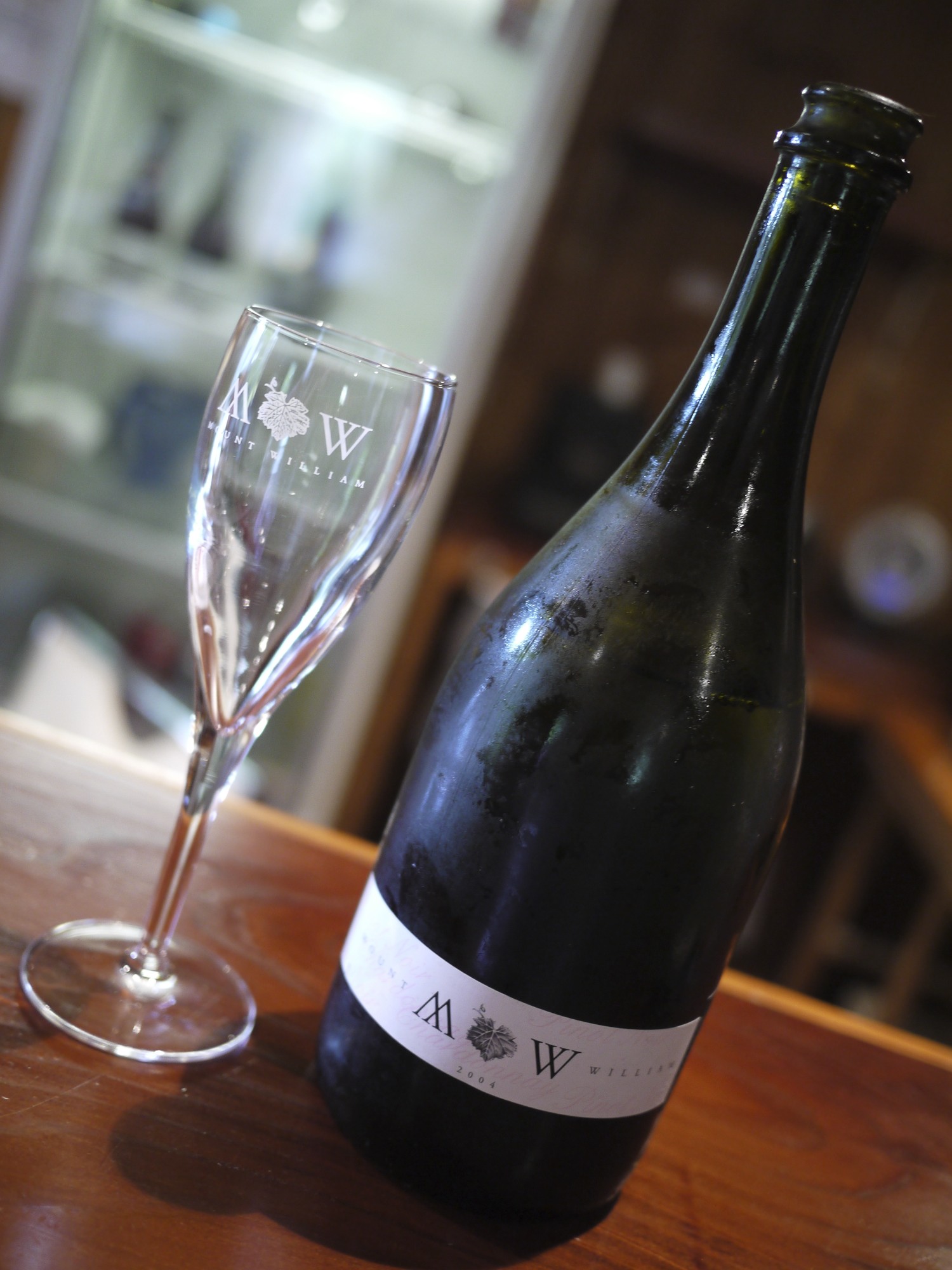
My wife and I recently had a casual lunch at Taxi on Federation Square in Melbourne to celebrate a friends birthday. As our friend had flown over from Denmark with his wife for our wedding, we thought it would be appropriate to crack open a nice bottle of Australian sparkling wine but admittedly we were both not very familiar with the regional producers. The sommelier at Taxi was very enthusiastic about a particular bottle so we decided to bite the bullet and go with it. He chose well. Really well. The bottle was the 2004 Blanc de blanc from Mt Williams Winery, Macedon Ranges. It had an elegant palate of lime and peach flavours with a refreshing citrus finish. As usual, given my obsessive personality, I immediately arranged a visit to the Macedon ranges for the following week to visit the winery that had won quite a few awards for their blanc de blancs!

P1130602

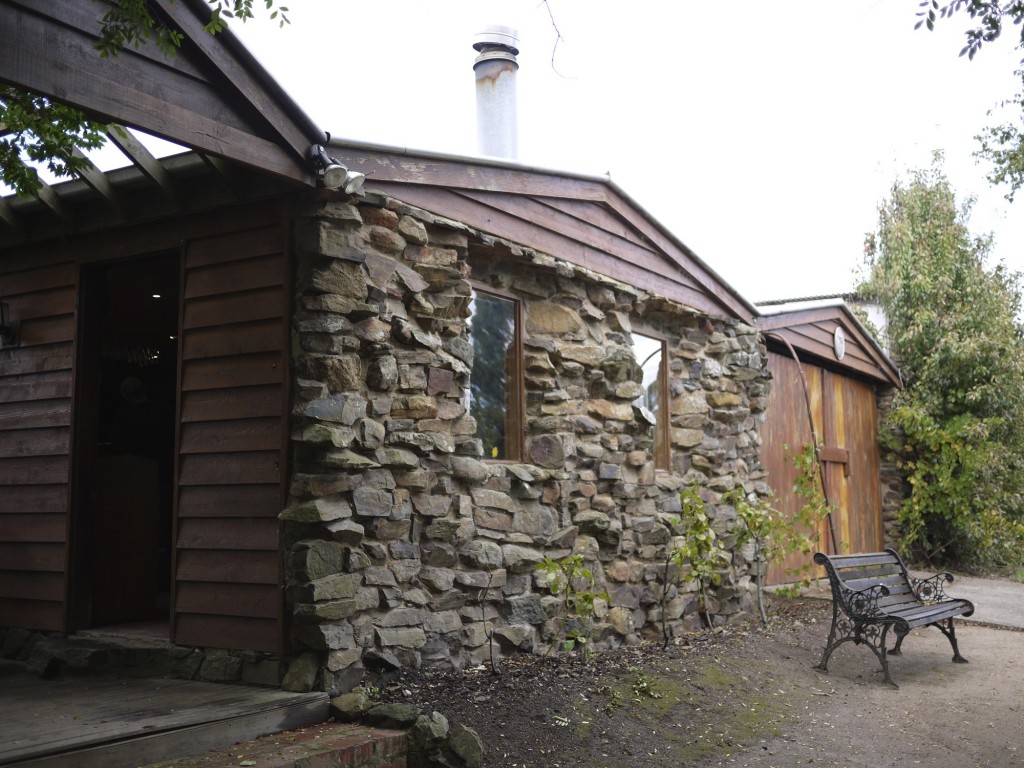
The Macedon Ranges Wine region is located only an hour and half North of Melbourne and is less known than the competing bigger wine regions of Victoria such as the Yarra Valley and the Mornington Peninsula. It is the coolest mainland region in Australia and wines produced in this region tend to be quite uni-dimensional with an elegant nature, balanced with a higher amount of natural acidity and finer tannins. Mt William winery is located off a long dirt road on the northeast slopes of Mt William, between Lancefield and Kilmore, at an altitude of 605 metres. Their vineyard site is a sloping amphitheatre of grey loam soil to 600mm depth, overlaying a clay base. The considerable slope of the blocks ensures a frost-free site of excellent sunlight interception and provides spectacular views over the surroundings.

P1130570

Adrienne and Murray Cousins purchased the 220 hectars of grazing property back in 1985. Whilst sheep and angus cattle remained an integral part of their farming program, they established pinot noir, chardonnay, cabernet franc, semillon and merlot between 1987 and 1999. Their blanc de blancs in particular have won them many awards and accolades over the past few years and we were keen to try what they had on offer.P1130578

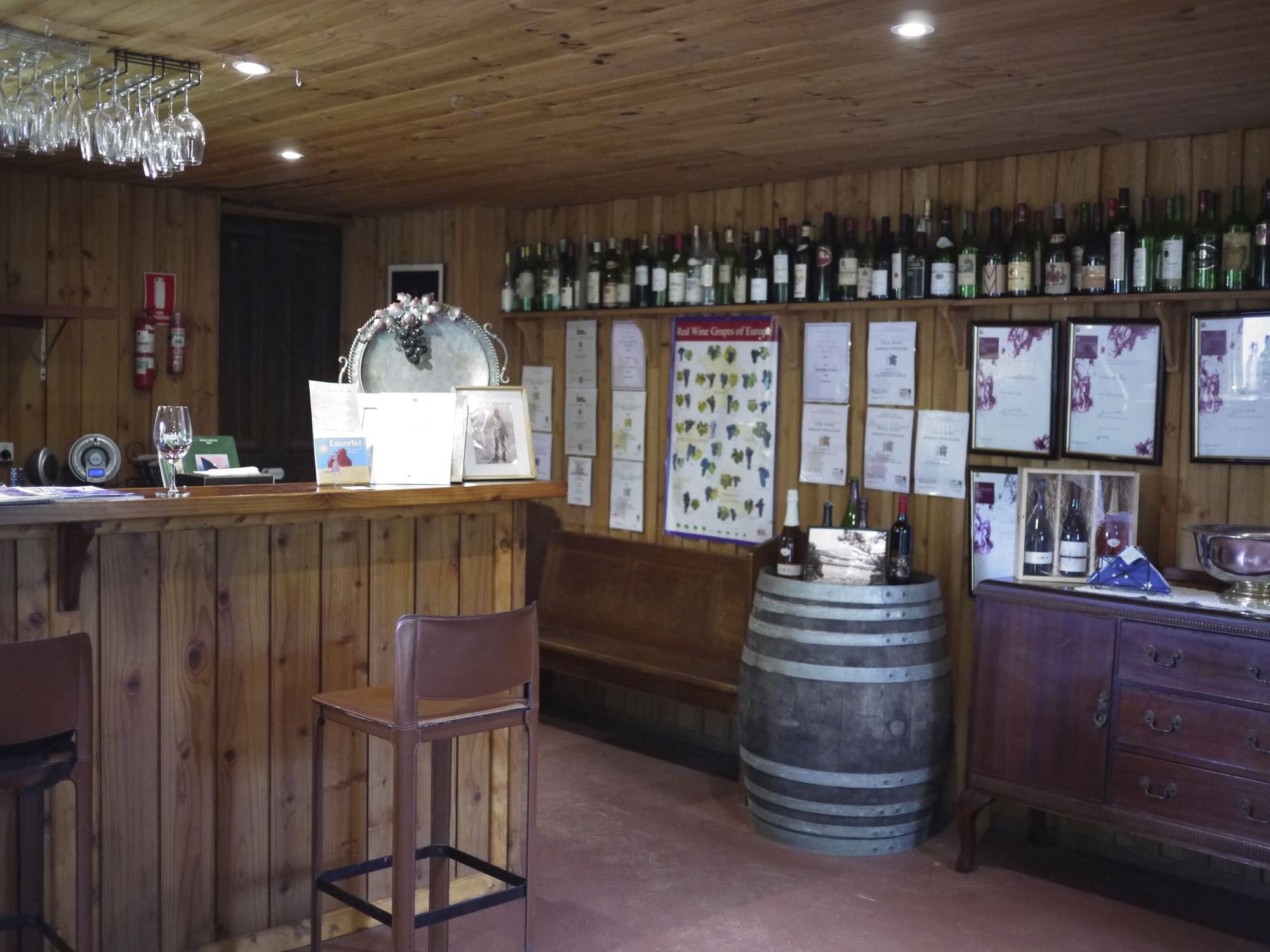
We were welcomed warmly by Adrienne and her friendly black labrador and were the only ones at the winery that day. Unfortunately, we were soon disappointed to learn that all their blanc de blancs from 2004 had sold out at the cellar door and their agents similarly had hardly any left! Despite the slight hiccough, given Adrienne’s hospitality, we decided to stick around and try the other sparkling wines they had on offer. I don’t claim to know wine as well as a sommelier does and I sure do not have the same level of sophisticated vocabulary to describe them. However, I really did want to share this experience because I was very impressed with a couple of bottles we tried.

P1130579

We started off with a very interesting glass of 2003 Mount William Winery Jorja-Alexis Pinot Rose. This really reminded me of one of the most unique and delectable sparkling rose I came across in England from Nytimber. It was deep salmon-pink and indicative of the premium pinot noir fruit used in making this sparkling rose. It had a very intense spicy red fruit with a long palate and aftertaste. There was a divided opinion amongst our group as some people found it too acidic and tart, whilst I absolutely fell in love with it. So much so that I immediately asked for a few bottles to be put aside for purchase (and currently nestled in my wine cellar)! This sparkling rose would be a perfect accompaniment to oysters, prawns and crayfish amongst other fresh seafood. 

P1130583

Second up was the 2004 Mount Williams Pinot Noir Chardonnay. Richly fruited and textured thanks to a lengthy six years on lees, this sparkling wine had a bright and zesty freshness of citrus and strawberry fruit. Admittedly, we still preferred the 2004 blanc de blanc we had tried in Taxi but we were happy to buy a couple of bottle of these as well.

We were also very prepared with a picnic basket as we had set off from Melbourne for the day and knew there were not many restaurants in the vicinity. As the weather was so beautiful and they had a table outside the cellar door, Adrienne suggested we made the most of this by enjoying our charcuterie over a glass of their sparkling wines. We naturally obliged and spent a lazy afternoon soaking up the sun.

As it also transpires, their cottage located right next to the cellar door had become available for hiring after the last permanent tenant moving out. It was a beautiful cottage that was tastefully decorated and big enough for three couples. Suffice to say, we will definitely come back on the next occasion and stay overnight. Let’s hope they don’t run out of their next batch of blanc de blanc before we get there!

Amber, Hong Kong

Amber dining room Chef: Richard Ekkebus      Website: www.amberhongkong.com     Cuisine: Modern French

Following two consecutive years of success and recognition as the only restaurant in Hong Kong to enter the World 50 Best Restaurant list, it was no surprise to see Richard Ekkebus’ Amber taking the 4th spot in the inaugural Asia’s 50 Best Restaurant Awards in 2013. It is Ekkebus, as well as a growing pool of daring talented regional chefs, who has been instrumental in leading the gastronomic revolution in Asia, bringing the regional restaurants to the world stage of culinary excellence.

P1130118

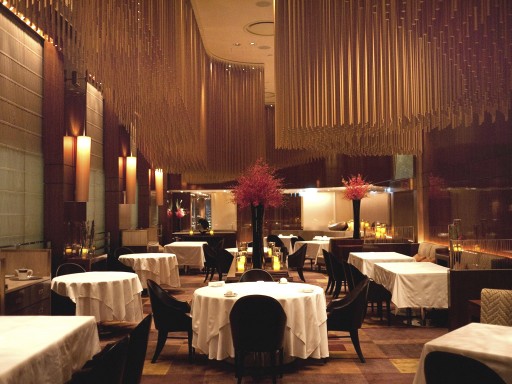
Occupying the 7th floor of the Landmark’s Mandarin Oriental hotel, Amber’s dining room designed by Adam Tihany boasts a luxurious double ceiling throughout. It consists of a special feature of 4,320 gold rods hanging from the ceiling, creating a dramatic visual effect. Similar to Tihany, Ekkebus has been inspired by the sense of mobility and internationalism of Hong Kong. This allows him to take advantage of being able to source fresh superior produces from across Asia, applying his traditional French cooking techniques with an innovative twist in presentation. The culmination of these elements makes dining at Amber a gastronomic treat and certainly worthy of the two prestigious Michelin stars the restaurant has been bestowed.

P1130121

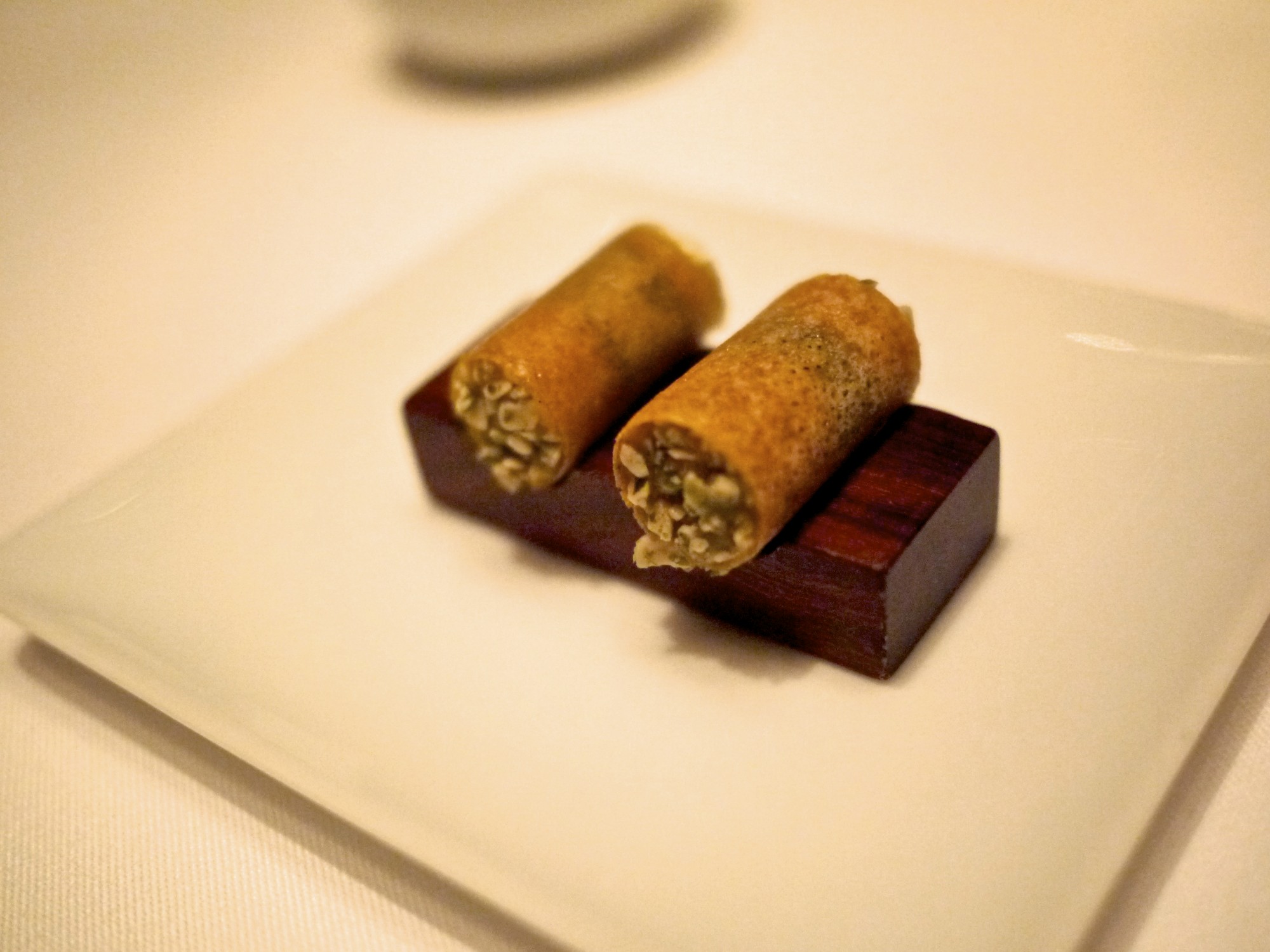
I had been waiting for this highly anticipated meal for six months as I had heard so many chefs speaking highly of Ekkebus across the world. As a glass of champagne was poured, the little treats of amuse bouches started arriving at our table, gradually progressing from the mellower flavours of a canneloni with black truffle coulis, kabocha pumpkin and pumpkin seeds which was very delicate in flavour and contrasting textures of creaminess and crunchiness.

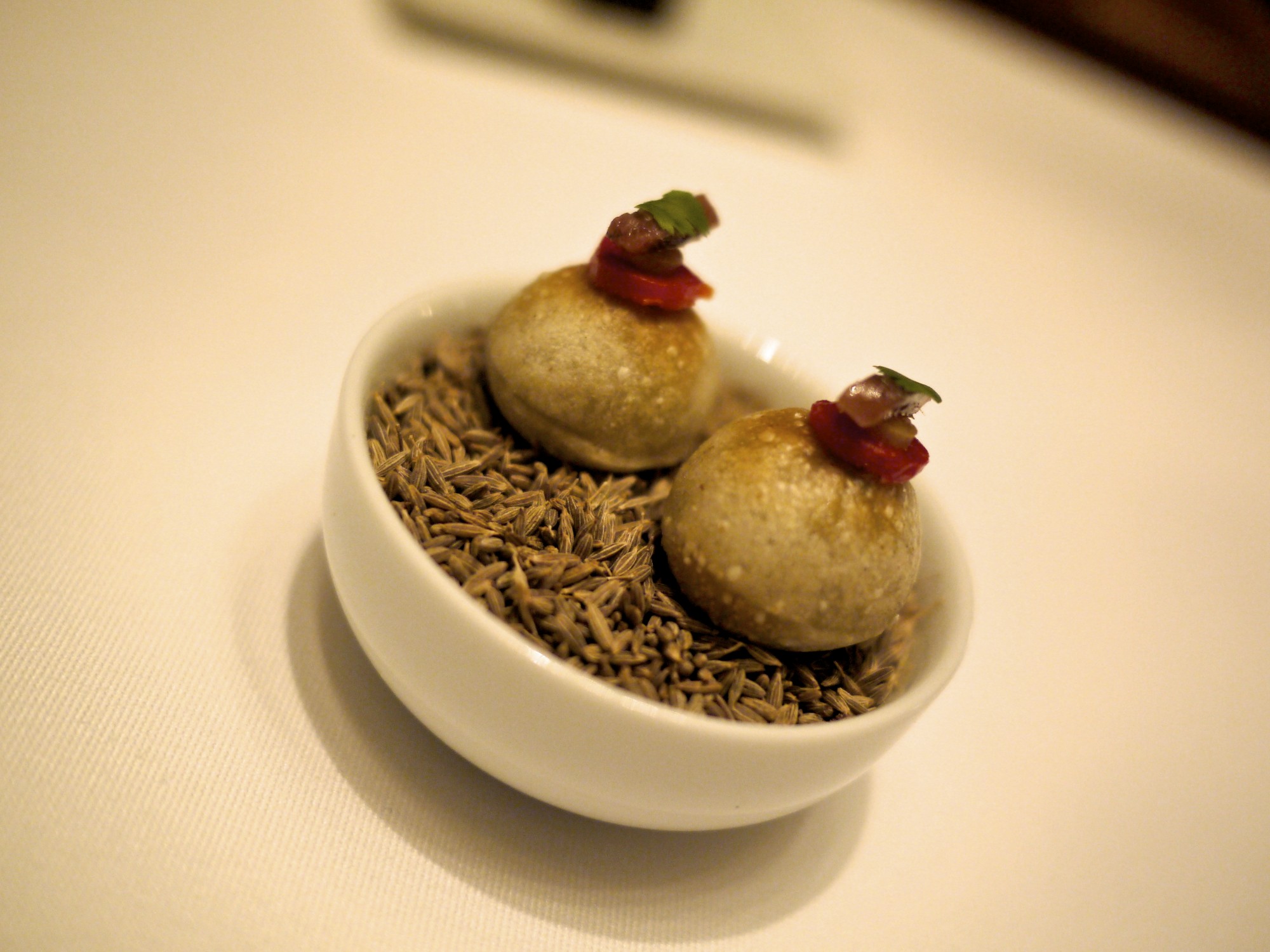
P1130125The play on texture continued with the pita balls stuffed with aubergine and red pepper which has a slight smokiness to the sweet filling.P1130142

We were fortunate to be dining in March as Chef Ekkebus managed to source some top quality Perigord black truffles, and he was not shy in making use of them that evening! The cauliflower soup with egg sabayon and black truffles was very earthy, refined and in good portion size.

P1130140

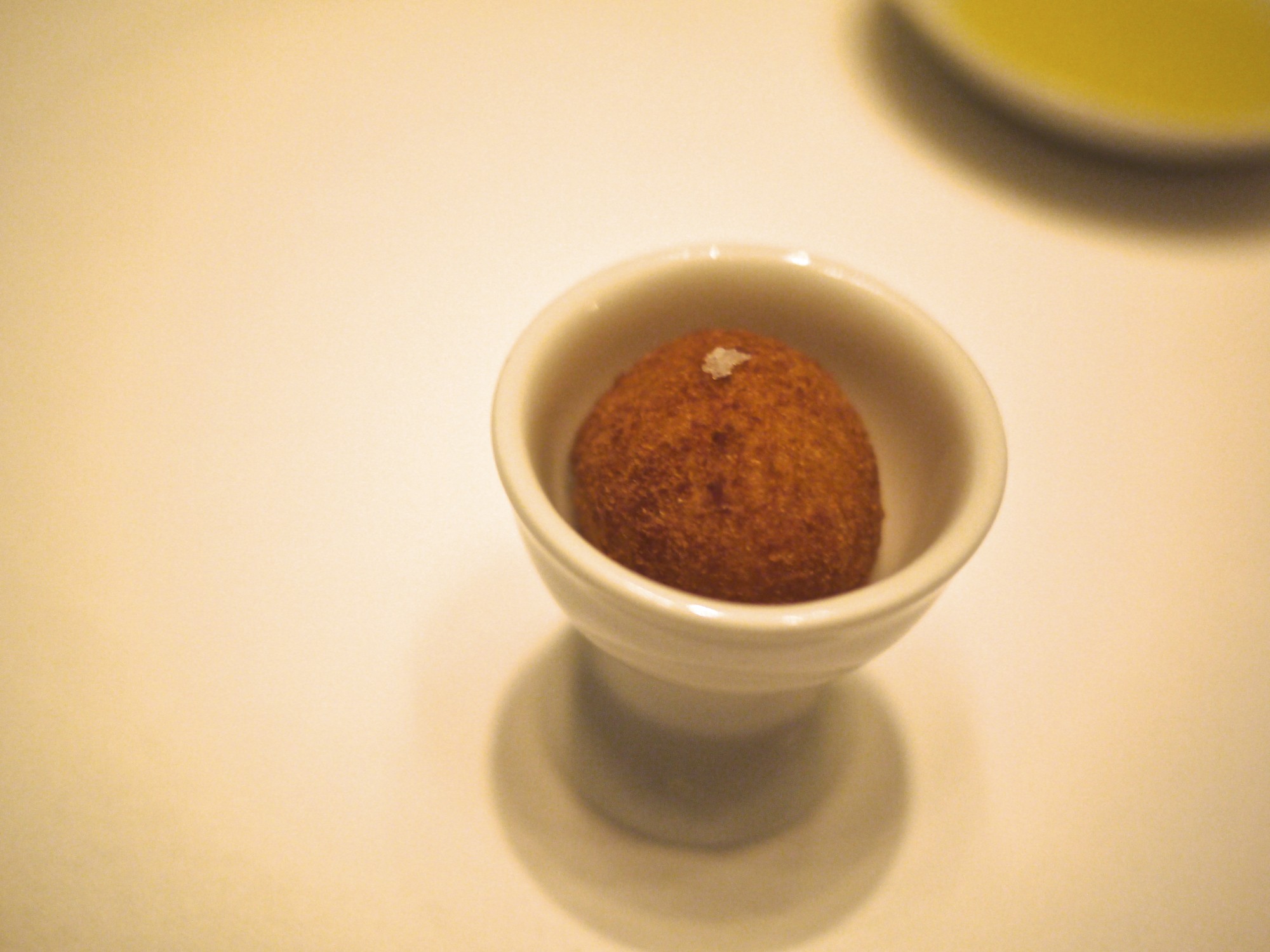
One of my favourite amuse bouche that evening was the Iberico pork and mustard fried ball. The warm filling oozed out and the flavour combination of the pork and mustard was just superb. I particularly liked the contrast of the crispy outer coating to the juicy filling in one bite. I could easily have had a couple more of these!

P1130137

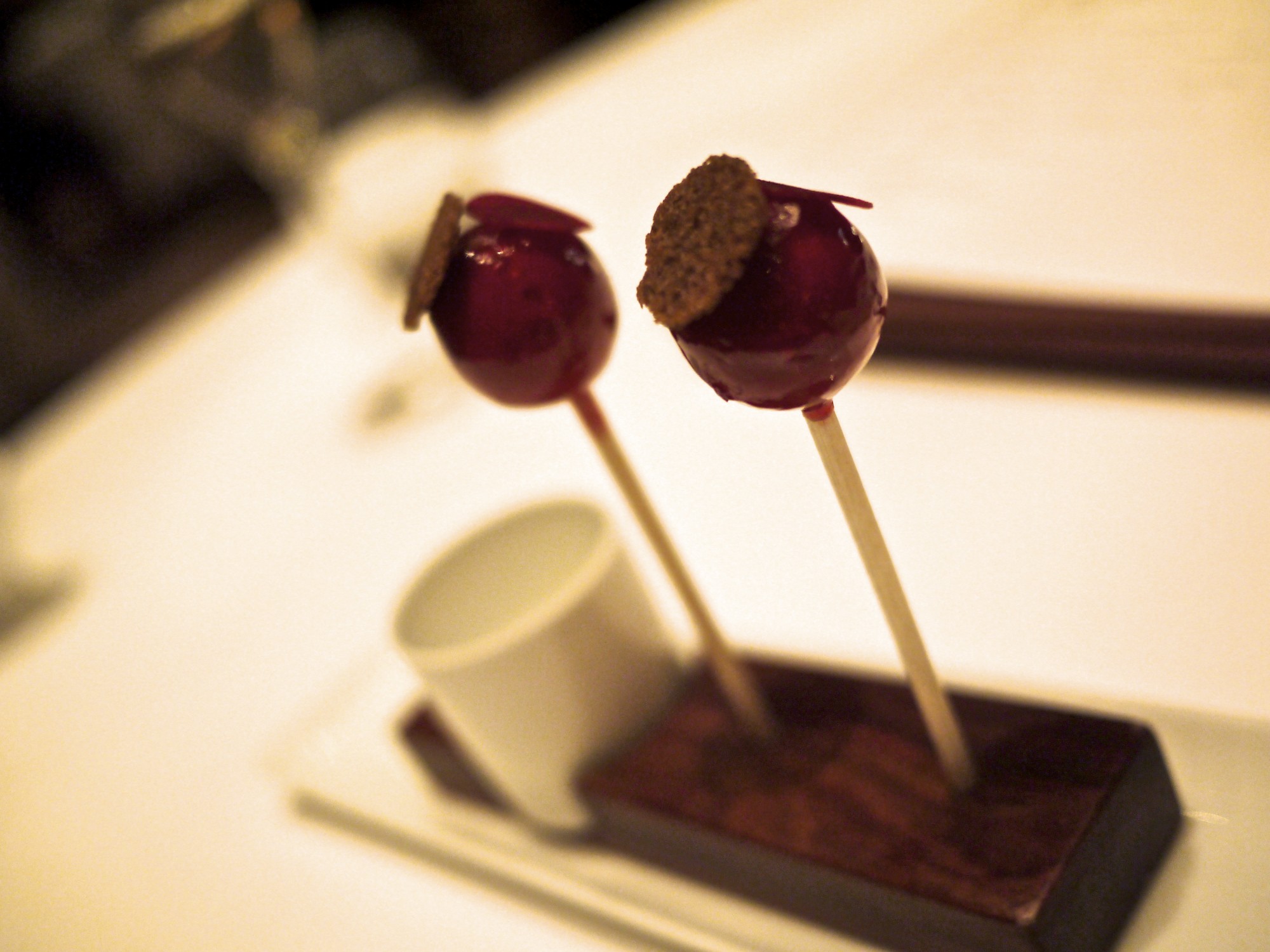
Another favourite was the duck foie gras lollipop, which was perfectly balanced with the acidity from the layer of raspberry coating and the crunchy texture of the gingerbread crisp on top. It was refreshingly cold inside to top it off.

P1130147

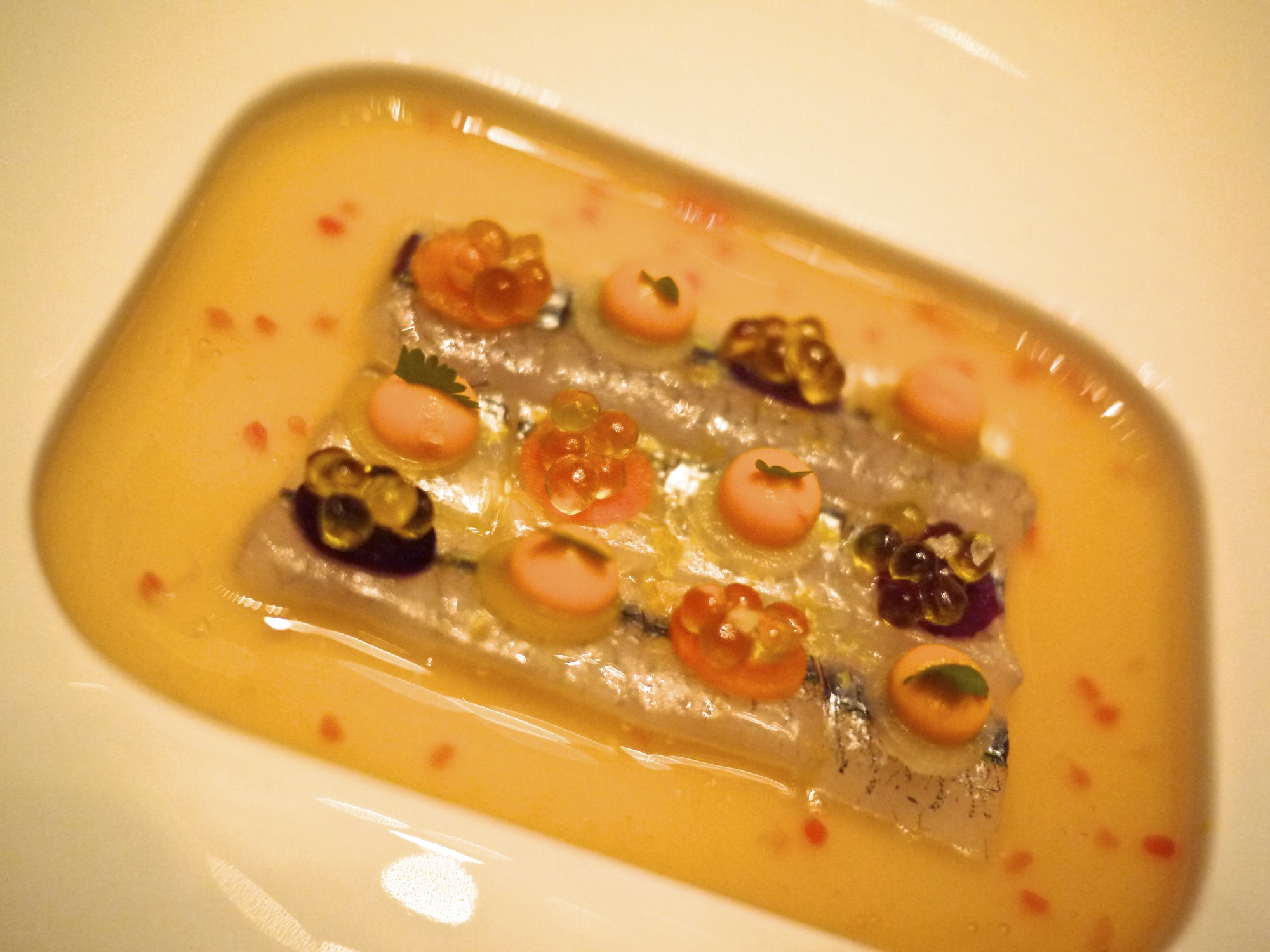
As the table was being cleared, the sommelier came over with the first wine pairing of the evening, which was a glass of a very crisp and herbaceous 2011 Domaine Laporte, Sancerre Les Grandmontains. The first course of the evening was an instant hit and almost too pretty to eat. The needlefish ‘sayori’ which had been marinated with olive oil ‘caviar’, heirloom carrots, finger lime and ginger was sourced from Japan and served raw. The acidity from the lime and the carrot and ginger bouillon cut through the delicious oily fish, and the salmon roe provided the perfect seasoning to the dish.

P1130150

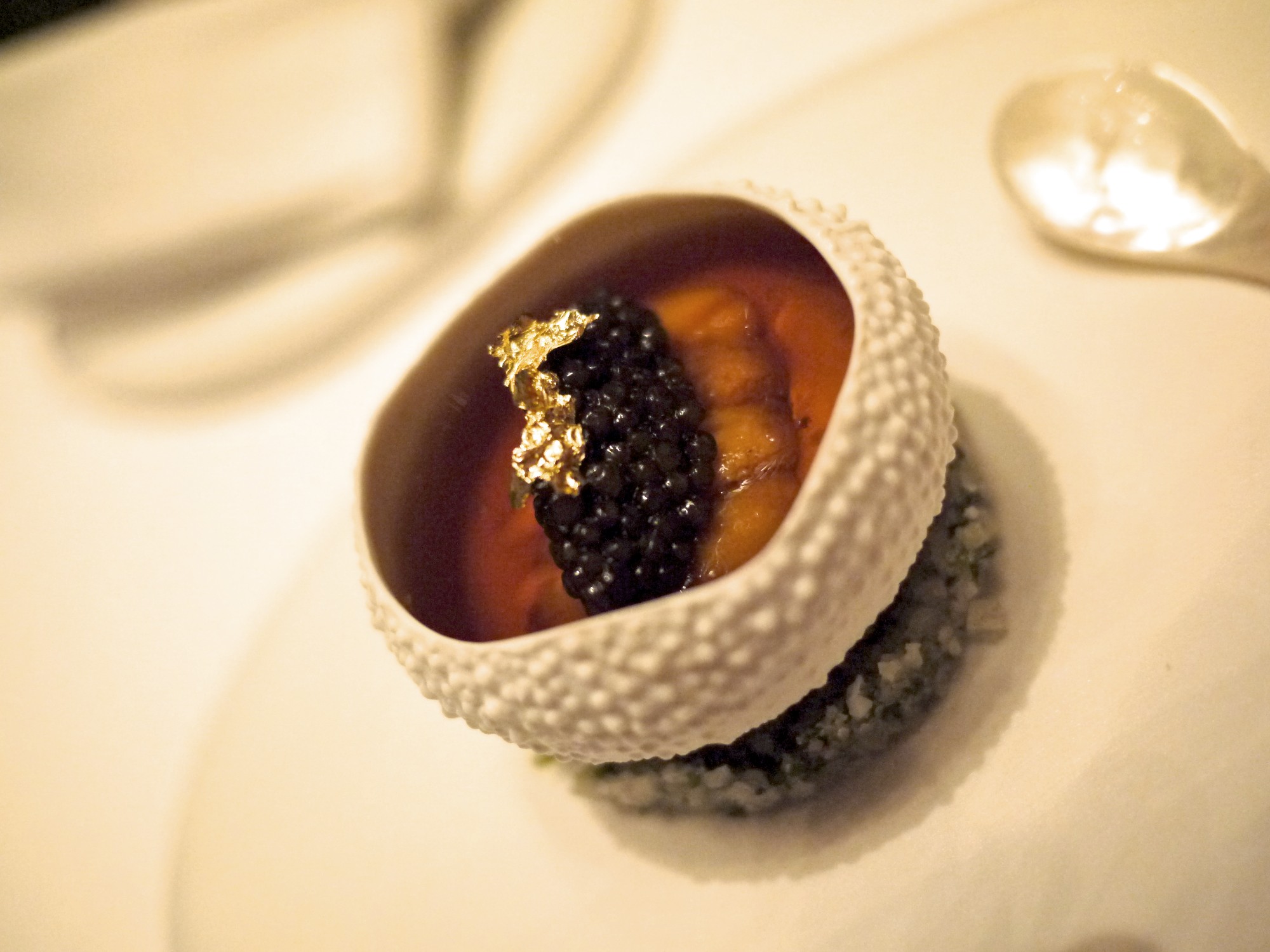
Further impressive was the signature dish of the Hokkaido sea urchin, which was served in a lobster jelly with cauliflower purée and a quenelle of black caviar. The balance between the lobster jelly, which set a canvass of the flavour of the sea, the elegant and creamy sea urchin, and the salty black caviar was flawless. Moreover, unlike typical exported sea urchin, this one was fresh from the day and did not contain any myoban which gives the bitter aftertaste. It was a delicious taste of the ocean that already justified my trip. 

P1130153

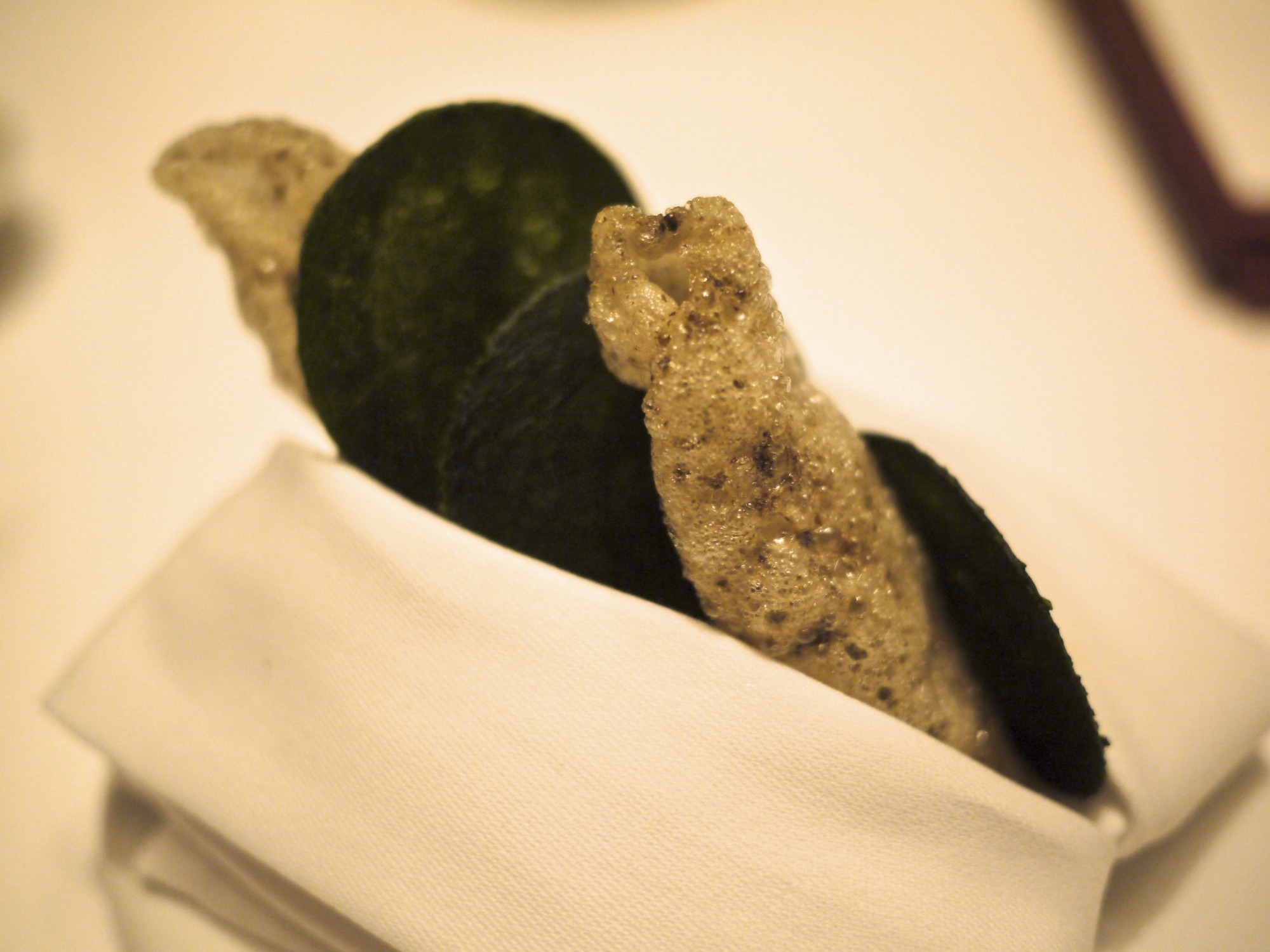
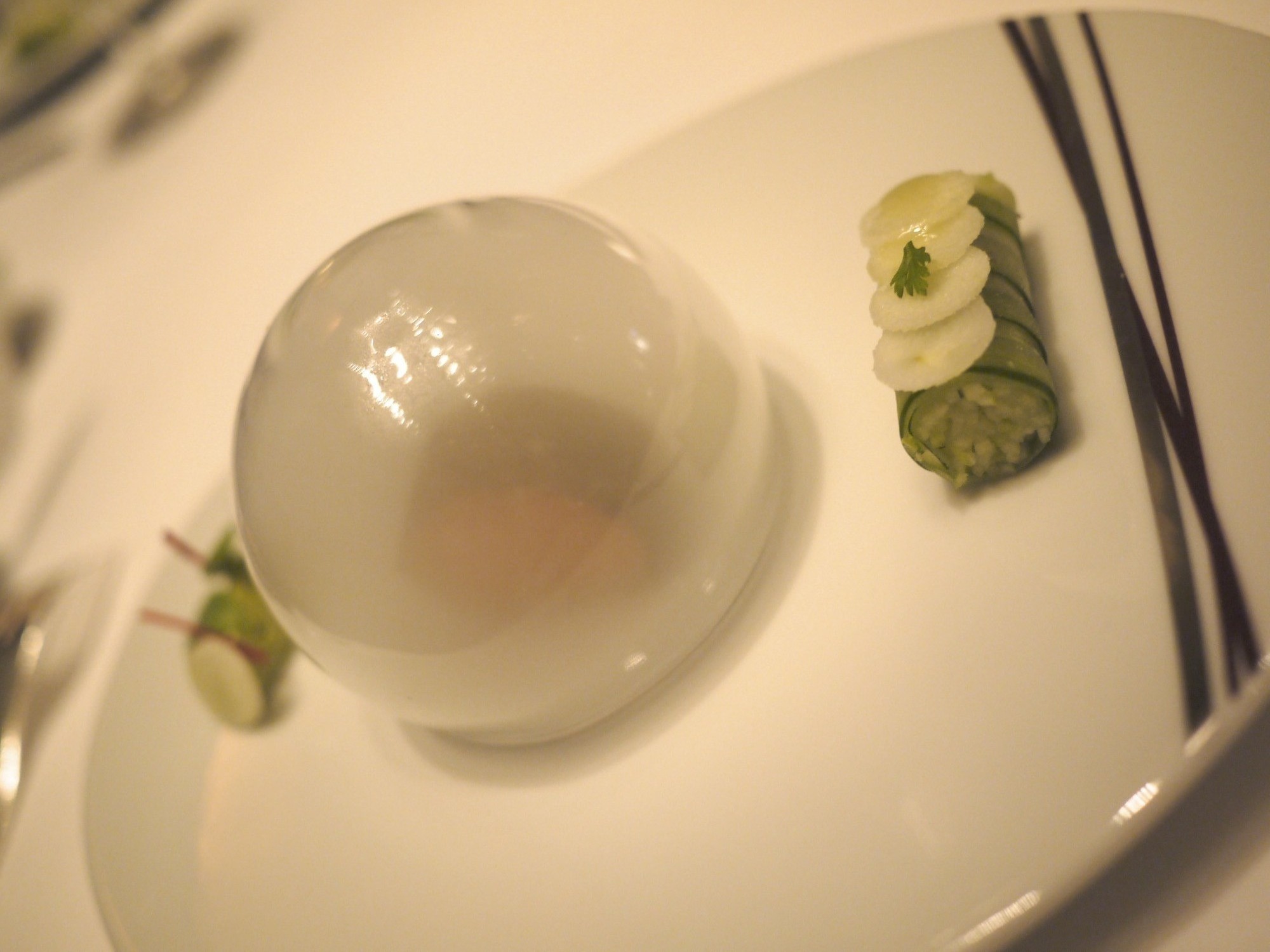
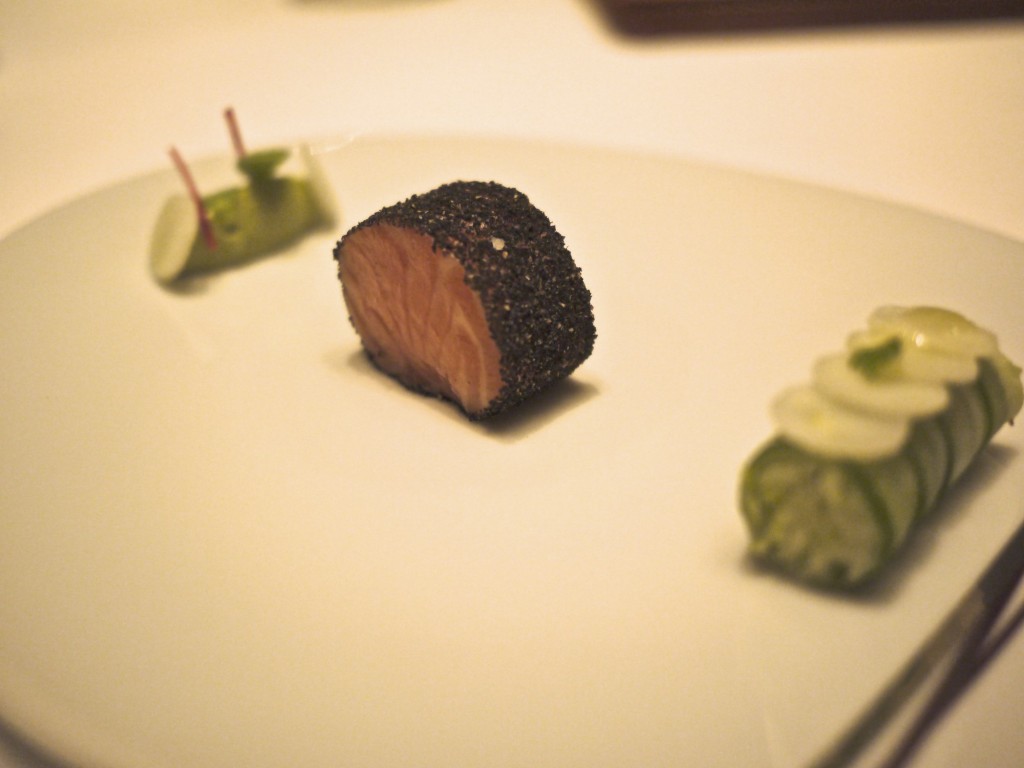
The sea urchin was served with crispy seaweed waffles on the side. P1130157 The Tasmanian Salmon was an inspired dish. The confit salmon was served as it was still being smoked in a glass bowl. As the bowl was lifted you could smell a lovely woody aroma, and what I thought was ingenious was the way in which Ekkebus infused the smoke into the dish by a second method of using the same glass bowl to serve the accompanying sake of NV Born Tokusen Junmai Daiginjo.

P1130164

The salmon was covered in squid ink and bread crumb coating and melted in your mouth with very little effort of chewing. I was worried the smoke was going to ruin the delicate salmon but that was unnecessary. The avocado purée and the granny smith apple wrapped in cucumber added some much needed acidity to cut through the salmon and lift the dish, and the horseradish was fortunately not overpowering but present on the palate. A very well balanced and clever dish that left me speechless!  

P1130168

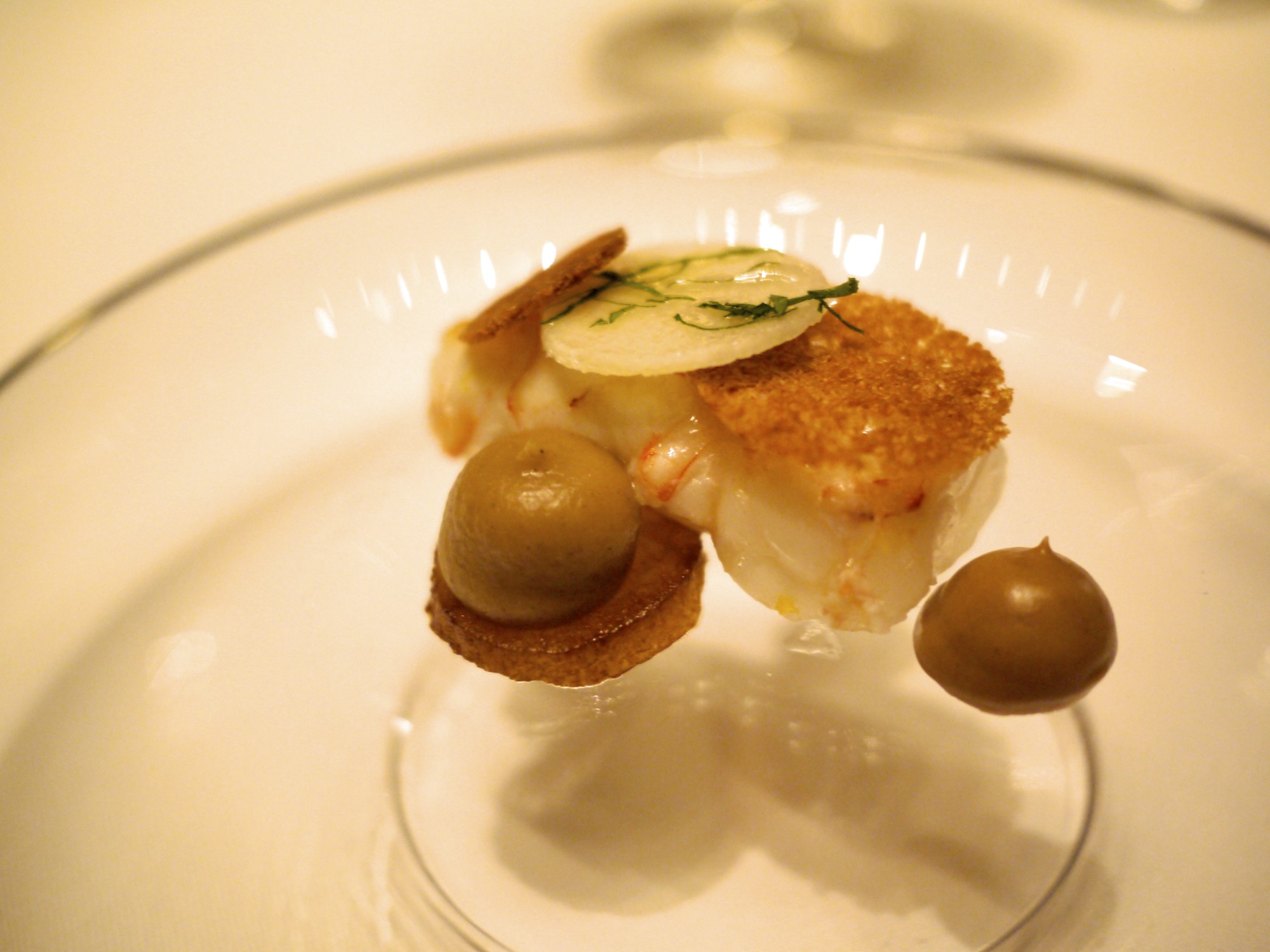
Langoustine seared with bergamot, dark roasted brioche, caramelized parsnip purée and raw “passe crassane” pear. The langoustine sourced from New Zealand was fresh and perfectly cooked with a beautiful juicy texture. The Italian parsley and bergamot made a significant difference to the sweetness coming from the parsnip purée and the pear and the textural element from the brioche completed the trifecta.

P1130179

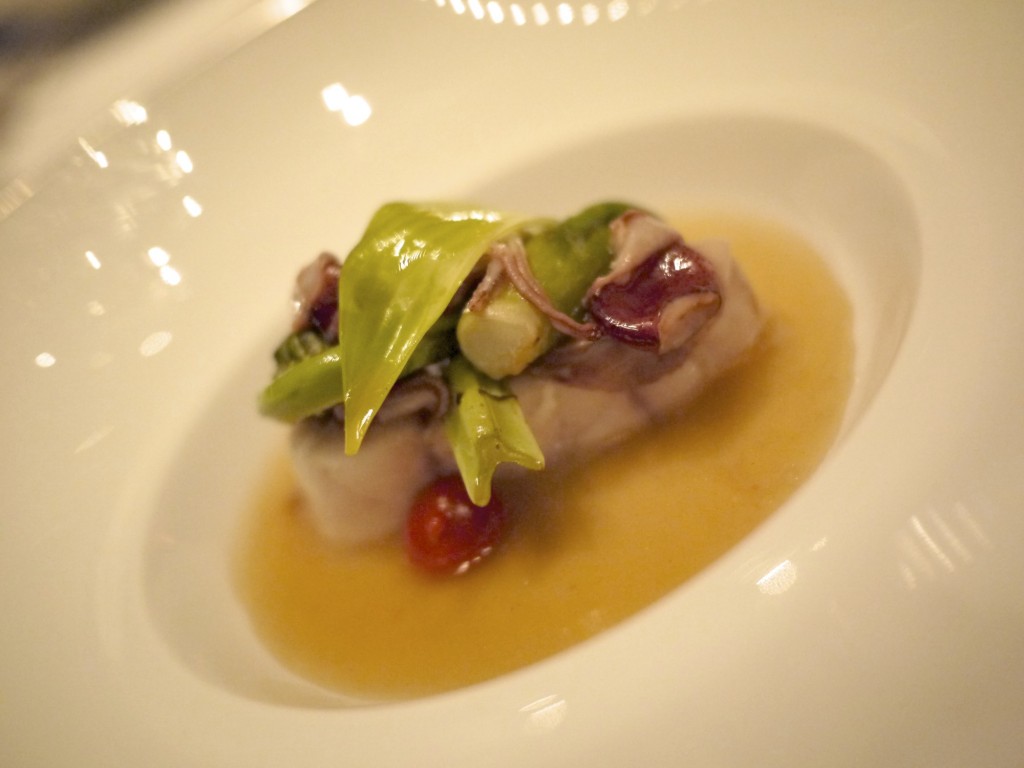
Takaba Grouper poached with tete de veau, barbecued bell pepper purée, seared firefly squid and spring vegetables from fukuoka. The purée went very well with the grouper and the vegetables had a good crunch to them. Whilst the fish was also good, I must admit it was far less exciting on the palate and visually compared to the preceding dishes. We felt a bit flat to finish the seafood segment of the dinner on the grouper but we were wrong… very wrong!P1130185We expected to be served our main meat course next but Chef Ekkebus decided to make a last minute change and incorporate one last seafood dish, which ended up being the best dish of the night! We were fortunate enough to have been served with an off-the-menu special course of the ‘ebisu’ oyster. This had been cooked in its shell at 67 degrees and was served with wilted tetragon, shallots, duck gizzard, pieds de moutons mushroom and vin jaune. It was truly a jaw-dropping dish that married European and Asian techniques, ingredients and flavours. I had never encountered this unique combination, which started off rich and deep from the amalgamation of the ingredients and ended with the clean finish of the oyster hiding underneath. My companion and I had no words to exchange other than the look of bewilderment and delight, interrupted only with nodding heads each time we took a bite!

P1130191

The subsequent course of the Kagoshima wagyu beef striploin with a purée of oven roasted Cevennes onion and braised short ribs was great but was a little overshadowed by the preceding course. Don’t get me wrong, I was quite impressed with the marbling of the beef and the four distinct preparations of the onion – puréed, thinly chopped, caramelized and pickled. I think it is fair to say that most meat dishes I have come across would struggle to follow the previous act.

P1130194

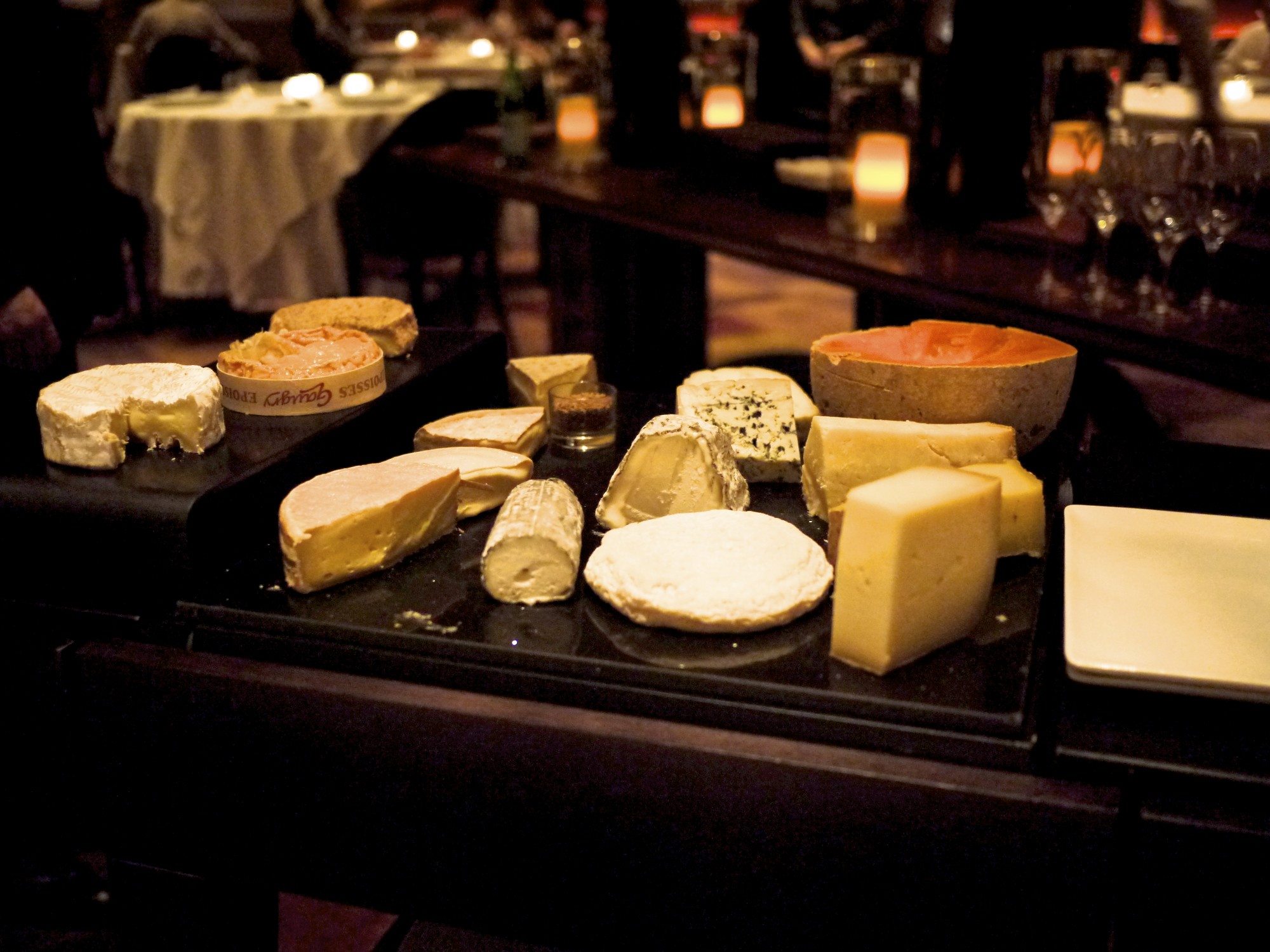
Similarly, I couldn’t argue with the quality of the cheese supplied by Bernard Antony. I was pleased to see a great selection of unpasteurized cheese including my favourite Epoisses and Mimoullete, nicely matched with a glass of a 2004 Luis Canas, Seleccion de la Familia, Rioja.

P1130201

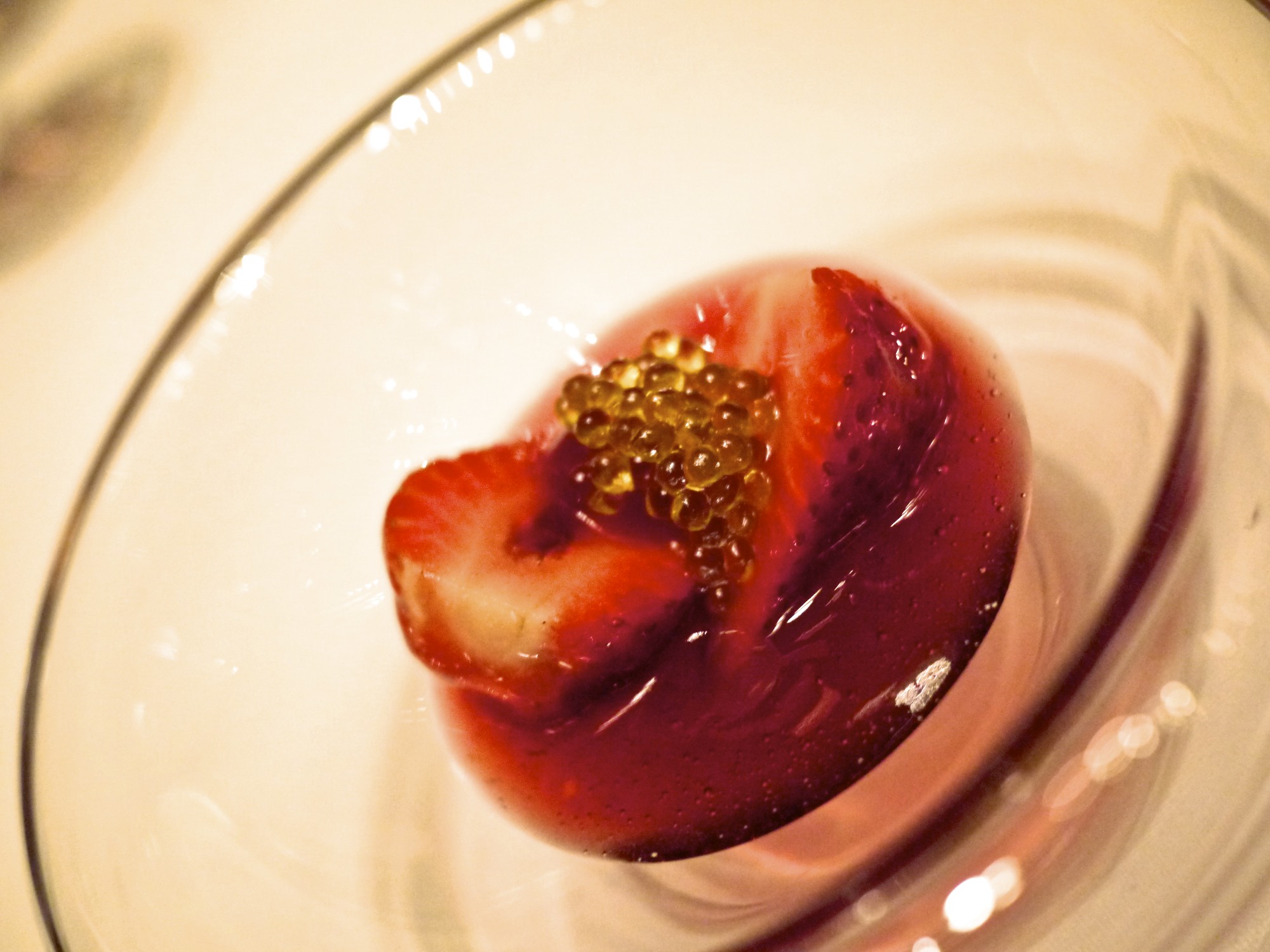
I didn’t quite know what to expect for the finale as a typically rich French dessert would have rather been disjointed to the fresh and light arrays of dishes I had thus far. I also feared that it would be difficult to follow the extraordinary dishes that had preceded it. However, the Amaho strawberry from Fukuoka, served in a hibiscus infusion, olive oil, Sichuan pepper and cassis granite was light, refreshing and nothing short of novel. The flavour from the strawberry was as impressive as the ones I had tasted in season in England and the Sichuan pepper added an interesting dimension of spice to the contrasting cold cassis granite.

P1130212

The finale of the tasting menu was an Abinao 85% chocolate soufflé served with a cacao sorbet on the side. Whilst chocolate soufflé is perhaps not construed to be the most original of dessert, the execution was against flawless and exemplified Ekkebus’ roots and skills in traditional French cuisine. The contrast of the flavour and differing temperatures of the melting chocolate and sorbet lifted this dessert to something more interesting, yet familiarly comforting. Naturally, the quality of the ingredients used to make the desserts made the difference as well.

P1130219

The petit fours looked amazing but I struggled to get most of them in as I was utterly full and exhausted from the culinary experience over the past four hours, not to mention the copious amount of wine that was paired with each course.

P1130222

While I expected possibly a few good dishes from this meal, I am always cautious when restaurants focus on foreign cuisines and flavours, given the obvious geographical disadvantage of sourcing the produce.  In this case however, I was blown away. Having tasted some of the finest Paris had to offer, I was quite taken by Ekkebus’ skills and ability to efficiently utilize and incorporate the wide array of Asian produces to his cooking style; the ebisu oyster being a perfect example. What’s more, I think many of us forget the importance of that balance between personable and professional service skills of the front of house that still remains absent in majority of fine dining establishments across Asia. This was something that Amber mastered with abundance, and they did so with a passion that was contagious. There’s so much Asia has to offer and I look forward to the discovery of other great produces through Ekkebus’ cuisine over the forthcoming years.

Exploring San Sebastian in search for the best Pintxos

P1120622The city of San Sebastian is synonymous with fine dining where one is spoilt for choice from various Michelin starred restaurants including Spain’s first 3-Michelin starred Arzak. Whilst fine dining was on our agenda, we surely could not leave this city without sampling some of the best pintxos that made the city famous in the first place. After weeks of researching into the casual dining scene, we came up with a pintxo route that allowed us to sample the specialities from various taverns.
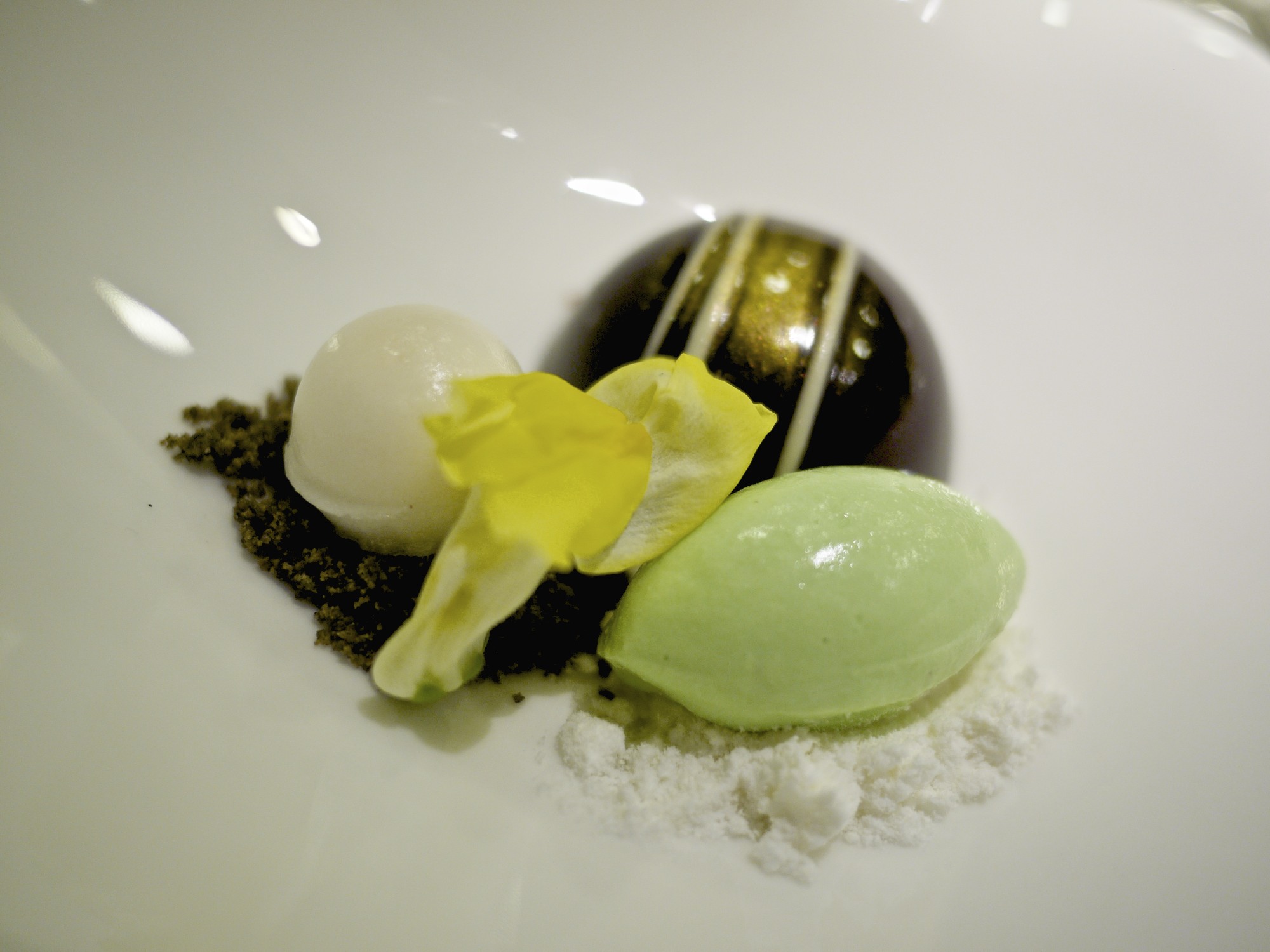
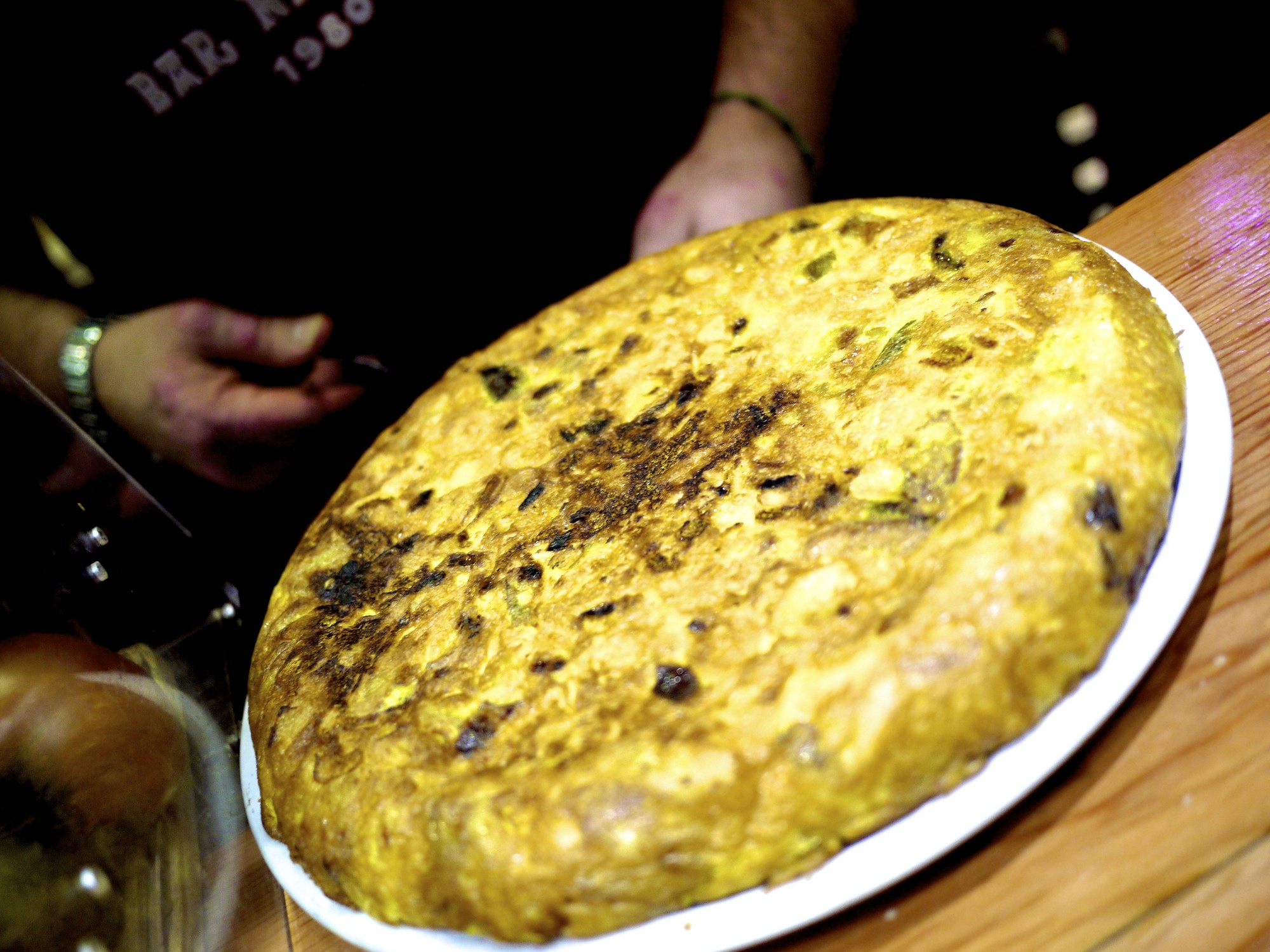
The Spanish are notorious for dining late but there is one tavern in San Sebastian which everyone has to arrive early in order to avoid disappointment. P1120624The tavern of Nestor on Calle Pescaderia, 11 serves the most amazing tortilla and tomato salad. Only a couple of tortilla’s are made every day at 1pm and 8pm, and we were lucky to have just made it in time to snap up the last three portions amongst four of us.

P1120628I’ve had my fair share of tortilla’s but this one was just superb. It was creamy, the seasoning was perfect and the layers of potatoes still held its shape and texture inside. The difference here was the caramelised onions which added depth to the flavour with it’s sweetness. What a great start to the evening!

P1120631Their tomato salad with olive oil and Maldon salt was so simple yet a perfect accompaniment to the tortilla. The tomatoes were so fresh and full of flavour, and the olive oil had none of the bitter aftertaste. Naturally, we were soon mopping the plate up with bread.

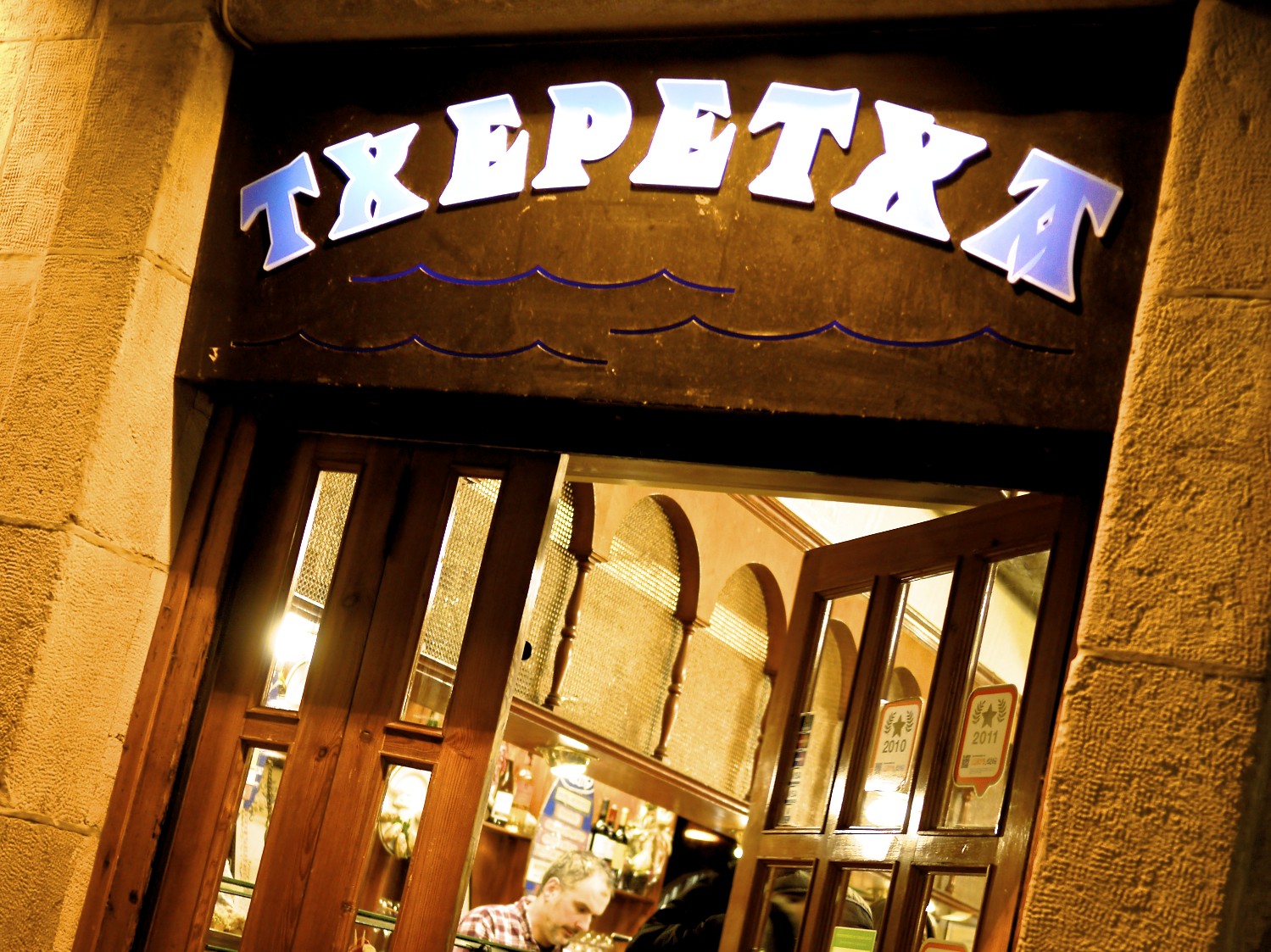
P1120634Our next stop, Txepetxa, is located on Calle Pescaderia 5, which is literally a few metres away. This place is all about the anchovy pintxos; to be precise there were more than ten dishes. I was curious to compare them to the famous ones from my mother’s town of L’Escala and they did not disappoint.

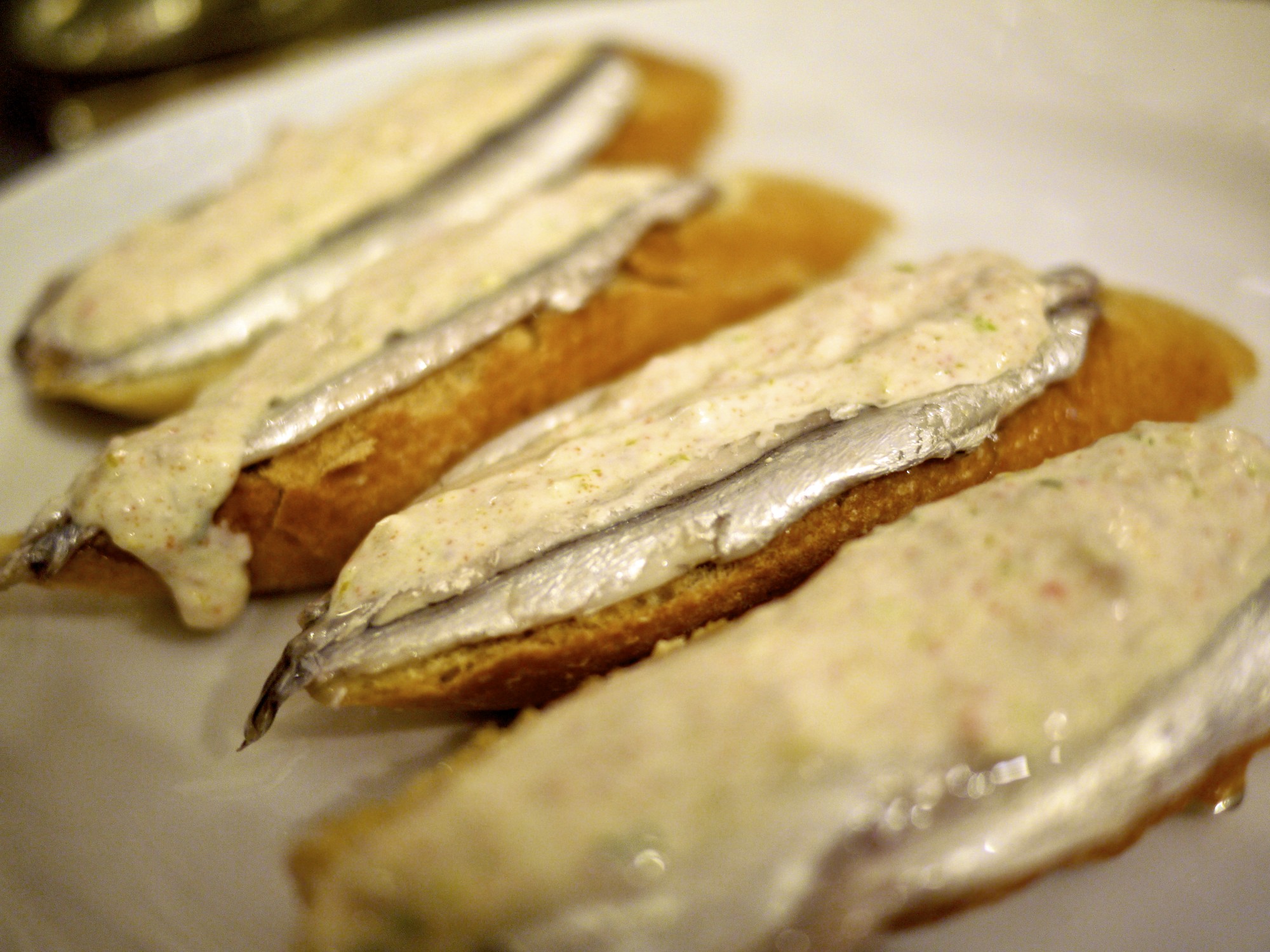
P1120637As we had a few places to visit this evening, we didn’t quite want to get full so early. We therefore decided to go for their famous anchovies with majid crab sauce, served on bread. The flavour of the anchovies that had been cured in vinegar really stood out and it was surprisingly unsalty. The crab sauce was so fresh and the slight seasoning from the anchovy brought the flavour out. This was definitely one of the highlight of the evening!

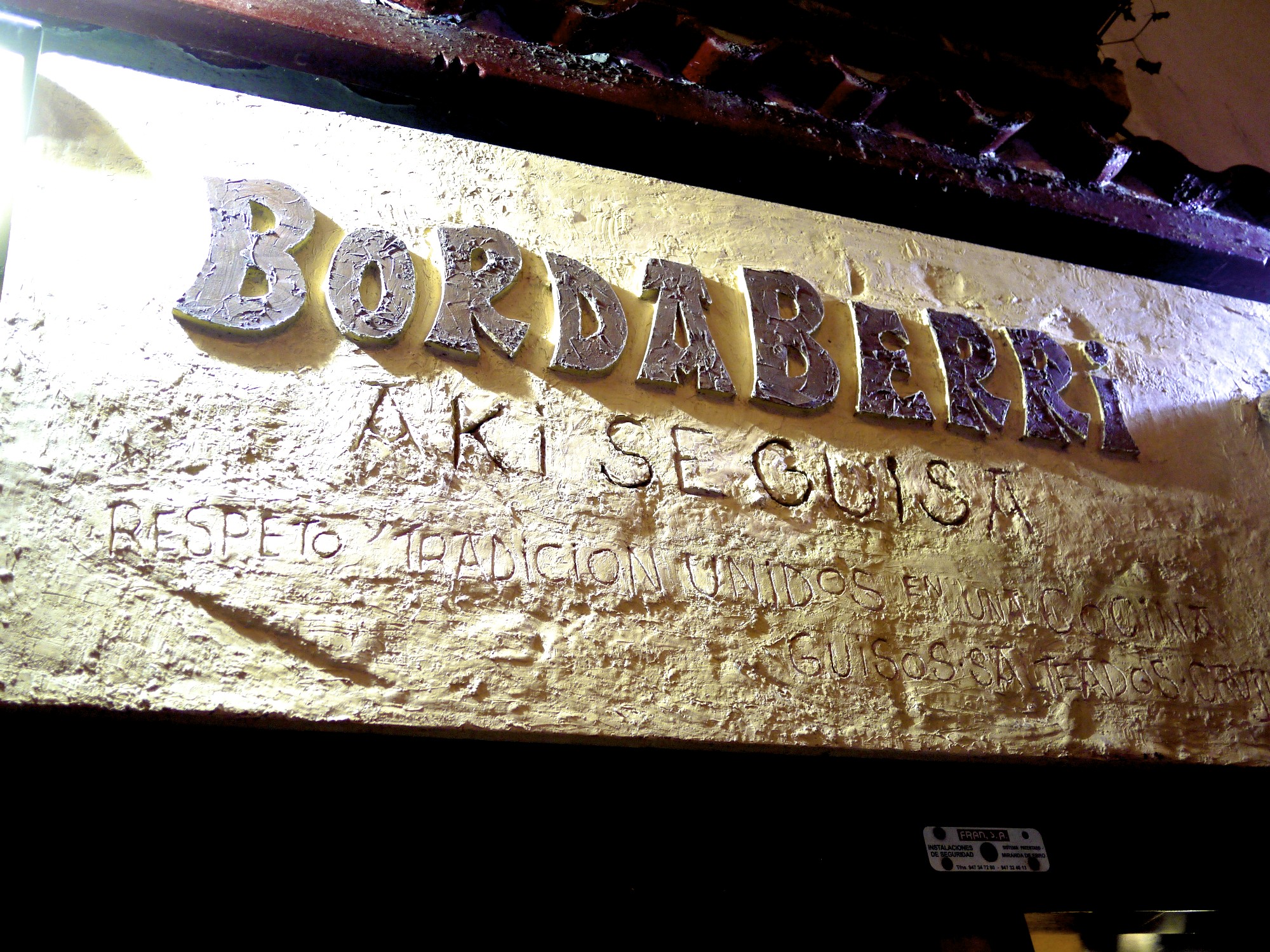
P1120640 On to Borda Berri at Fermin Calbeton 12 where I was told we would find the best meat course of the evening.

P1120643The veal cheek certainly was rich and soft in texture but I was rather disappointed to find it over seasoned. A glass of beer washed it down really well but this certainly was not as good as the one I had tried in Mas Pou in the province of Girona.

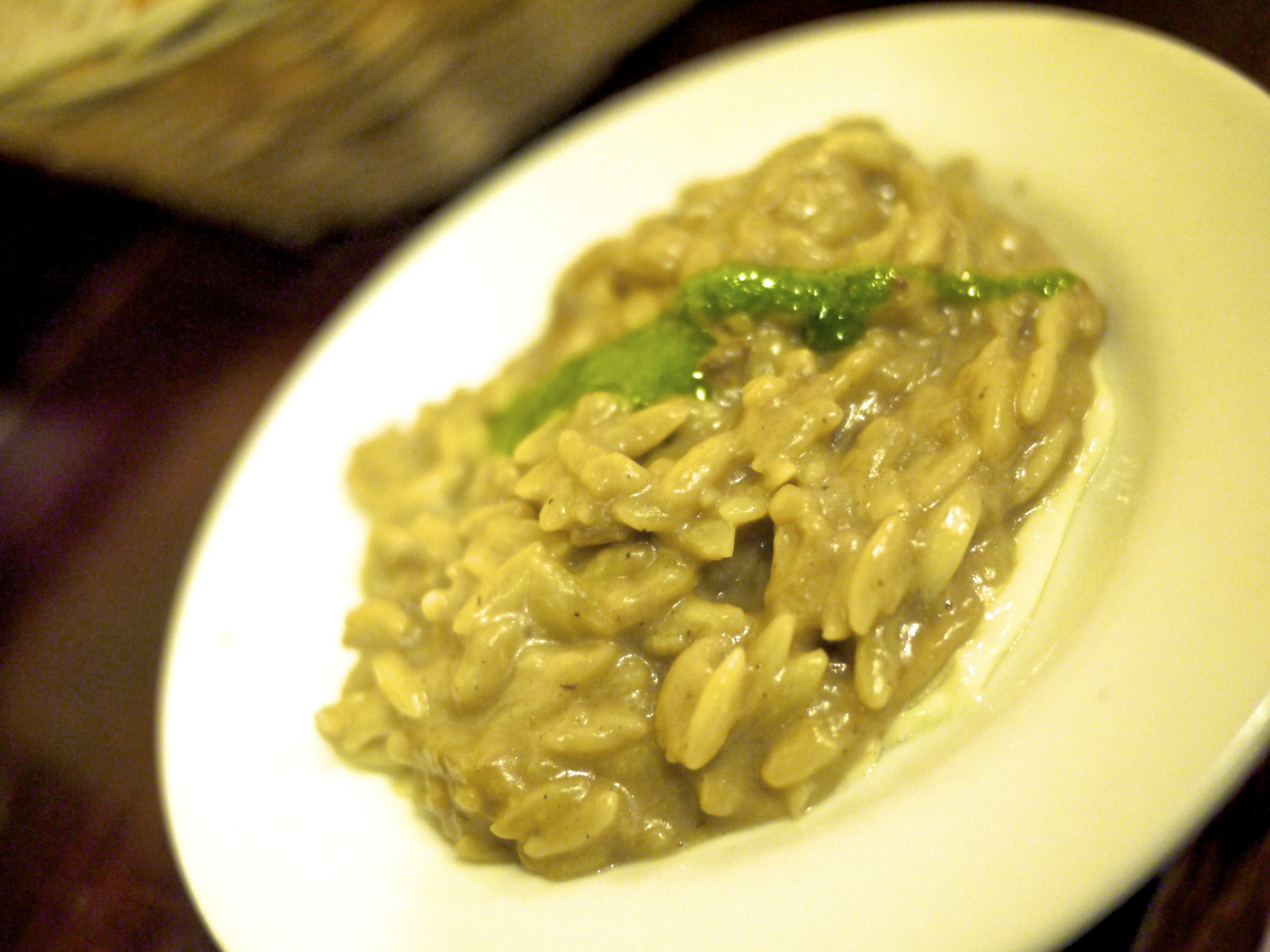
P1120644The mushroom risotto was much better. Similar to the cheeks, it was cooked perfectly with a bit of bite. The mushroom flavour really came through and I had no issue mopping this up.

P1120653After a somewhat mixed feeling, we headed over a few streets down to Ganbara on San Jeronimo Kalea, 19 to try their famous mushroom pintxos but we were unlucky to find out there wasn’t much left and the place was completely heaving!

P1120655I was still feeling quite thirsty from the cheeks so immediately ordered a bottle of local cidre before deciding on what to eat.

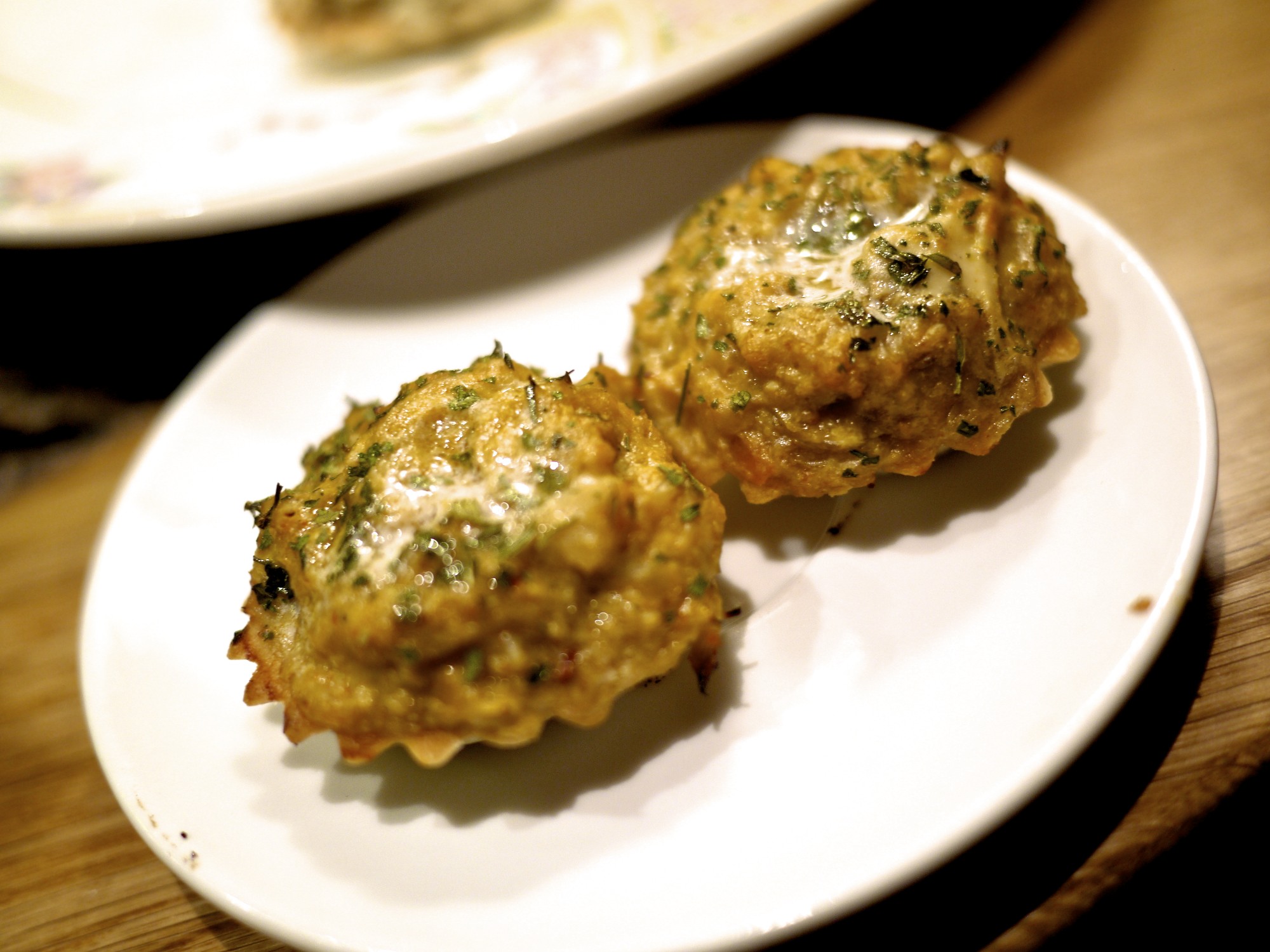
P1120659After much deliberation, we made the right choice by opting for the sea crab tartlet which was warm and full of flavour. The size was perfect for one bite as it was oozing out of the crust.

P1120664

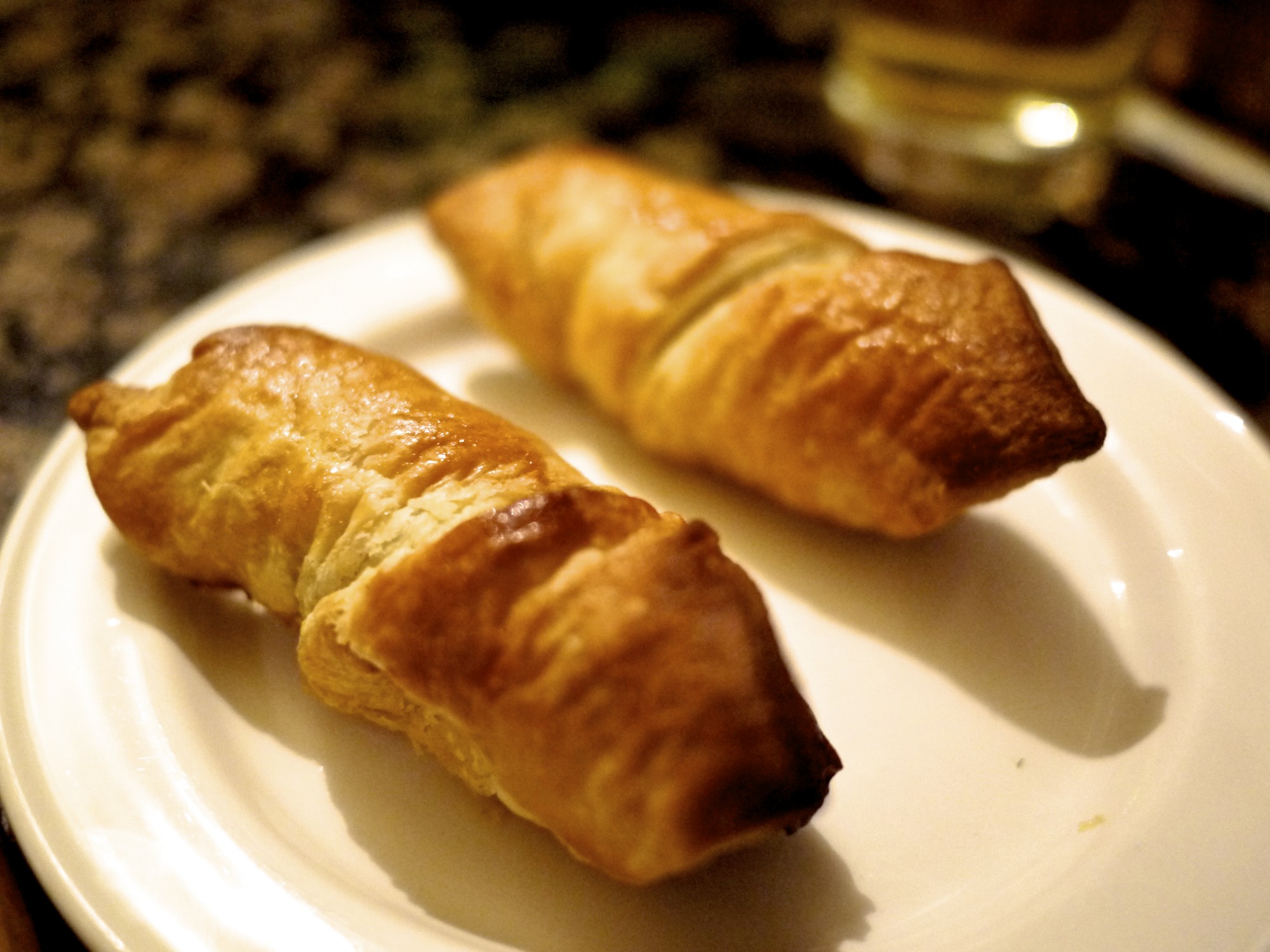
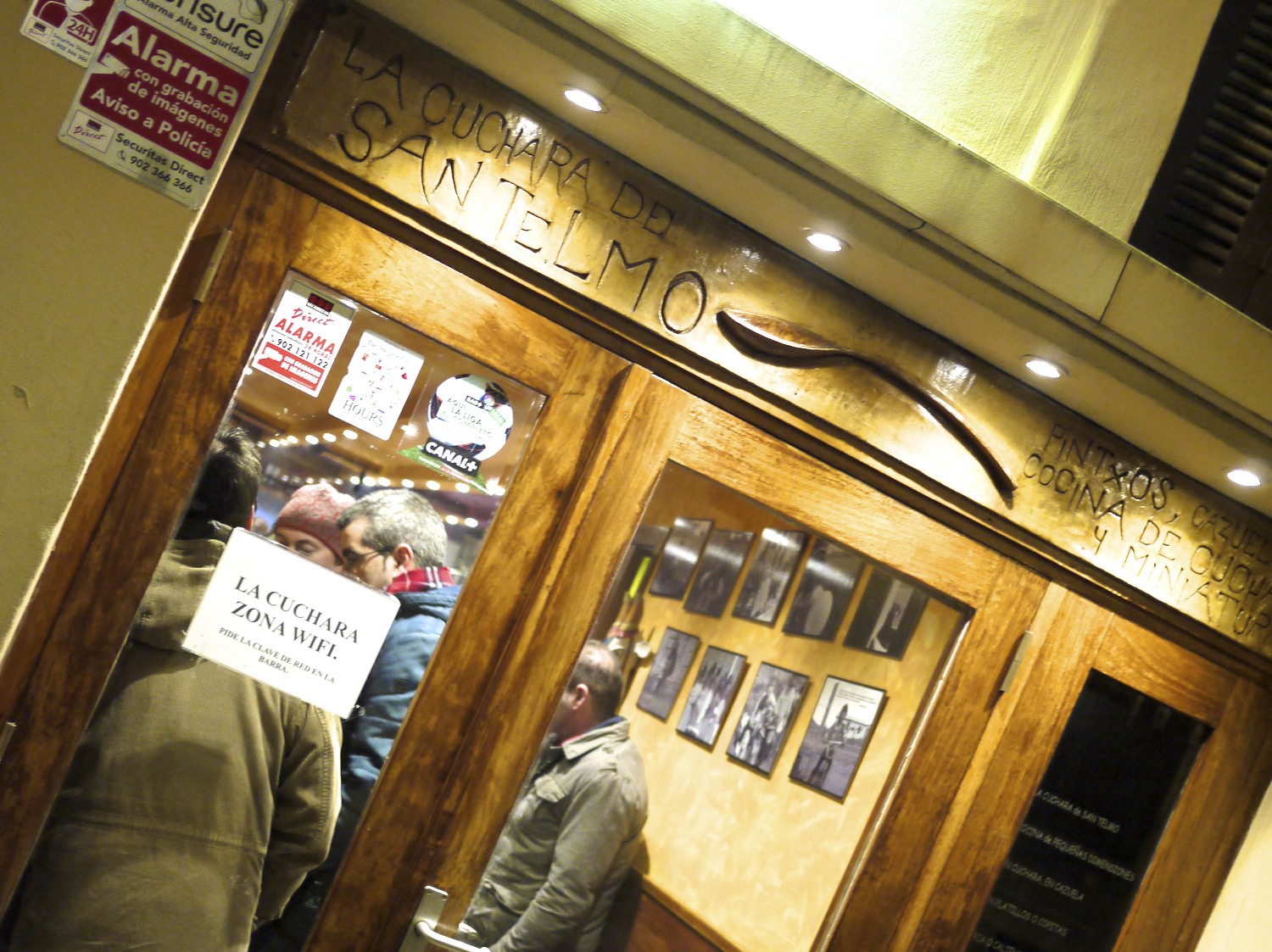
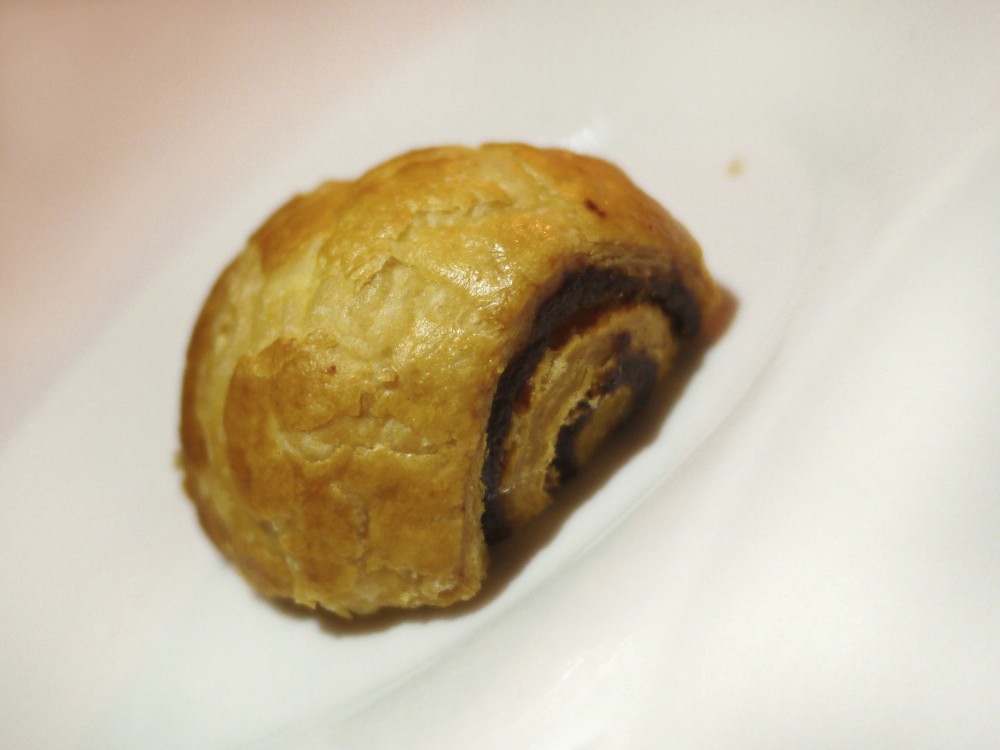
And some chistorra (fast-cured sausage from the Basque region) in puff pastry. It was served fresh from the oven and the spiciness of the sausage was just right.P1120670A more modern approach to pintxos at la Cuchara de San Telmo at Calle 31 de Agosto, 28.

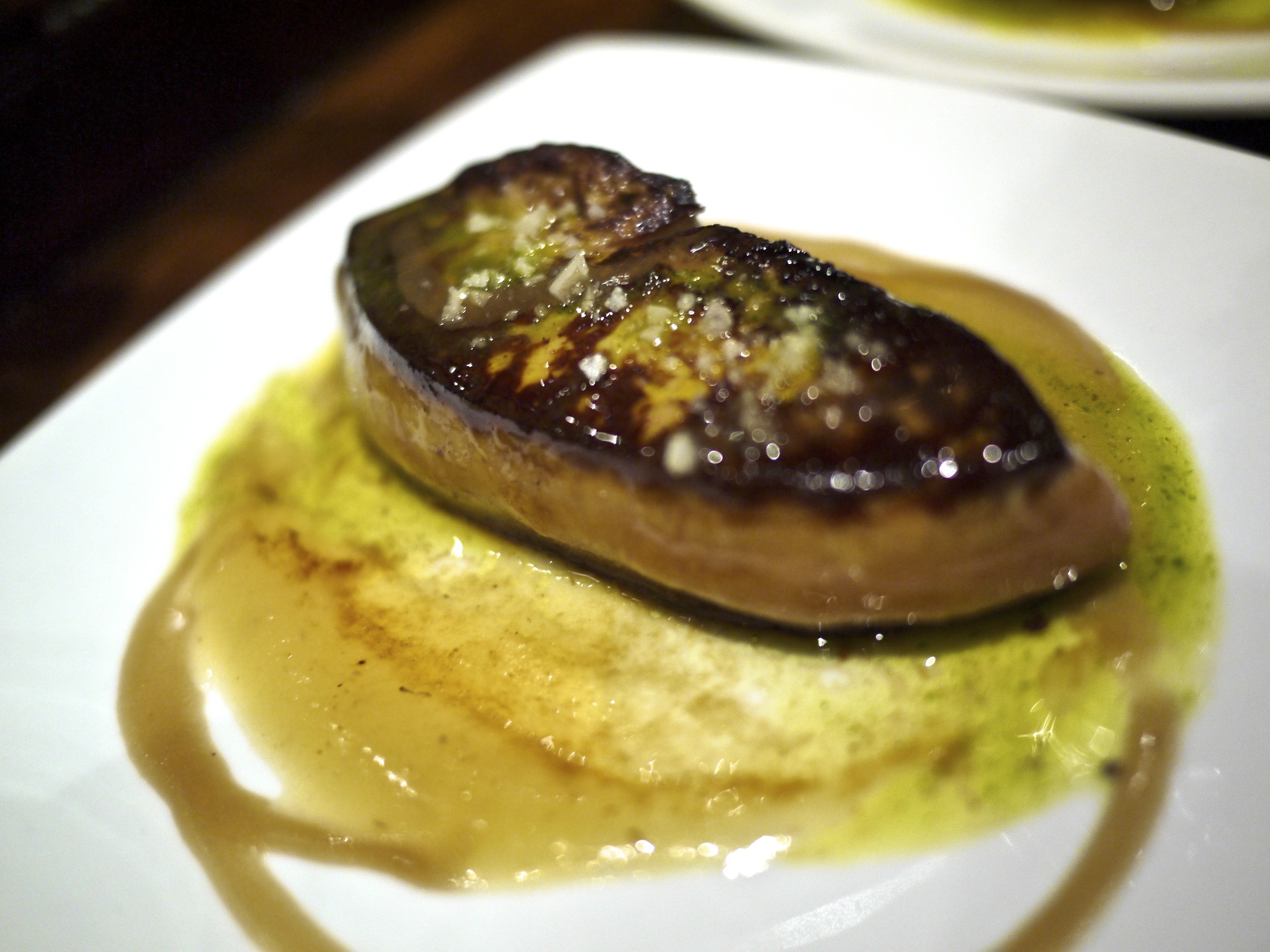
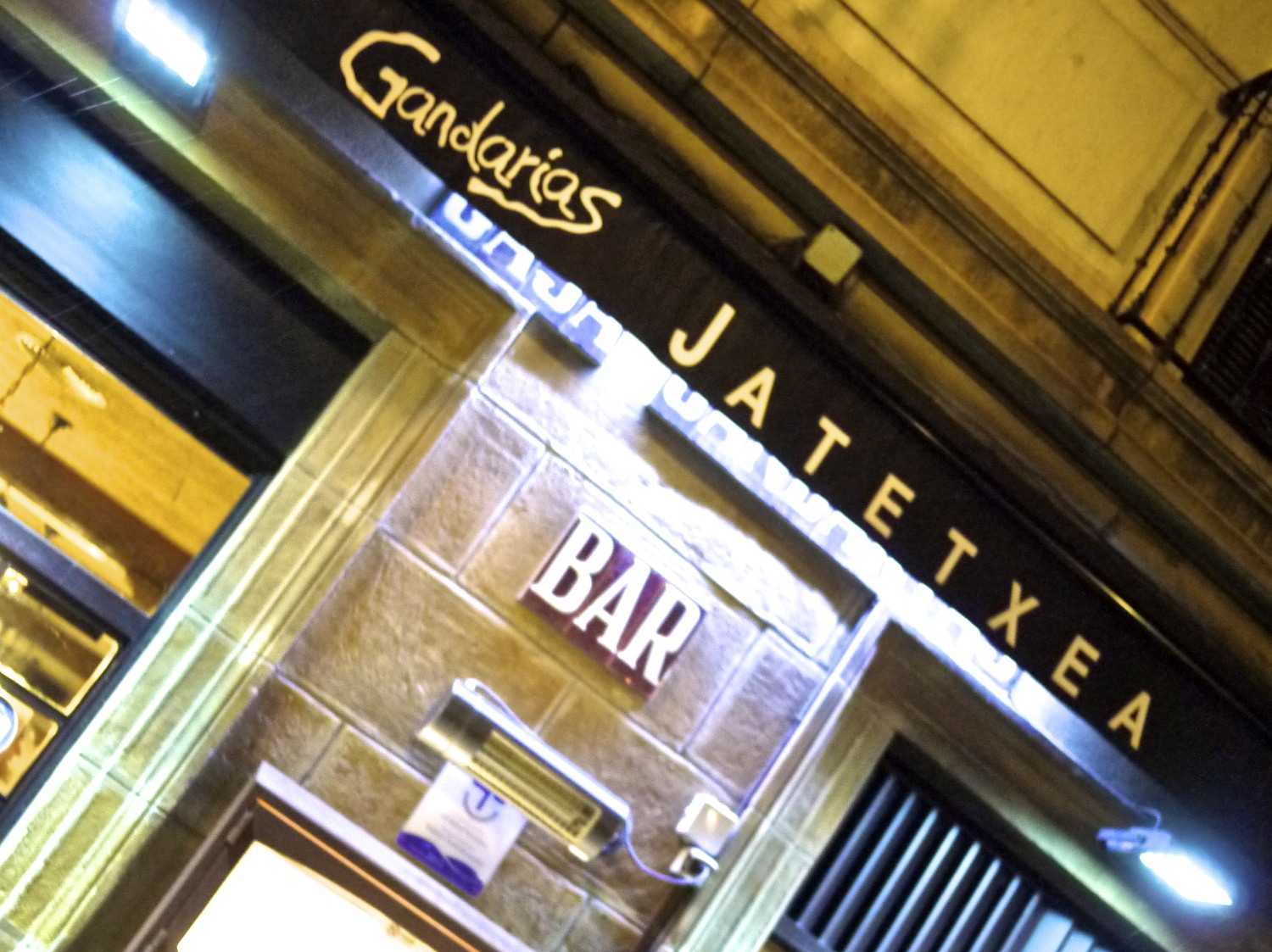
P1120669The seared foie gras with a green apple jelly was very good and I was astonished to find it was so reasonably priced at 3.60 euros only (Feb 2013)! It was great to see that luxurious ingredients were affordable to everyone in San Sebastian. The apple jelly was perfect to cut through the foie.P1120684Unfortunately, the last place on our list A Fuego Negro, which serves kobe beef mini hamburgers was shut! Luckily a local overheard us conversing in Spanish and gave us a few more recommendations. Had it not been for her we would have walked straight past Gandarias Jatetxea on Calle 31 de Agosto 23, which is famous for steaks.

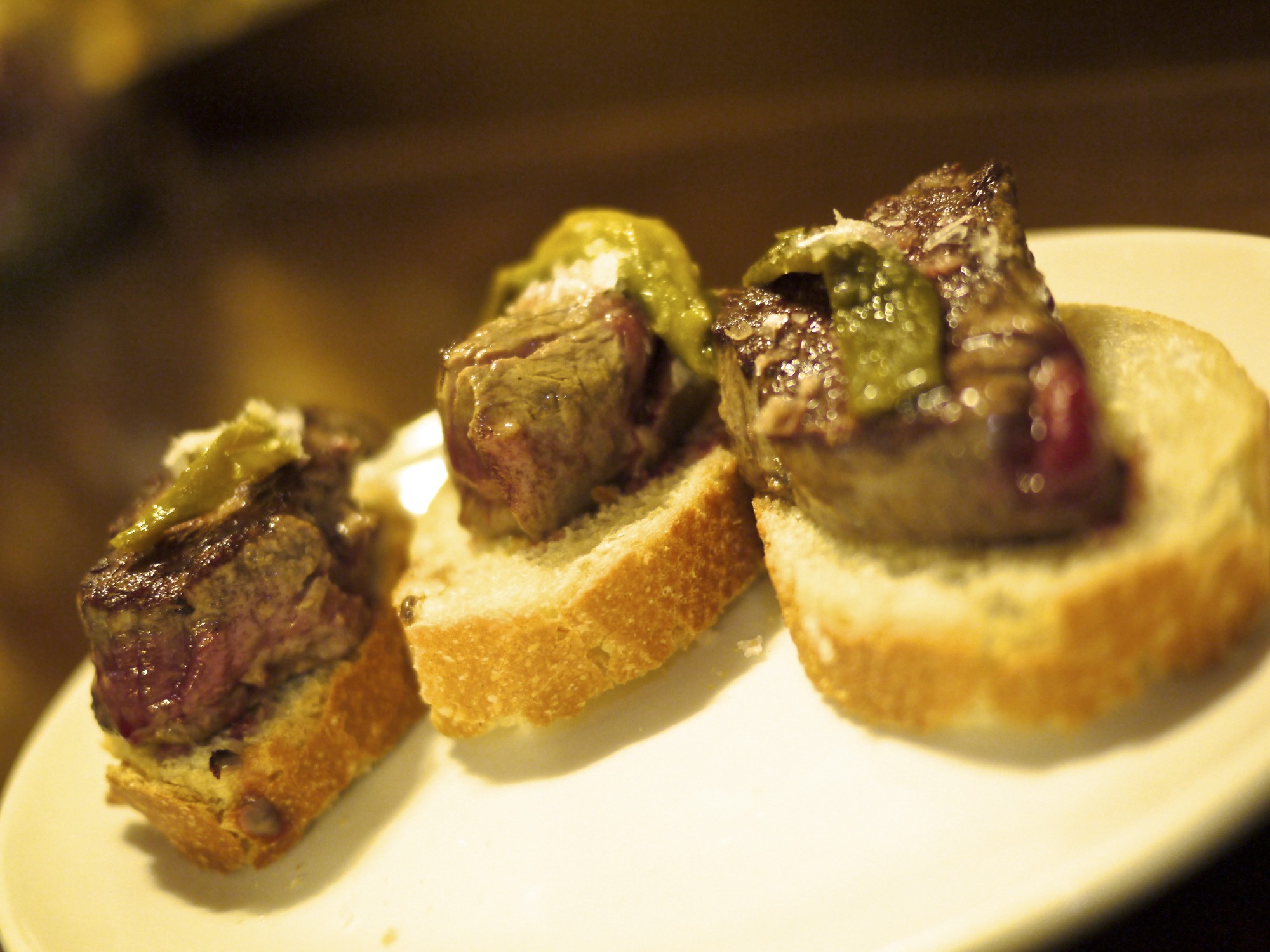
P1120679We were quite full at this stage, or so we thought, and opted for the solomillo (sirloin) with green peppers on bread. The meat was so soft and cooked exactly the way I like my meat; medium-rare. This was so good we decided to stay here and order another three pieces each before heading to a bar for some cocktails.

I can see why so many people flock to this city for the humble pintxos. Although the concept of pintxo dining is very casual and laid back, the locals here take food very seriously and it is evident wherever you go. One could easily spend a week here and hardly make a dent to trying all the amazing restaurants the city and the surrounding region has to offer. The solution? Move there permanently of course!


In search for Asia’s Best Pastry chef at 2am: Dessertbar

P1100416Chef: Janice Wong     Website: www.2amdessertbar.com      Cuisine: Avant Garde Dessert

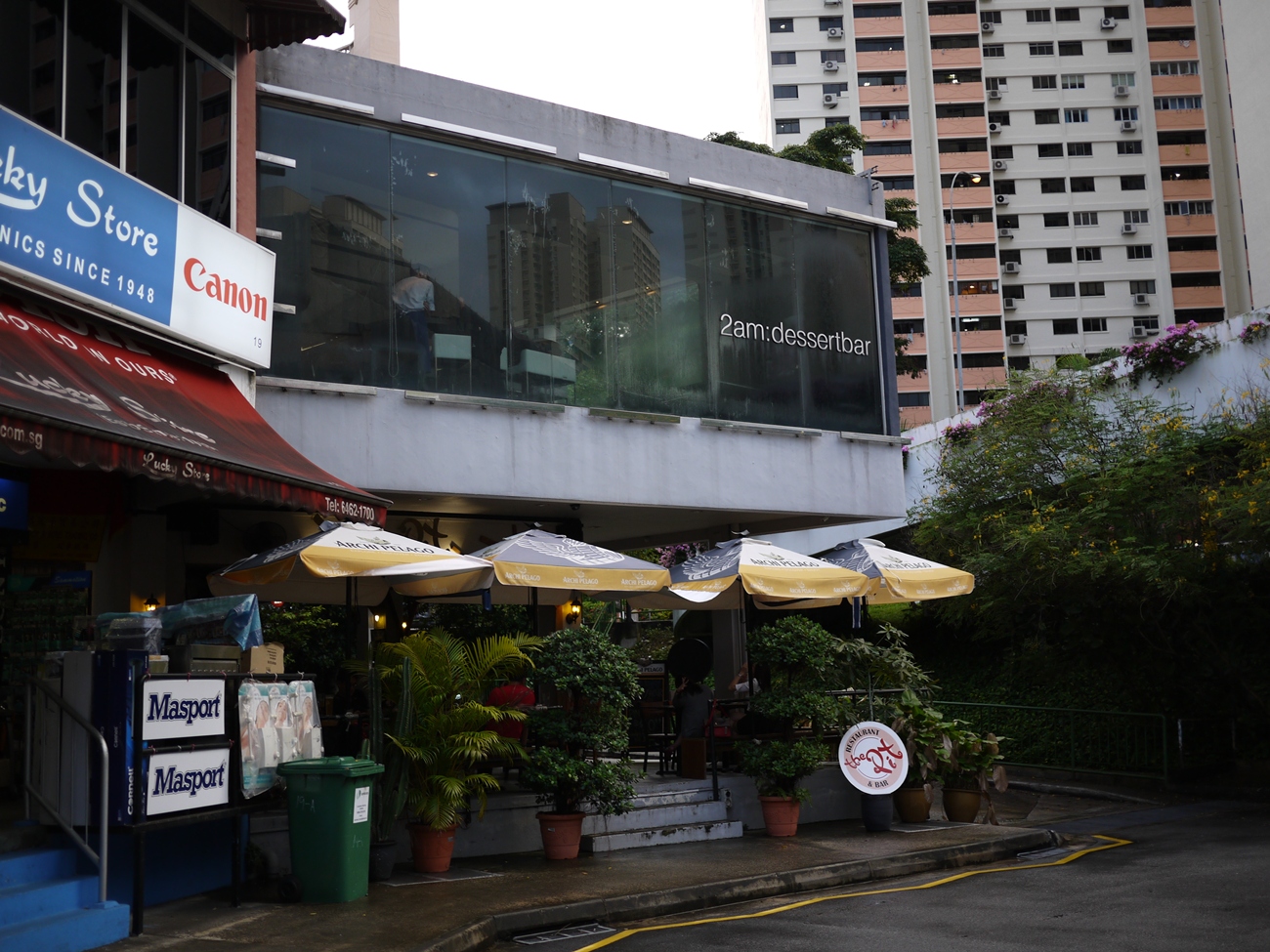
Something very exciting has been happening in the centre of the upmarket area of Holland village in Singapore. Her name is Janice Wong, a young and dynamic chef who’s trained at some of the world’s best restaurant including Per Se and Alinea, and she’s been running the 2am Dessertbar since 2007. Chef Wong has continued to hit the headlines, having been appointed as ambassador to modern Singaporean cuisine, and more recently attaining the impressive title of Asia’s Best Pastry Chef 2013. With such accolades at such a young age, I surely could not leave without checking this place out, and who better than Fine Dining Explorer to join me as I found out he was in town for a couple of days!

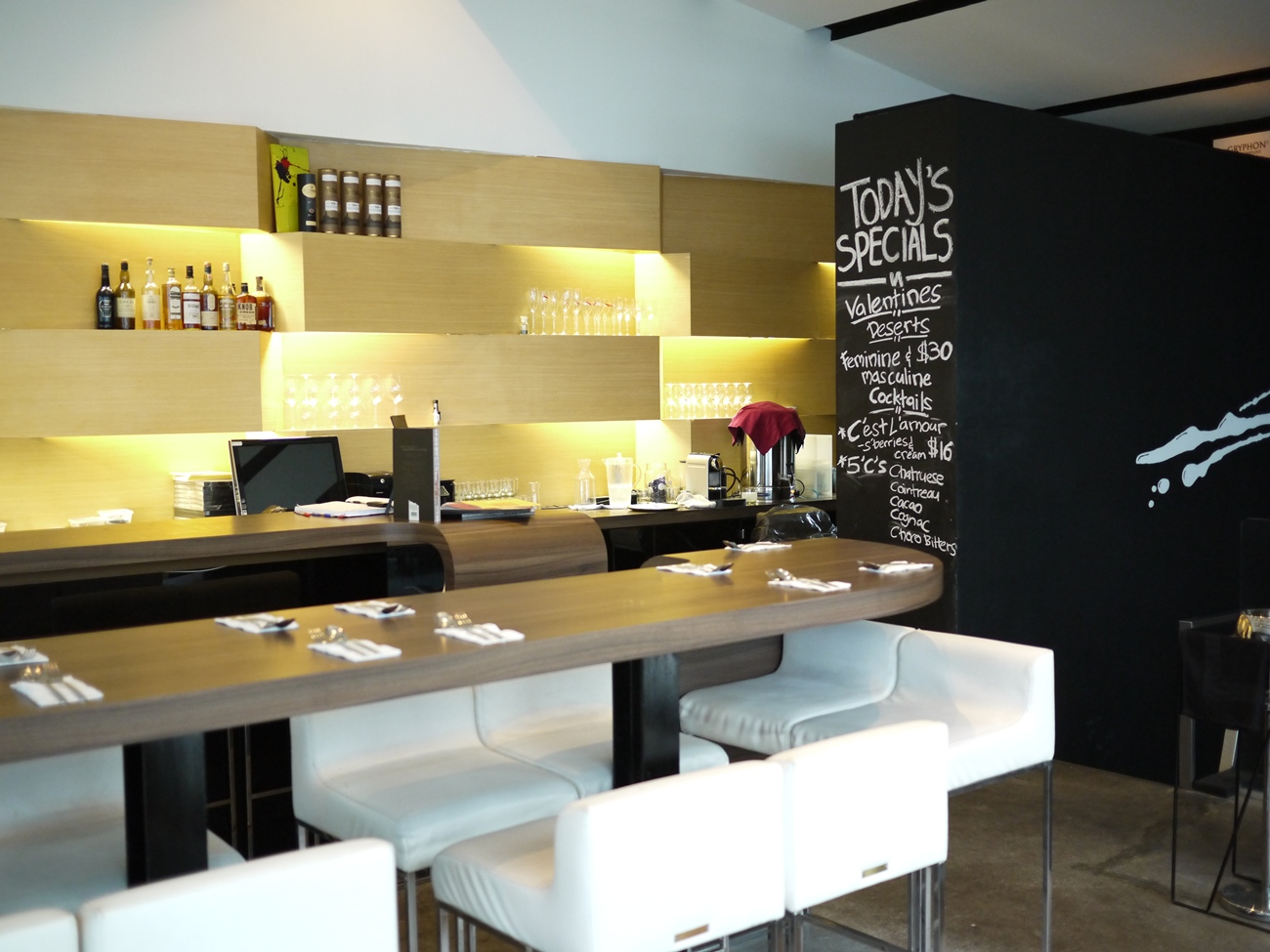
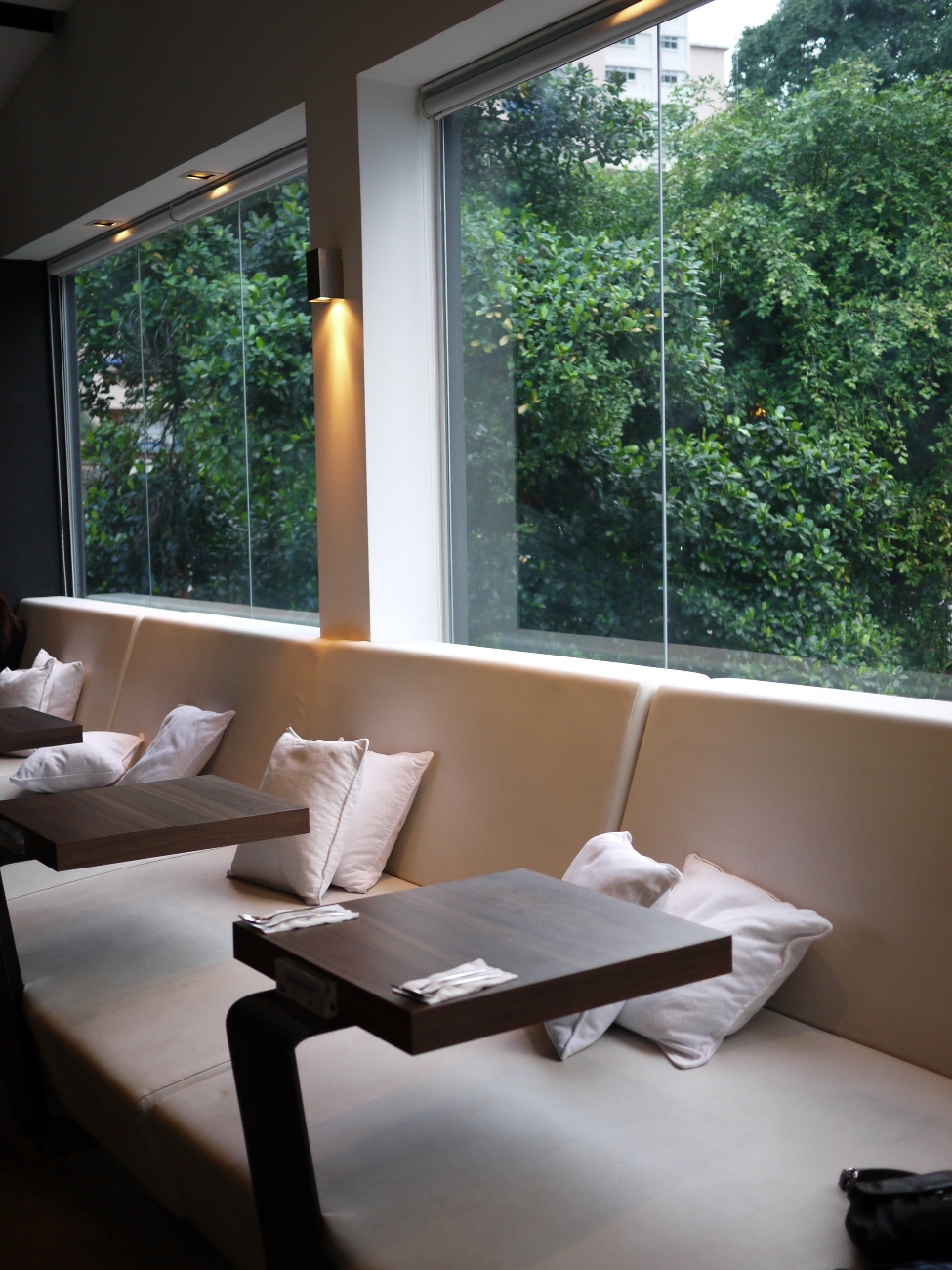
P1100424The establishment essentially offers trendy desserts with wine pairing, with a small selection of savory dishes. How often does one find a sommelier dedicated to desserts? There was a choice of counter seats and long sofas on the side where you could lay down while having your dessert. Stylish, and we liked it.

P1100429Kayambe H20 – 72%MichelCruizel and Evian water, yuzu sorbet.

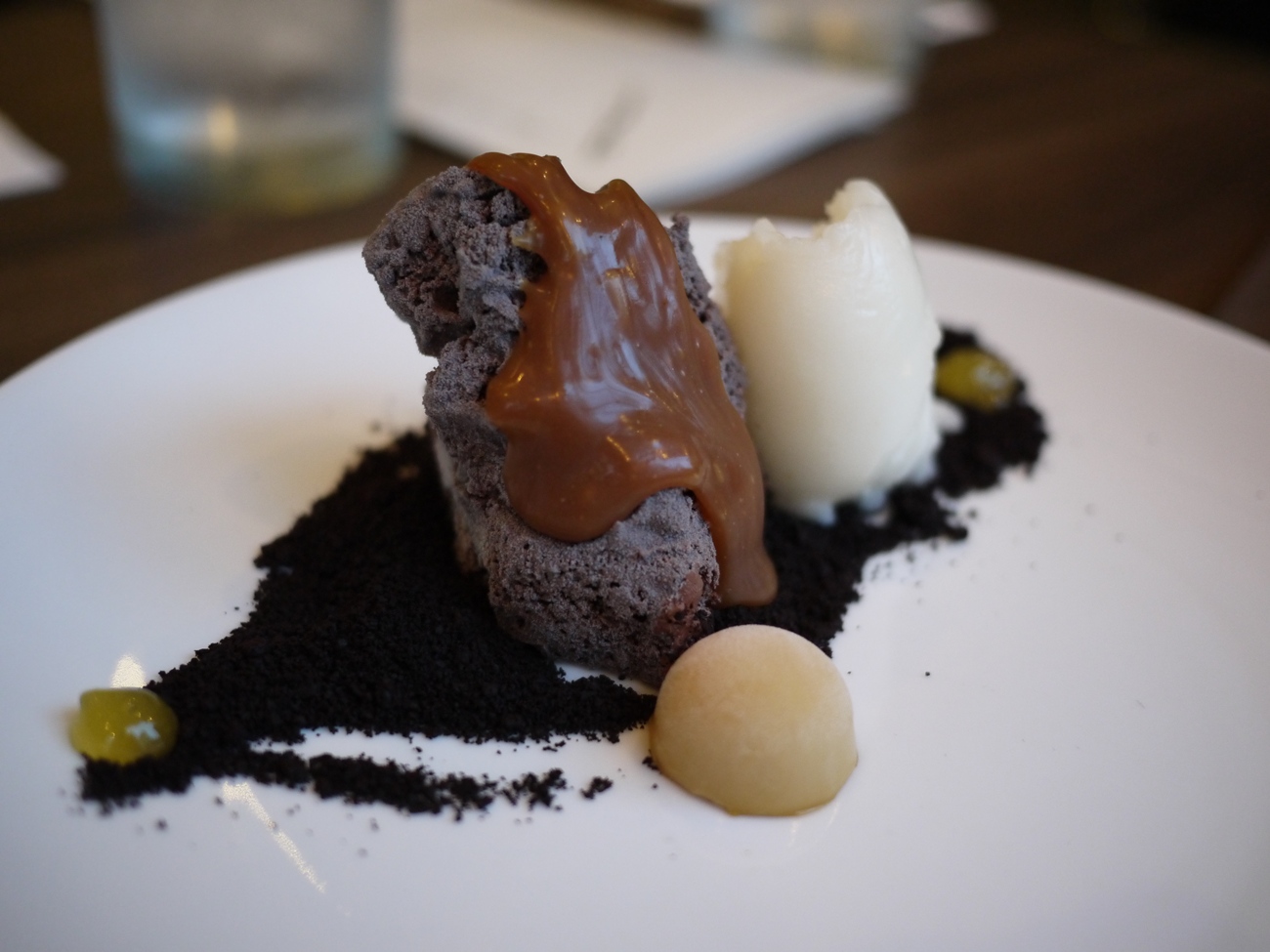
The solid was made using dark chocolate but lightened with water instead of milk. Not much sugar was used and it was quite bitter, although there was a hint of sweet element from the caramel that was drizzled on top. Initially we were concerned about the acidity of the yuzu sorbet to the chocolate, but no, the sorbet had a mild sweetness instead. I had some food envy but I was not disappointed with the choice of…

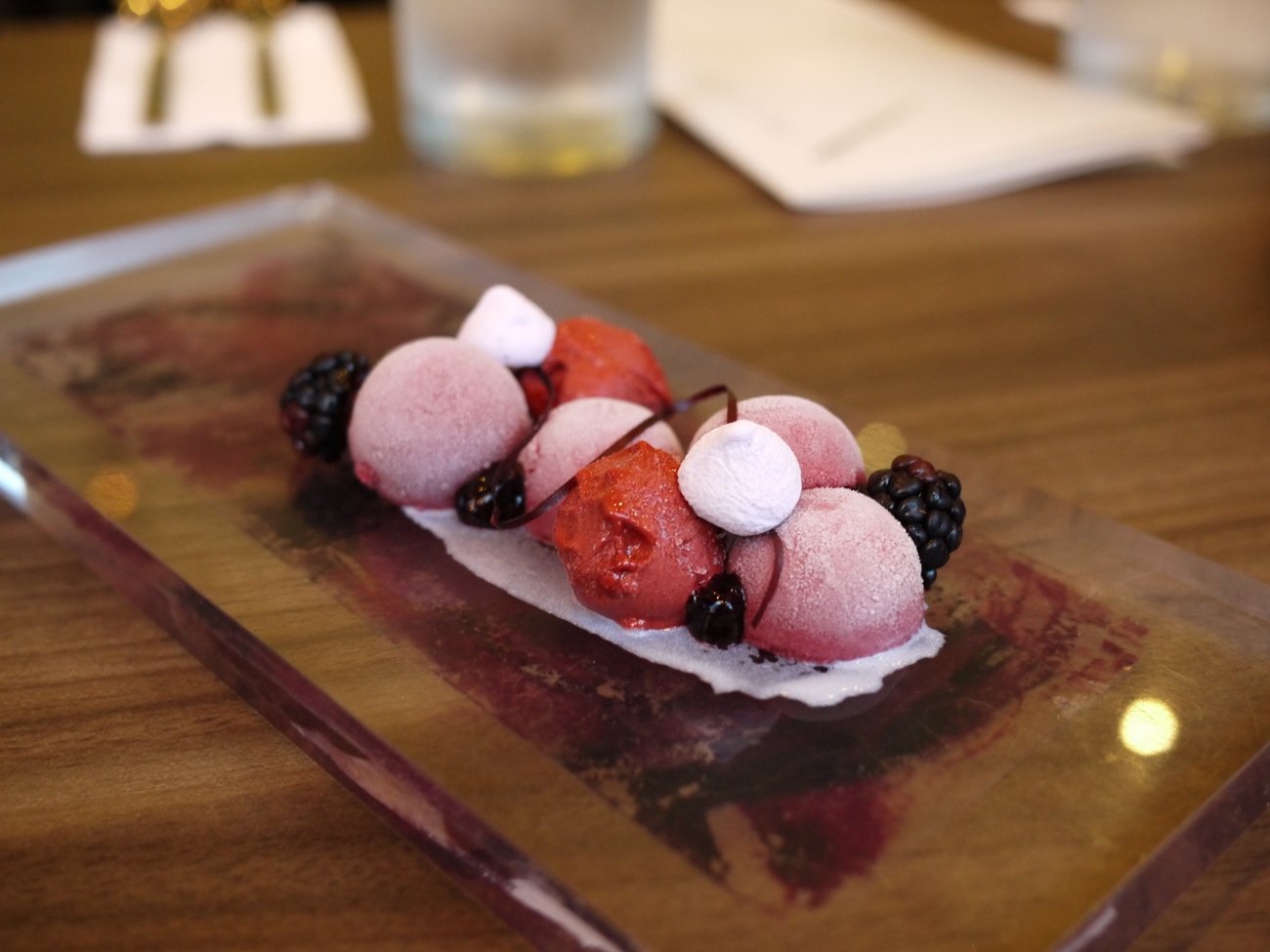
P1100433… Purple – Purple potato purée, blackberry parfait, lavender marshmallows, “fruits of the forest” sorbet.

The texture of the little domes of purple potato purée reminded us of mochi, which was quite interesting and unexpected. The marshmallow had an intense flavour and smell of lavender. Together with the concentrated blackberry parfait, it was a highly unusual but successful combination of flavour and texture, not to mention very refreshing.

P1100426We arrived promptly at 6pm so luckily there was no queue ahead of us, but as we were leaving we did notice a massive queue of people trying to get their hands on some of the tastiest treats in Singapore! A word of advice though, reservation is necessary after 9pm. It was a great little place, and I would certainly love to try more of these delicious and unusual creations the next time I am in Singapore. Unfortunately, we both had prearranged plans which we had to attend to but rest assured we’ll both be back soon…

This review was done in collaboration with Fine Dining Explorer


Amaroz, Tolosa

P1060094Chef: Unknown        Website: www.restauranteamaroz.es     Cuisine: Traditional Basque

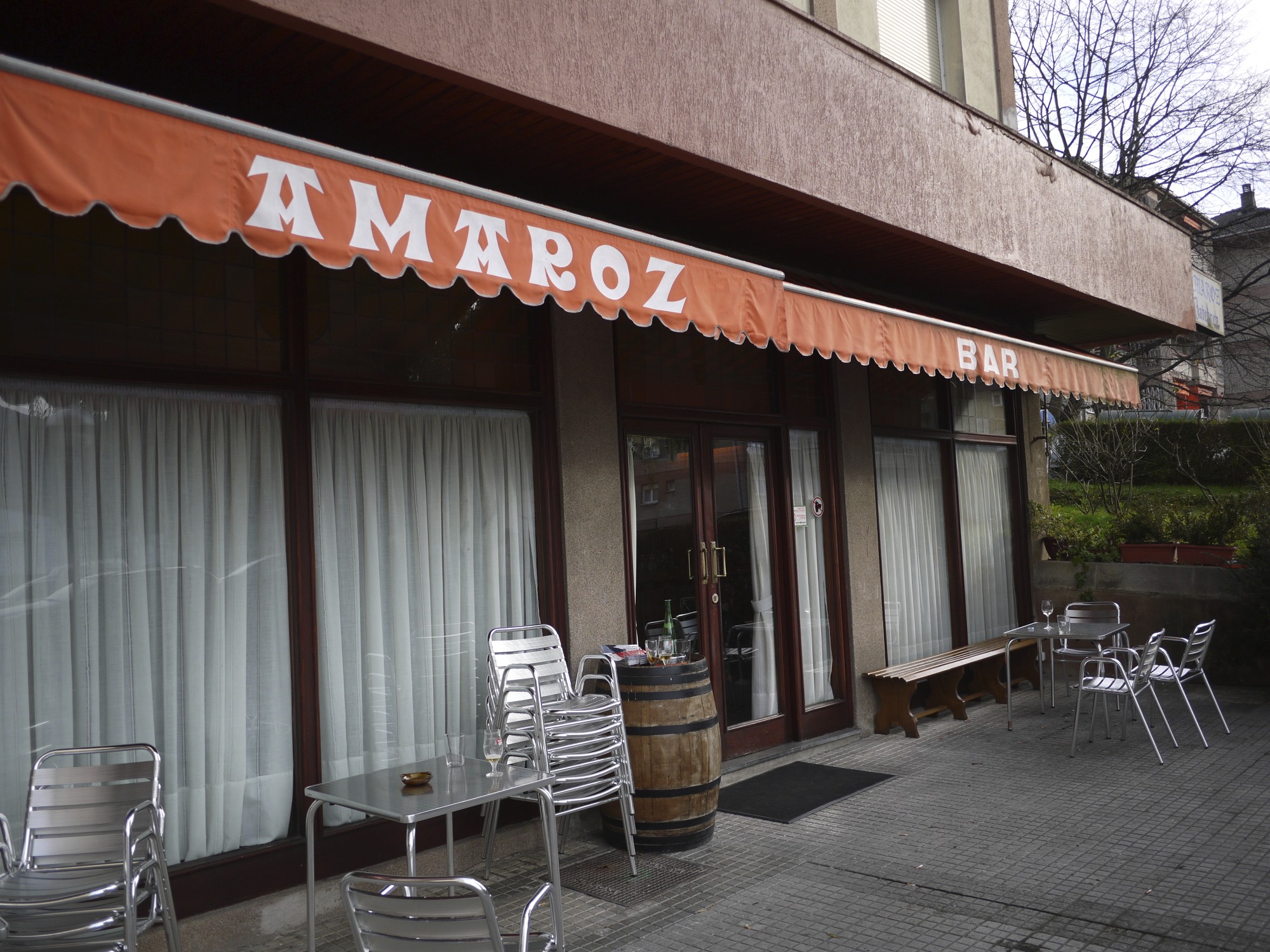
Every so often in my food travels I like to avoid the fine dinning scene and see what the locals are enjoying on a daily basis. Invariably, I come across a hidden gem that few outside have ever heard of, and Amaroz in the town of Tolosa is no exception. With a concentration of some of the country’s best restaurants in the nearby city of San Sebastian, I’m not surprised to see why this place has remained the locals well kept secret for the last 40 years.

P1060037When we first arrived there was no one else to be seen (the spanish eat notoriously late), however after a quick manzanilla as an apperitif, there was soon a rapidly growing crowd. The restaurant can cater up to about 50 people and requires booking in advance for the weekends. The decor was simple and plain but the proprietors were very welcoming. We started the meal with a glass of  the local favourite of Txacoli wine while enjoying our appetisers.

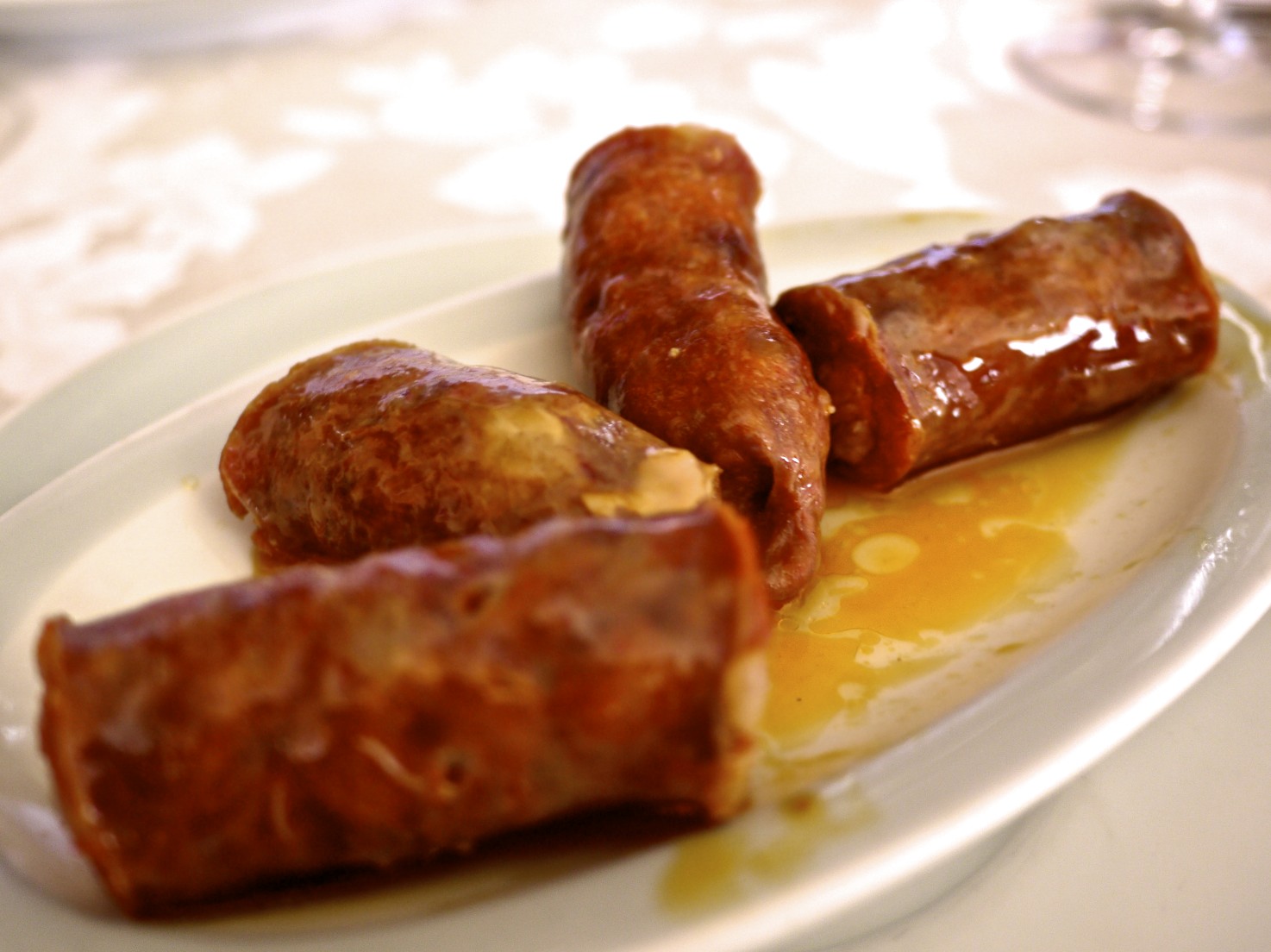
P1060043Some nibbles to start of with including chistorra a la sidra. The tender pork meat was pan-fried lightly and then simmered in cider which is slowly added but frequently. Mopped up with some bread, this was a delicious starter to whet your appetite.

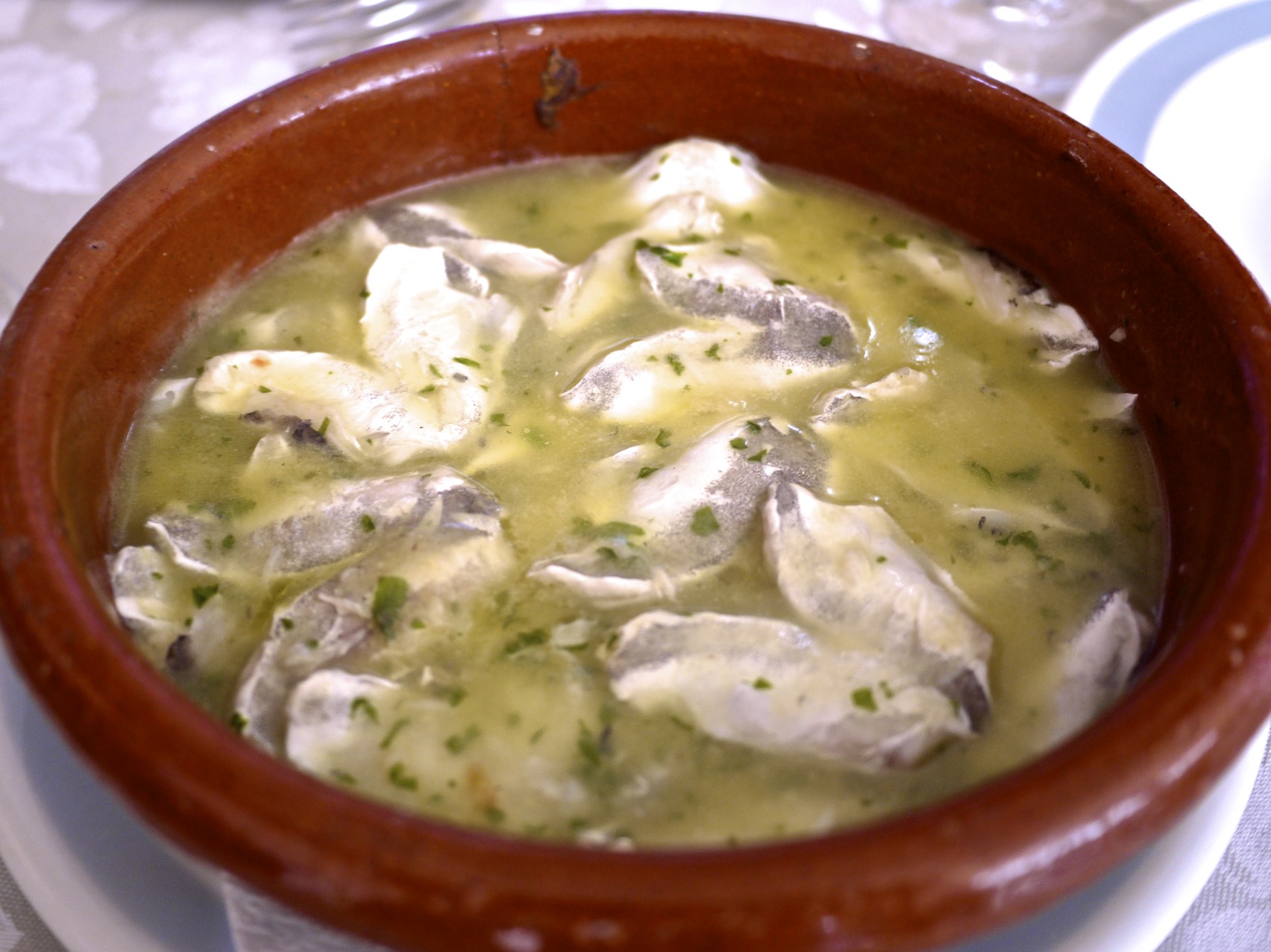
P1060053My favourite Basque dish, Kokotxas de Merzula en salsa verde. Kokotxas are essentially delicate pendulums of flesh growing in the throat of cod or hake, in this case the latter. The ones I had here were by far the best I’ve ever had. I found many places either overcooked them and added too much seasoning and parsley. This was delicate but had some texture, and the sauce was buttery with a good amount of seasoning.

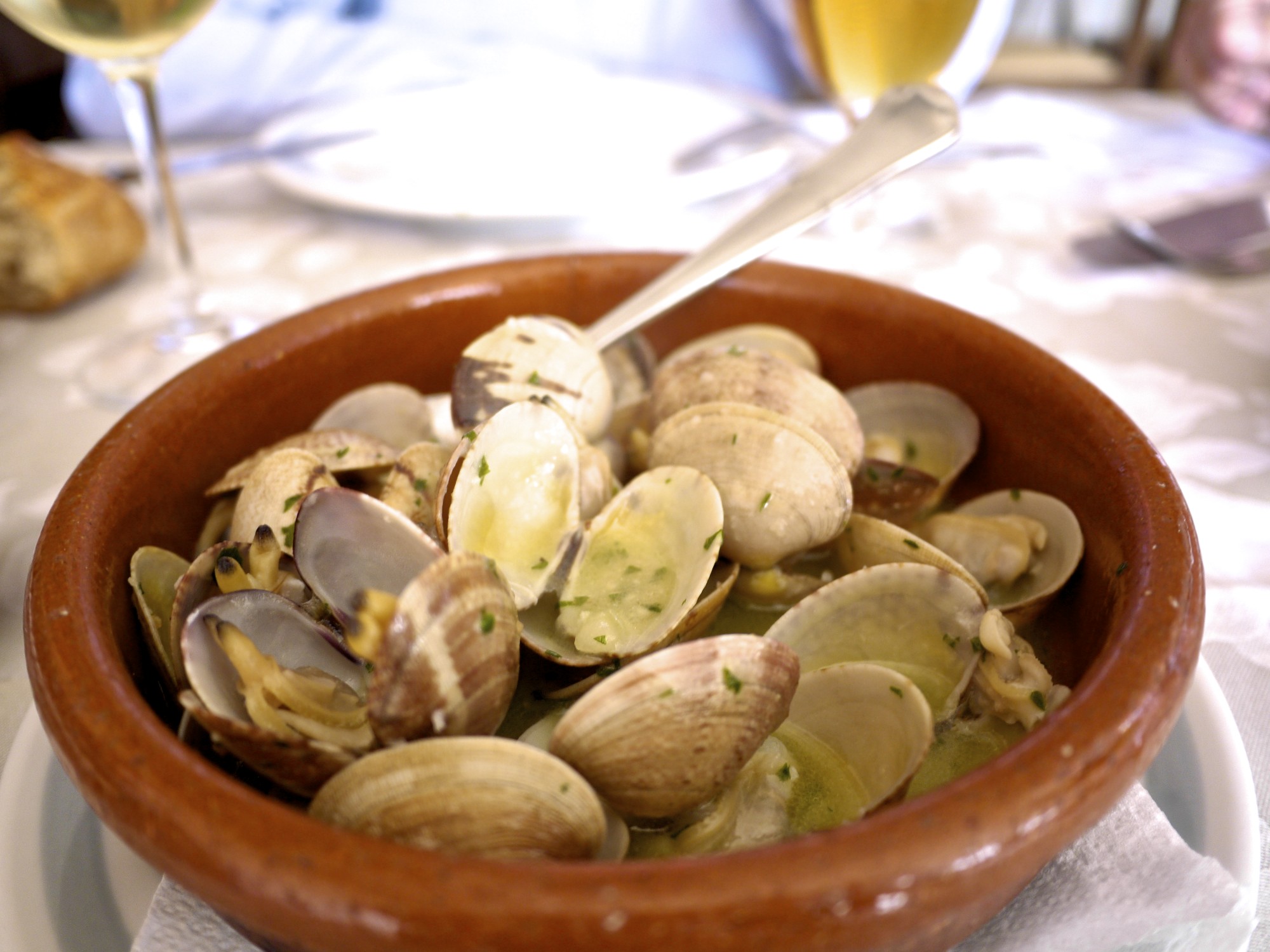
P1060056Served together with the kokotxas was a plate of Almejas al ajillo. This was a beautiful simple dish where the clams were cooked in their own juice with some wine and parsley. When you have top quality ingredients, there’s no reason to complicate a dish.

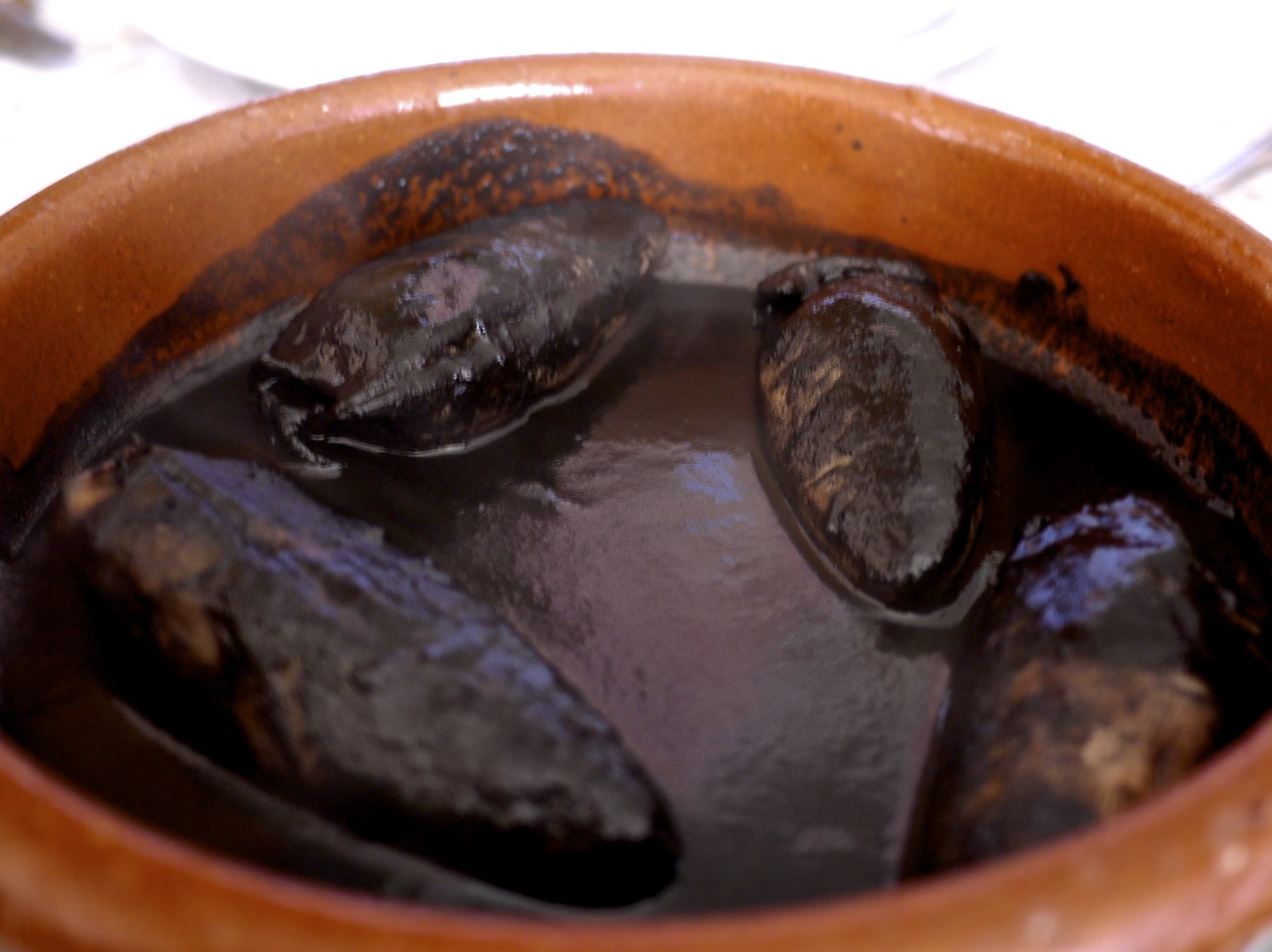
P1060065Last of the starters – chipirones en su tinta. The squid was cooked in its own ink resulting in a black stew-like dish where the squid was tender. The black sauce was deceiving as it contained onion, tomato and herbs. It’s a rich tasting dish that requires some skill to prepare as unlike normal squid dish that takes few minutes to cook to avoid the chewy texture, this one is slow cooked for hours.

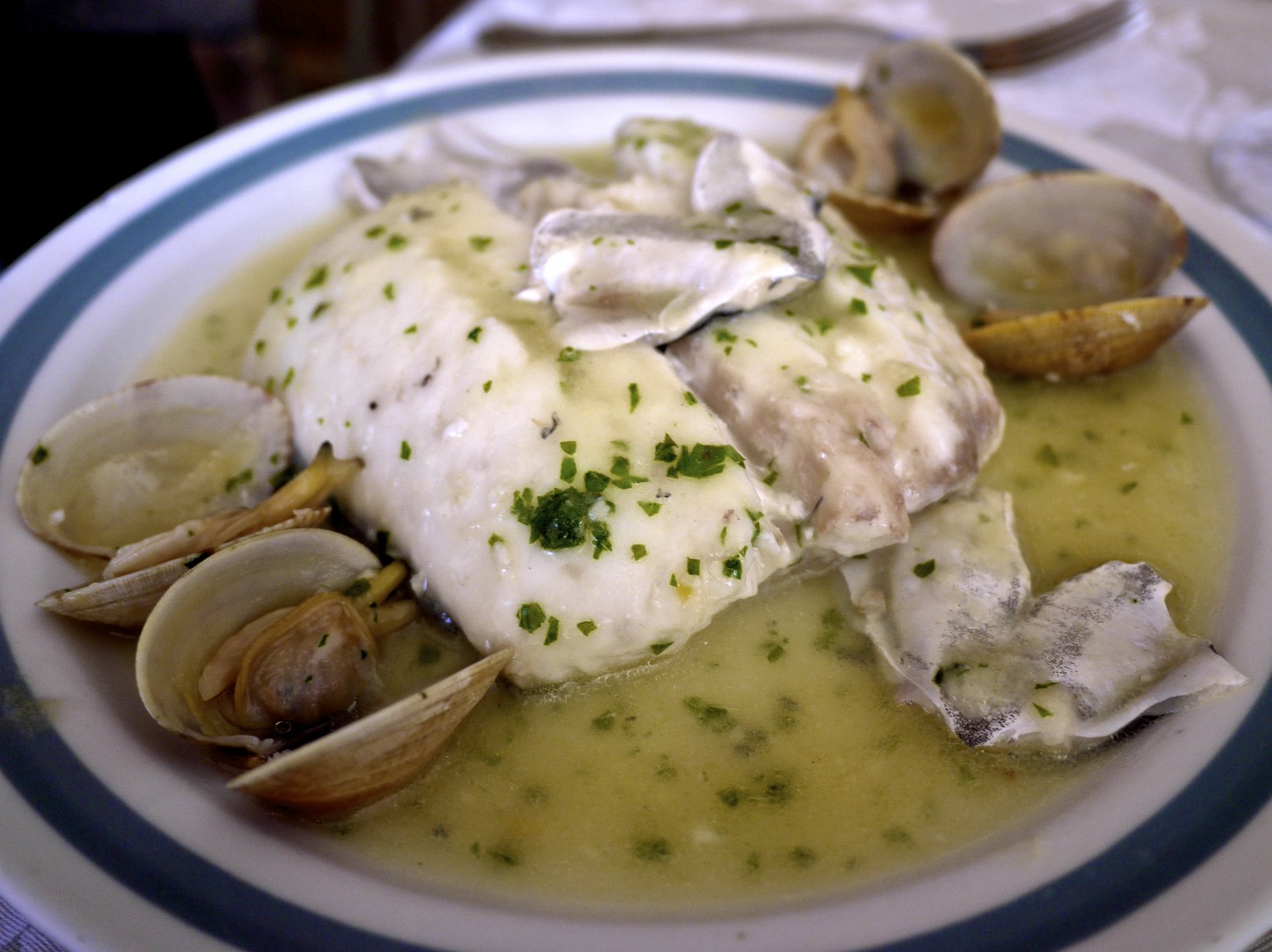
P1060071I personally chose the the merluza (hake) en salsa verde con almejas y kokotxas, mainly because I wanted to see how good the fish was given the superb quality of the kokotxas I had for starters. The hake was cooked perfectly and having had this dish a few times before, I particularly liked this dish over the other places I tried because you got a decent piece of fish with little distraction to the main component.

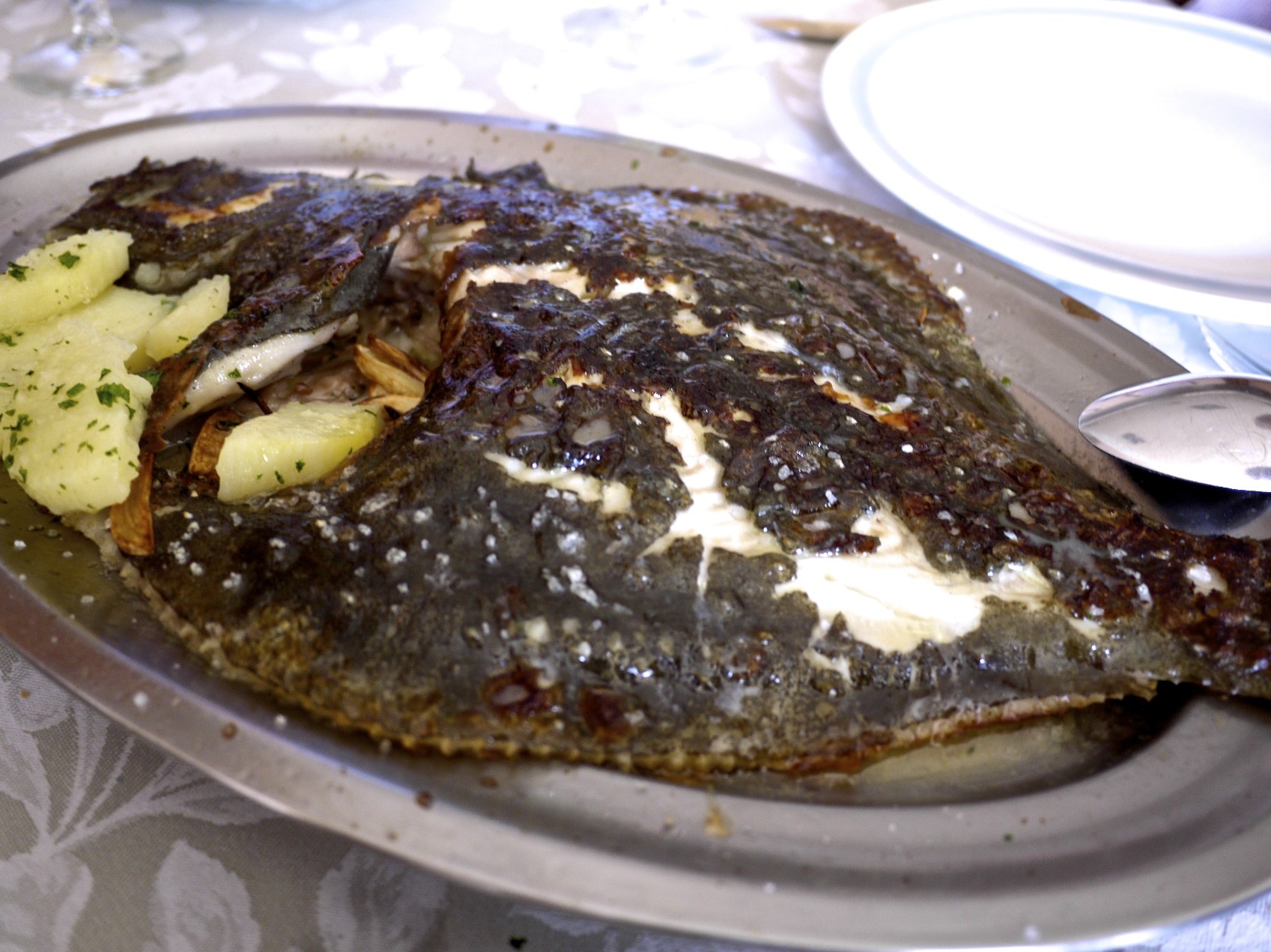
P1060076My partner opted for the Rodaballo al horno, which was turbot cooked in the oven. The fish again was lightly seasoned and stuffed with some crunchy garlic inside. This was definitely one of the best quality of turbot I’d tasted in Europe and could see why the Northern coast of Spain holds the title of the best seafood in Europe.

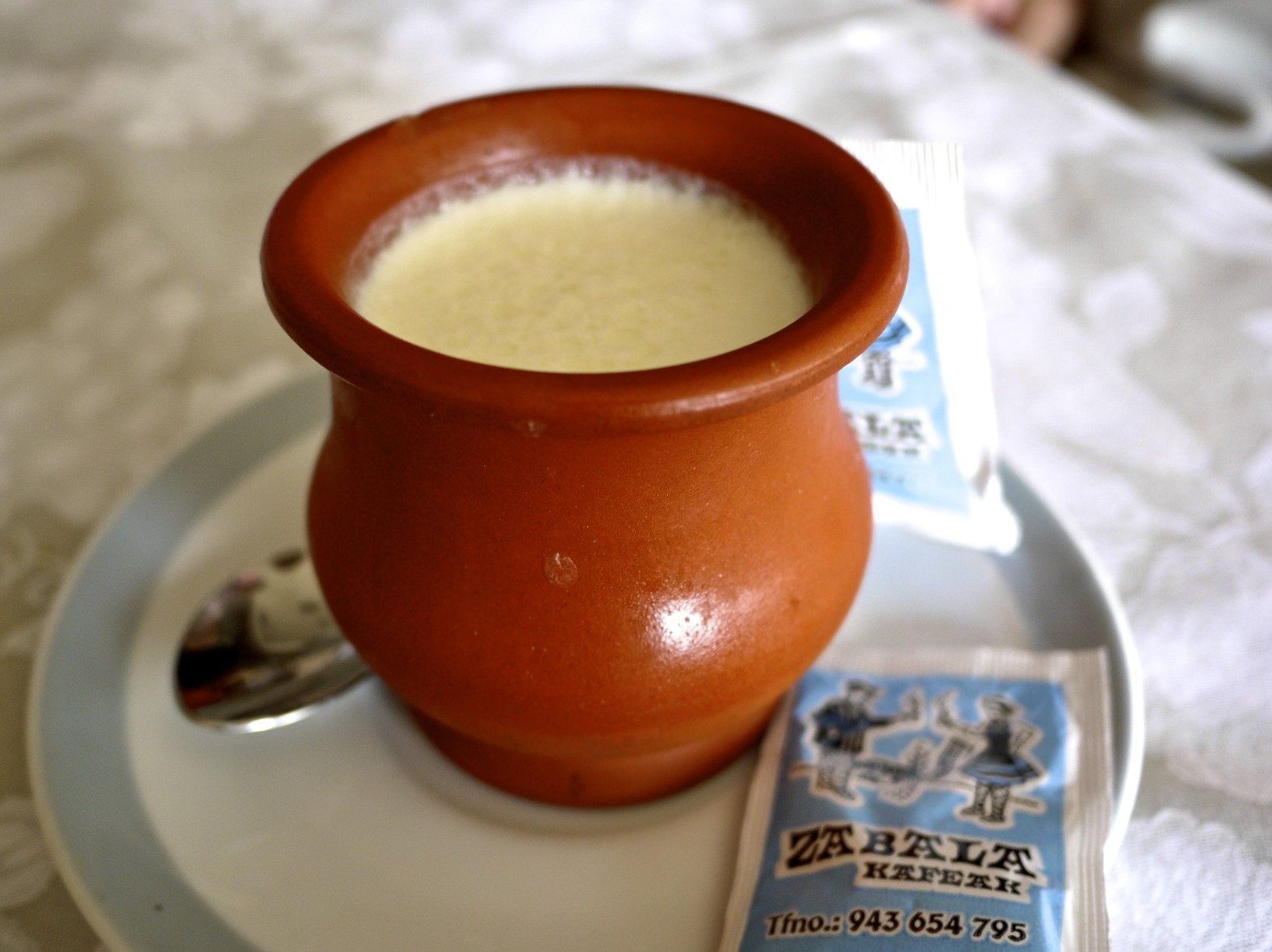
P1060092A light dessert of Mamia or Cuajada to finish the meal. This was a milk curd made from ewe’s milk, served with sugar in this case or sometimes honey and walnut. The curd is a product resulting from the coagulation of pasteurized milk, after having added a fermenting product called rennet, and was cooled to a temperature of 35 ° C. It was lovely to try one that was properly made from scratch.

I visited this place first time back in 2011 and have been going back whenever in the region. If you are looking for something casual but good honest food, I would recommend this place. It may be a bit out of the way but if you’re in that part of the world I would definitely suggest stopping by. It would be perfect for a casual family meal or a hearty lunch when traveling.


Vila Joya, Albufeira

P1110057Chef: Dieter Koschina    Website: www.vilajoya.com    Cuisine: Modern French/European

Since catapulting to the forefront of the fine dining scene as the 45th Best Restaurant in the World in 2012, I was extremely eager to visit Vila Joya for two reasons. Firstly, I was curious to discover what Portugal had to offer in the fine dining scene given the success their neighbour Spain had enjoyed over the last decade, and, more importantly, I was intrigued with the fact that it took an Austrian chef by the name of Dieter Koschina to bring Portugal into the playing field of culinary excellence.

P1070116We had wondered all day as to what we were going to encounter and it was difficult to have any preconception – an Austrian chef cooking in Portugal with a reputation for French style cuisine? We were naturally intrigued to see the culmination of these components, but before sitting down at our table…

P1100931… we had the opportunity to visit the kitchen where we discovered the “crEATivity table” – a table where four curious diners are able to observe the kitchen in full swing during their meal; a good enough reason to return!

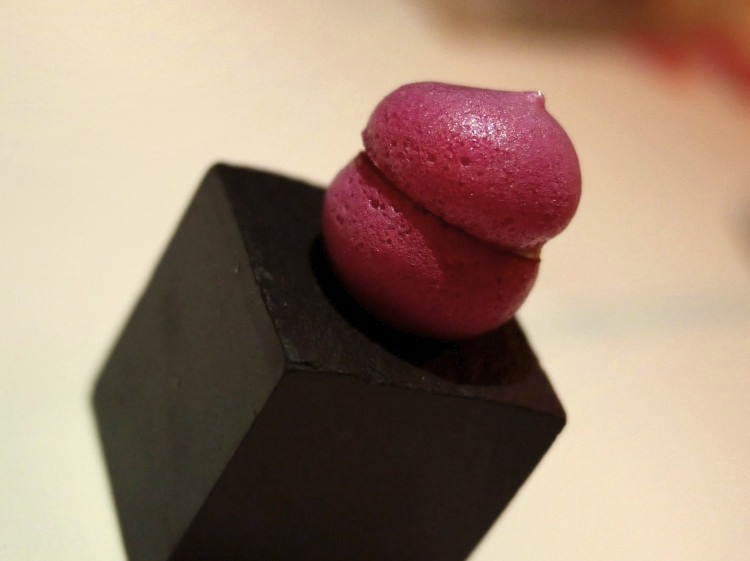
P1070145Back to the table and we started with a glass of Ruinart Blanc de Blanc. The array of snacks certainly set the bar high for the evening ahead. The Beetroot Macaron with eel cream was excellent, where the rich and delicate flavour of the eel was balanced against the tanginess of the beetroot.

P1070147Caviar Tempura – Tempura of salmon roe and bacon. A good flavour combination but I found it slightly salty for my palate.

P1070149Yoghurt Pistachio – Pistacchio wrapped up in yoghurt wrap.

P1070152The Parmesan sandwich was extremely light, airy and cool. A nice contrast to the other snacks so far.

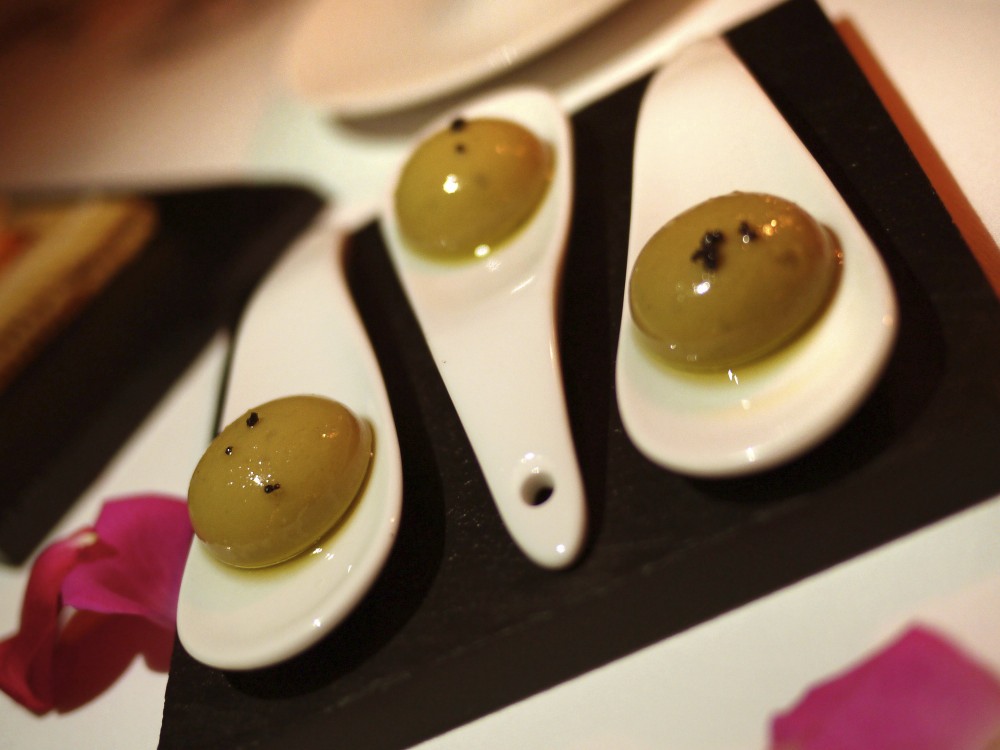
P1070156Green Olive, which was basically el Bulli’s olive oil spherification technique.

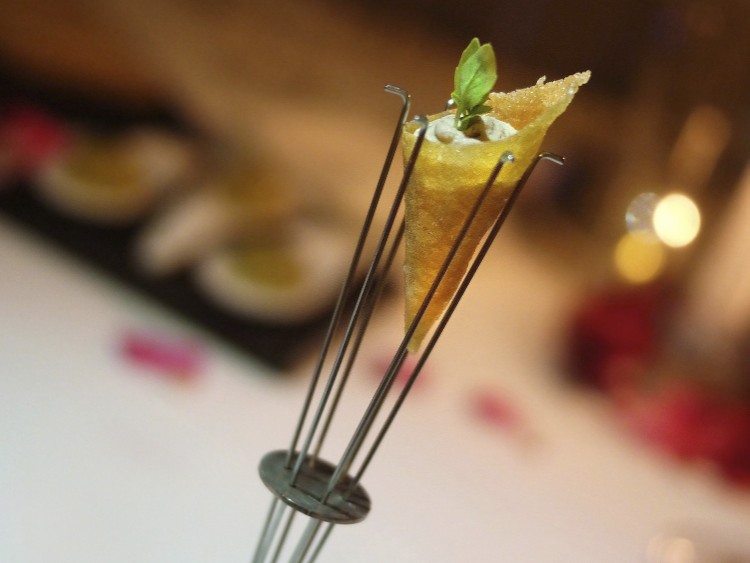
P1070159This was swiftly followed by the last snack, a Cornetto Tapenade, which had a fabulous crunchy texture surrounding the concentrated flavour of the sun-dried tomato and olive.

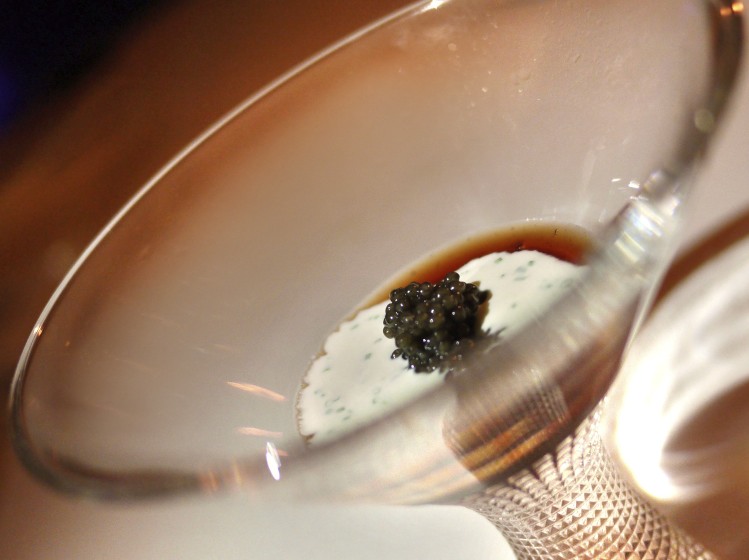
P1070167We enjoyed the progression of flavours of the snacks to the amuse bouche of Duck consommé with sour cream and imperial caviar served in a martini glass. The rich and earthy gelatinous duck consommé added a depth to the classic combination of sour cream and caviar, and the small portion was perfect as the flavour was very intense.

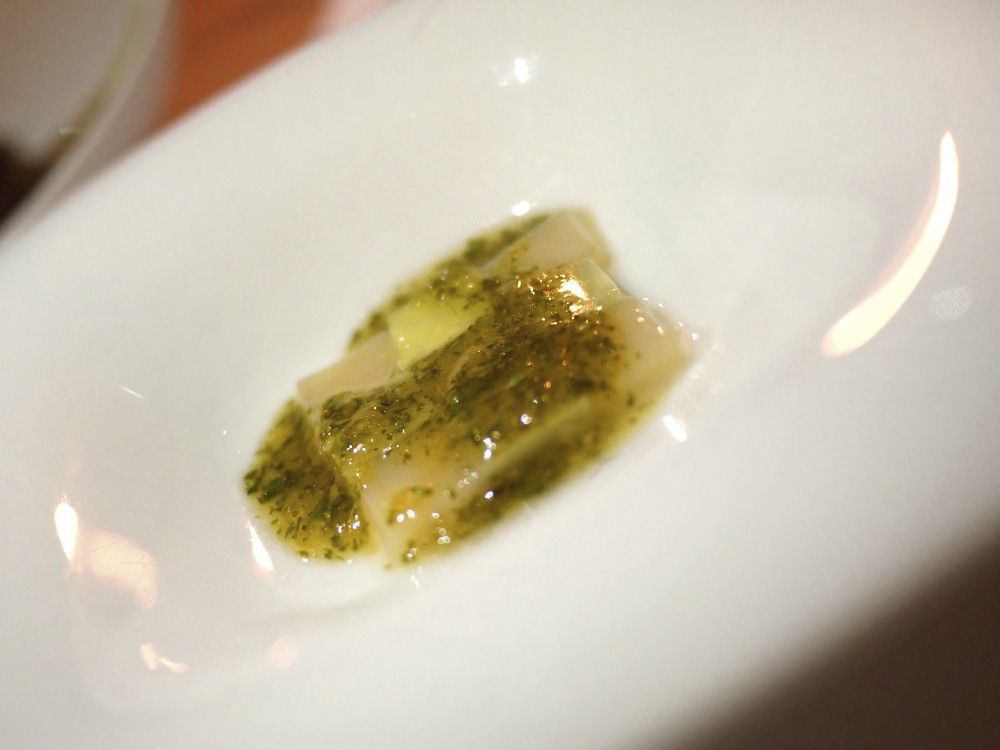
P1070194The opening act to the main courses was the first of three Variations of Scallops. It was an artistic plate of scallop, celeriac and vinaigrette dressing. To go with the three scallop dishes, the sommelier poured us a glass of 2010 Eminencia Loureiro, Minho, which was buttery but delicate, full of acidity and with a good floral note.

P1070191Second scallop installment was Seared scallop on a bed of artichoke puree with a black truffle gel.

P1070188And finally the last scallop dish was prepared as a Carpaccio with cauliflower to complete the trifecta. All three courses showcased Koschina’s creativity and technical skills, as it was impressive to see how unique each dish was despite using the same star ingredient.

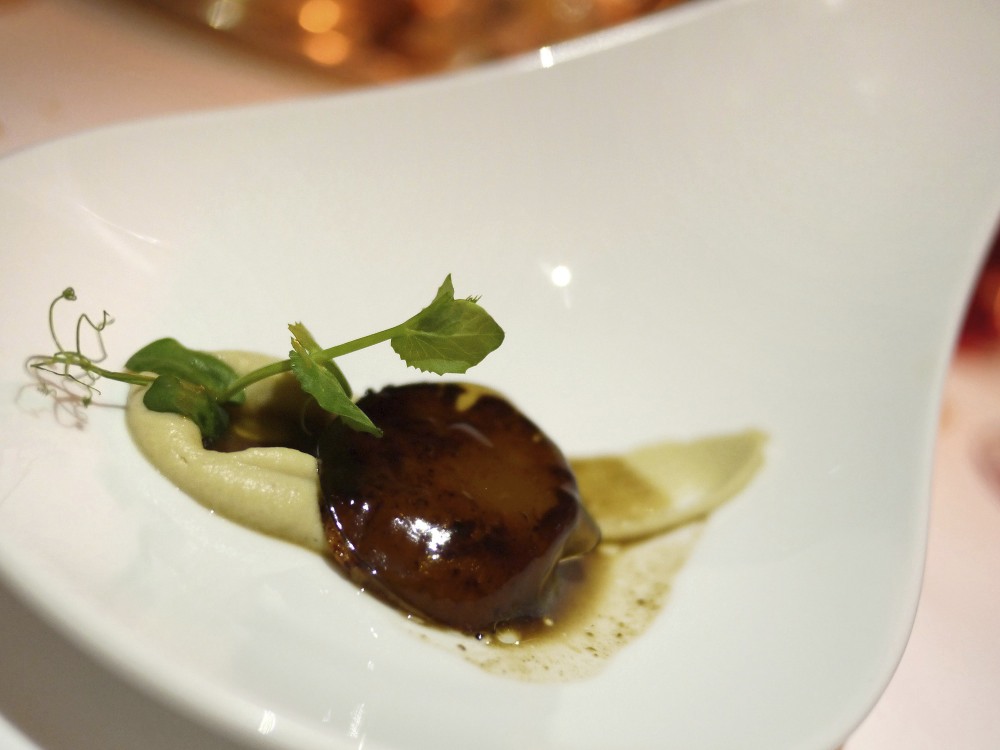
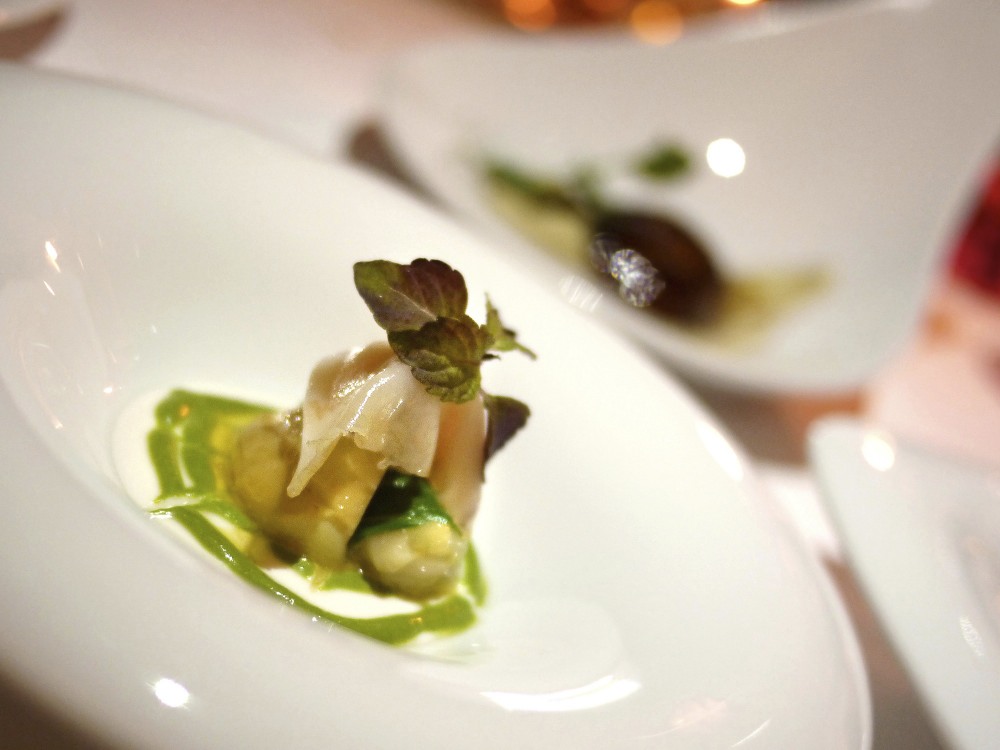
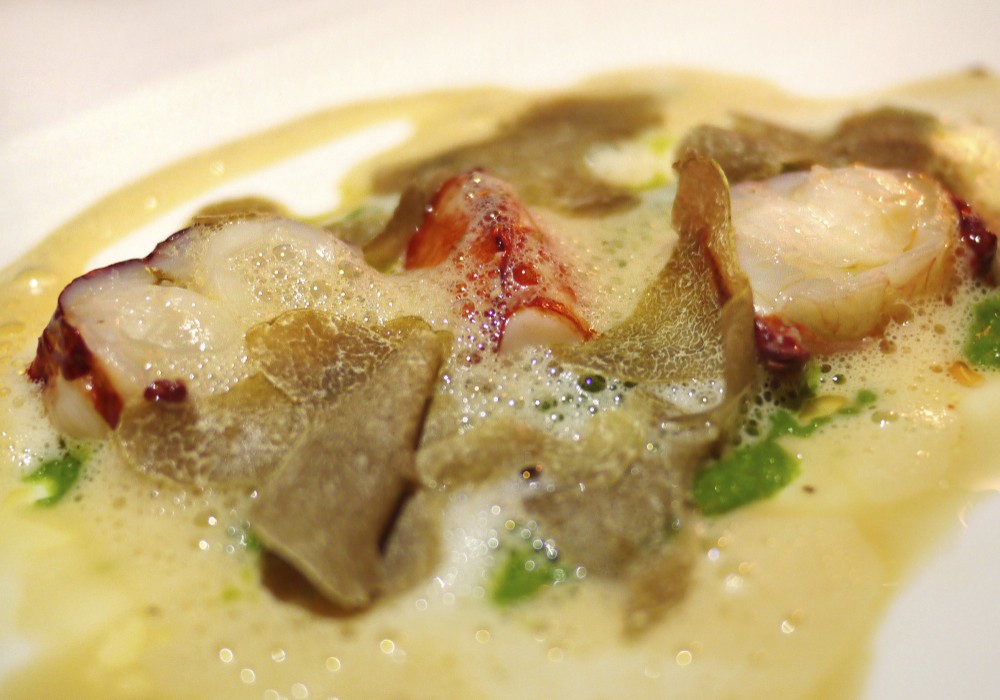
P1070198As our visit coincided with the season for the Alba white truffles, we were treated to a freshly delivered batch, arriving only that day. These jewels of the earth were put to good use in the Atlantic lobster, parsley polenta and Alba truffles, a novel combination of two of our favourite ingredients on one plate. The moist lobster magnified the aroma and flavour of the white truffle, and the bed of crunchy ceps and puréed broccoli completed the dish providing additional textural elements to the dish. We were very impressed by the manner in which the ingredients had not compromised, but instead enhanced the taste of either star item. The 2009 Vertice Grande Reserva, Douro had a good acidity and spiciness with a wood element.

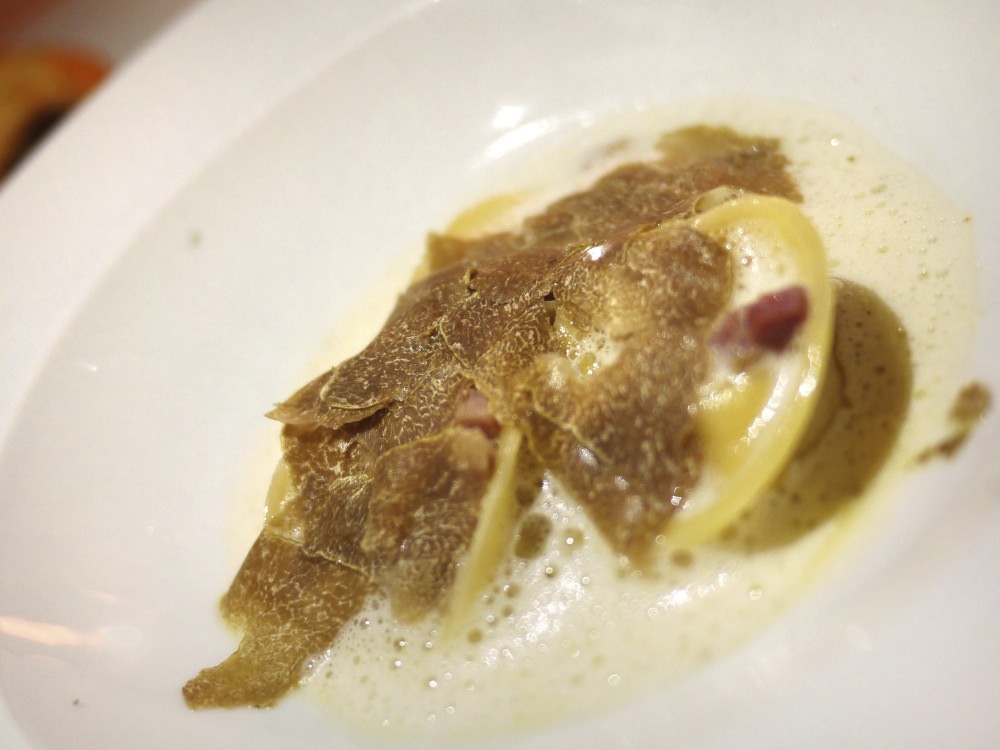
P1070202Luckily for us, we had a second white truffle dish of Carbonara agnelotti Alba truffle. It was quite similar to the divine fagotelli from Beck at La Pergola but this one had a slight edge with the white truffle. It was even served with…

P1070204… a truffled brioche to mop up every single morsel of the sauce. We were truly in truffle heaven!

P1070207

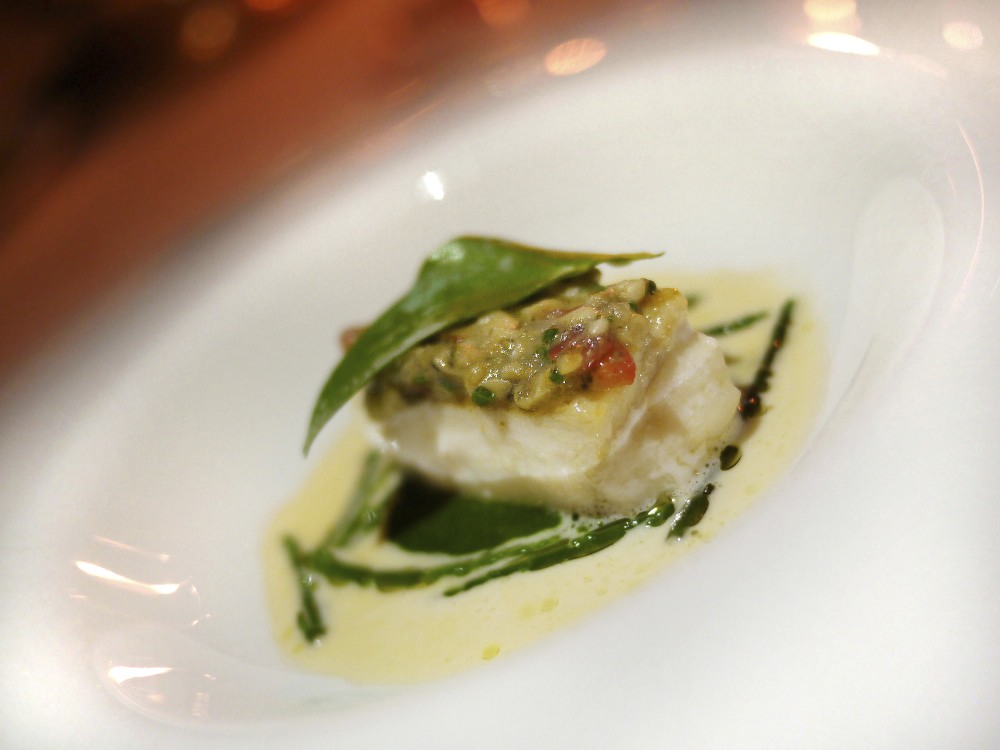
Finally the fish course! Poached turbot, Gillardeau oyster, passe pierre (aka sea green bean). We thought initially it may have been an overkill but the oyster leaf garnish was a great addition to the mouthful of the flavour of the ocean. The glass of a full-bodied 2009 Arrepiado Colection, Alentejo was paired to go with the fish courses. It had a citrus nose with a slight scent of vanilla.

P1070213

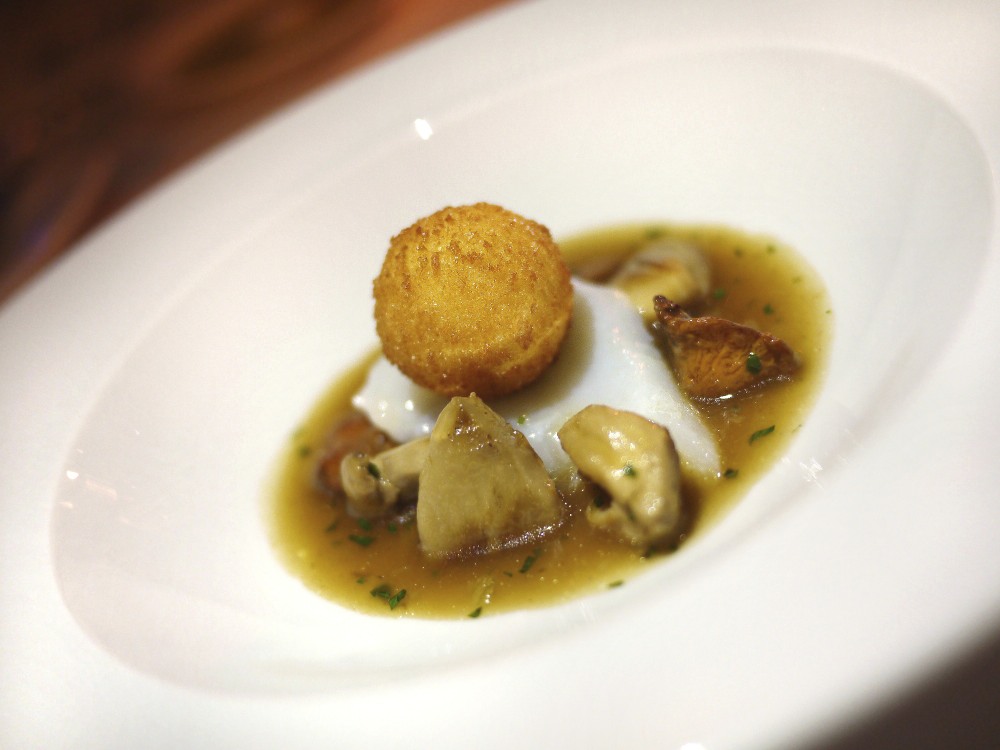
A meal in Portugal of course would not be complete without the nation’s favourite fish, bacalhau (or cod). The Cod fish confit, wild mushrooms and garlic had a lovely silky texture not generally associated with the typically large and flaky cod. The creamy deep fried ball of aioli provided a crunchy texture without overpowering the dish, and the accompanying chanterelles were the perfect touch to marry the ingredients together with its earthiness. Suffice to say, we were impressed with the calibre of the dishes so far.

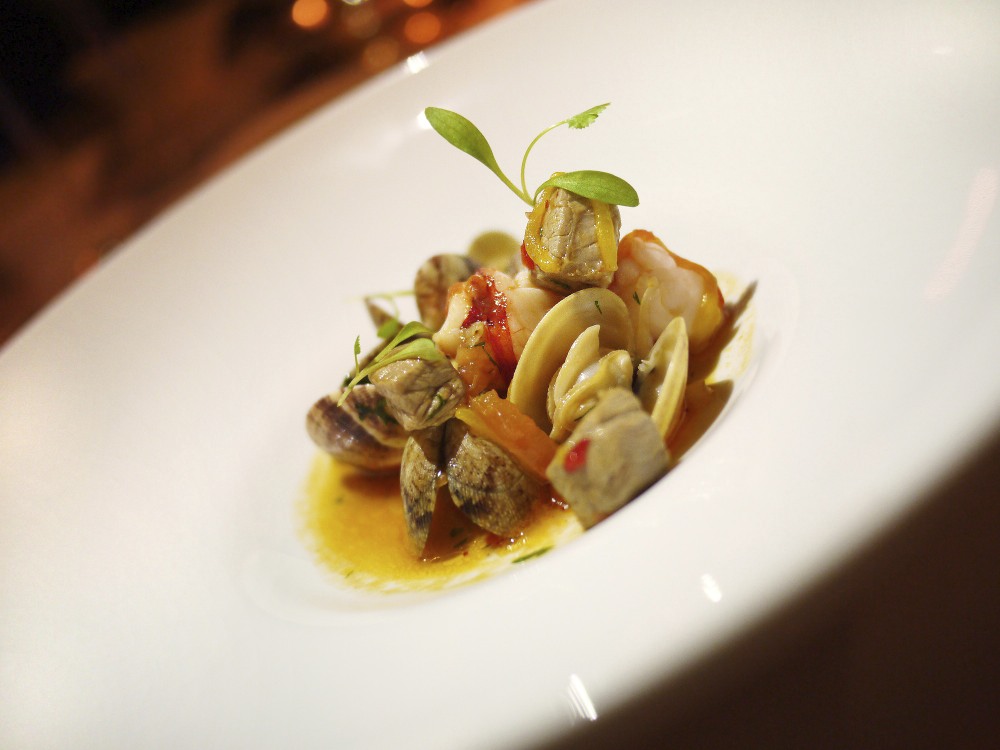
P1070219Continuing with the theme of novelty, Koschina’s version of the traditional Algarve dish, “Cataplana” Vila Joya, was another triumph.The dish is prepared in a clam-like shaped pressure cooker (the cataplana), which locks in the essence of the ingredients, in this case pork, cockles and lobster with a tomato and onion base. The finishing garnish of the crouton was perfect to soak up the remaining liquor, packed with all the flavours of the ingredients. It was a wonderful reinvention of a traditional regional dish whose roots dates back as far as the 8th century.

P1070224

Following on was the Young Pork belly, Chorizo sauce and octopus, where the sea and land met. This was a lovely soft pork belly and crispy skin, together with grilled octpus that had a bite. It was slightly salty again but had great flavours.

P1070227 The sauce served on the side of the above dish was made from chorizo, tomato, crouton and onion We enjoyed them both with a matching glass of a decantered 2004 Chryseia, Douro that had a smell and taste of a very fine porto, slight cigar smokiness and overripe currants. Happily, we only had Portuguese wine this evening and I was very impressed with the choices, possibly because my knowledge of Portuguese wine was quite limited.

P1070231

The finale to the main courses was the Miéral Duck, beetroot and raspberries. A rectangular cut of duck breast with raspberry and beetroot sauce, a duck breast spring roll with beetroot wedge, and an encrusted crispy ball of duck liver. It was a grand finale to the main act of the meal but perhaps was possibly a couple of mouthful too many!P1070239

Luckily we were moving on to the dessert courses. This started with a prelude of Pineapple Carpaccio and white chocolate soup served over a bed of fresh pineapple wedge and pine nut. The acidity from the pineapple and the sweetness of the chocolate made this a fresh and fruity palate cleanser. P1070244The subsequent Pear and cocoa beans ice cream was again a creative and light dish. The milk chocolate ice cream and dark fondant chocolate ball submerged in a cold pear juice was refreshing and clean on the palate, and what appeared to be an ordinary decoration of a thin chocolate stick had a surprising crunch to it. It was a superb introduction to the culmination of this extensive tasting menu, which was…

P1070249

… a Soufflé of croissant, apple tartare and sorbet of salted caramel, again incorporating a contrast of flavours (salty and sweet) and temperature (cold and hot). The flavour was not dissimilar to that of an apple pie, although the portion size was again spot on as it was a very hearty course.

P1070253It was by now approaching 2am and, as we sipped over a glass of 1964 Krohn Colheita Branco port with our petit fours, we found ourselves content in this little piece of paradise but exhausted from all the excitement. Our taste buds were well stimulated from the various innovative dishes with unique but successful flavour combinations. We had also been introduced to some of the diverse and delicious traditional cuisine that Portugal is famed for, which was complemented well by wine from a region that was previously unfamiliar to us. The adoption of the local produce and cuisine to his Northern European cooking techniques makes Koschina a truly unique chef who we will be expecting many more culinary delights from in the future. Let us hope that his cuisine will inspire other chefs in Portugal to follow suit.

Iggy’s, Singapore

P1010339

Head Chef: Akmal Anuar   Website: www.iggys.com.sg   Cuisine: Modern European

I always had a soft spot for Singaporean food because it epitomised the diverse rich culture brought over by the regional migrants. The local dishes sourced from regional fresh produce spoilt diners for choices offering a variety of curries, freshly caught seafood, juicy tropical fruits and delicious desserts. Recalling all these wonderful food that was being offered for a pittance at the hawker centres, I kick myself every time I think about my meal at Iggy’s in 2011.

I only had time for one meal on my stopover from Melbourne to London, and given the hype around Ignatius Chan’s restaurant, I thought I’d organise a meal to catch up with my old friends and kill two birds with one stone. Little knowledge did I have that I was about to have my worst fine dining experience, to date.

P1010338Stepping into the restaurant, whilst I didn’t find the décor in bad taste, I found the absence of any natural light rather disconcerting and claustrophobic. This was a different level of darkness compared to other restaurants such as Guy Savoy in Paris which at least had a few skylight windows; three hours of tasting menu in a dim room. Great, I only had just got off the plane!

Before I get into the detail I want to get two things out of the way. This review is based on a meal I experienced in May 2011 and not necessarily reflect the current standard. Secondly, the service throughout that evening was very good and I really couldn’t fault a single person attending us. I created a great rapport with one of the waiter and the sommelier chose a familiar but nevertheless delicious bottle of white Burgundy to go with our meal. So no qualms there!

The food that evening in general, however, was uninspiring, tasteless at times and certainly lacked consistency in terms of style and substance. Glancing at the menu, it felt as if Iggy’s was just showcasing the best produces the world had to offer without the ability to marry the flavours together. I would even go as far as saying that I tasted a dish with the worst combination of flavours ever, but let me come back to that later.

P1010306

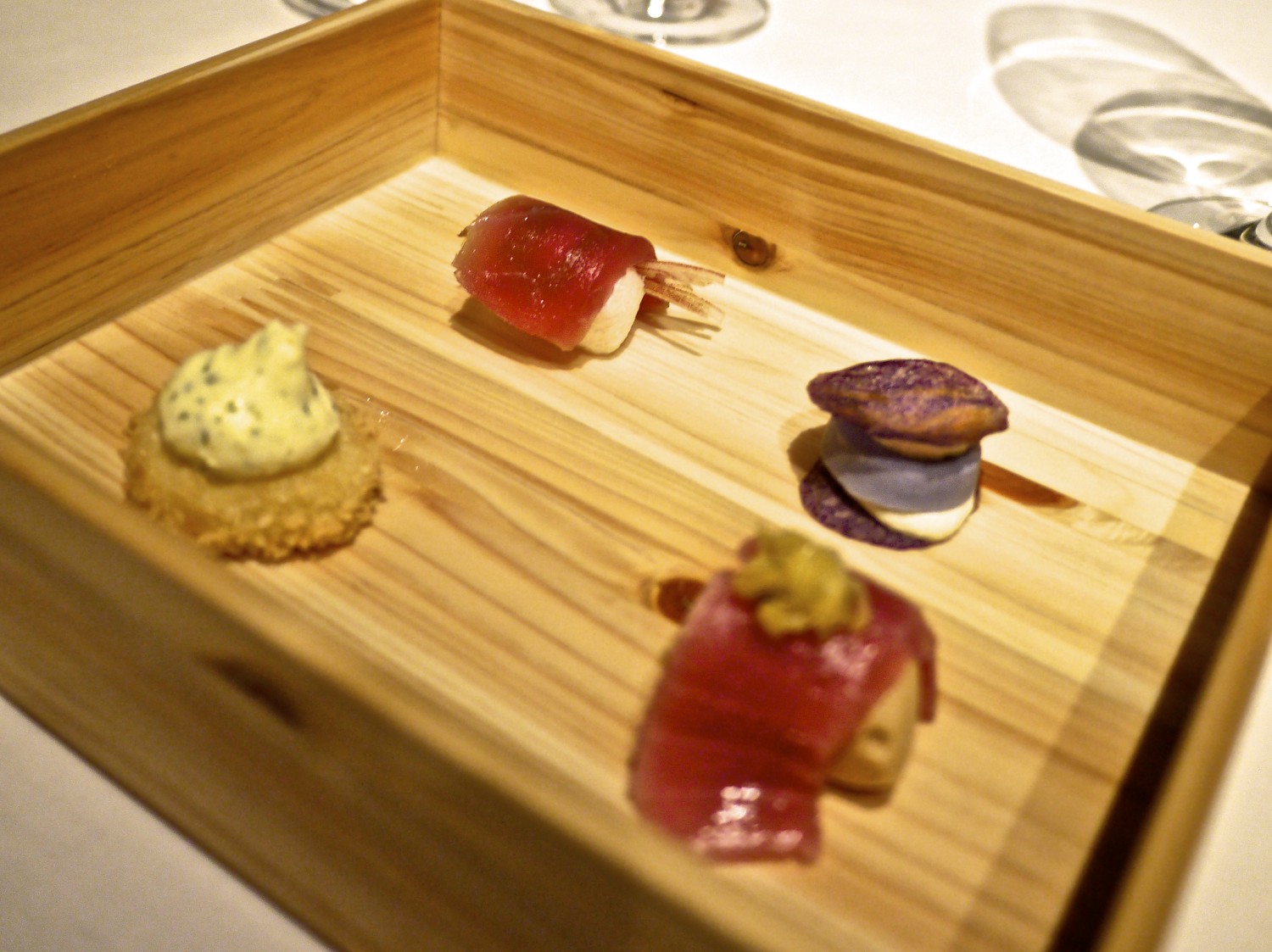
The amuse bouches was a medley of fish comprising of tuna with ginger flower and meringue, violet potato ice cream and potato crisp, cod croquette with citrus emulsion and toro marinated in chrysanthemum. It was probably the best dish of the evening although I must admit there was little seasoning which meant you could taste the slightly fishy flavour of the tuna.

P1010319The vegetable dish, From the Garden, which failed to even come close to replicating Michel Bras’ Gargouillou was a good example of what happens when you rely too much on foreign produce. The vegetables did not look or taste remotely fresh which was understandable given they were most likely all imported. It was a shame because there was a lot of work put into the dish as they managed to incorporate thirty different ingredients on the plate. It was also a bit oily to my liking for a vegetable course.

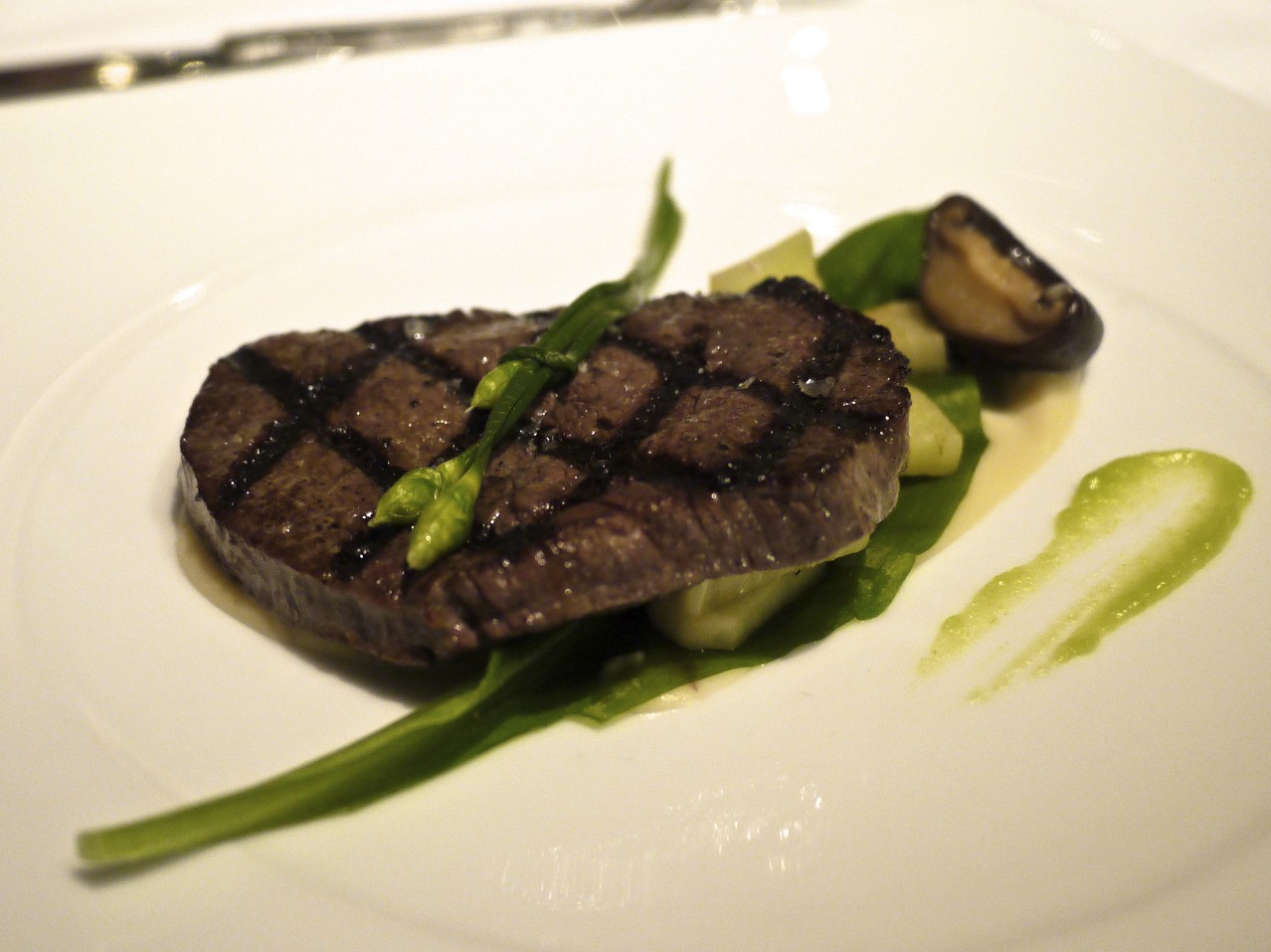
P1010321The main course of the wagyu tenderloin with pink garlic and mushroom was the biggest disappointment of the evening. I’d tried Australian Wagyu a week before at Vue de Monde, which was sublime so I was looking forward to it. However, I found these steaks were overdone with chewy texture and the pink garlic was lost in the midst of this otherwise one-dimensional flavour.

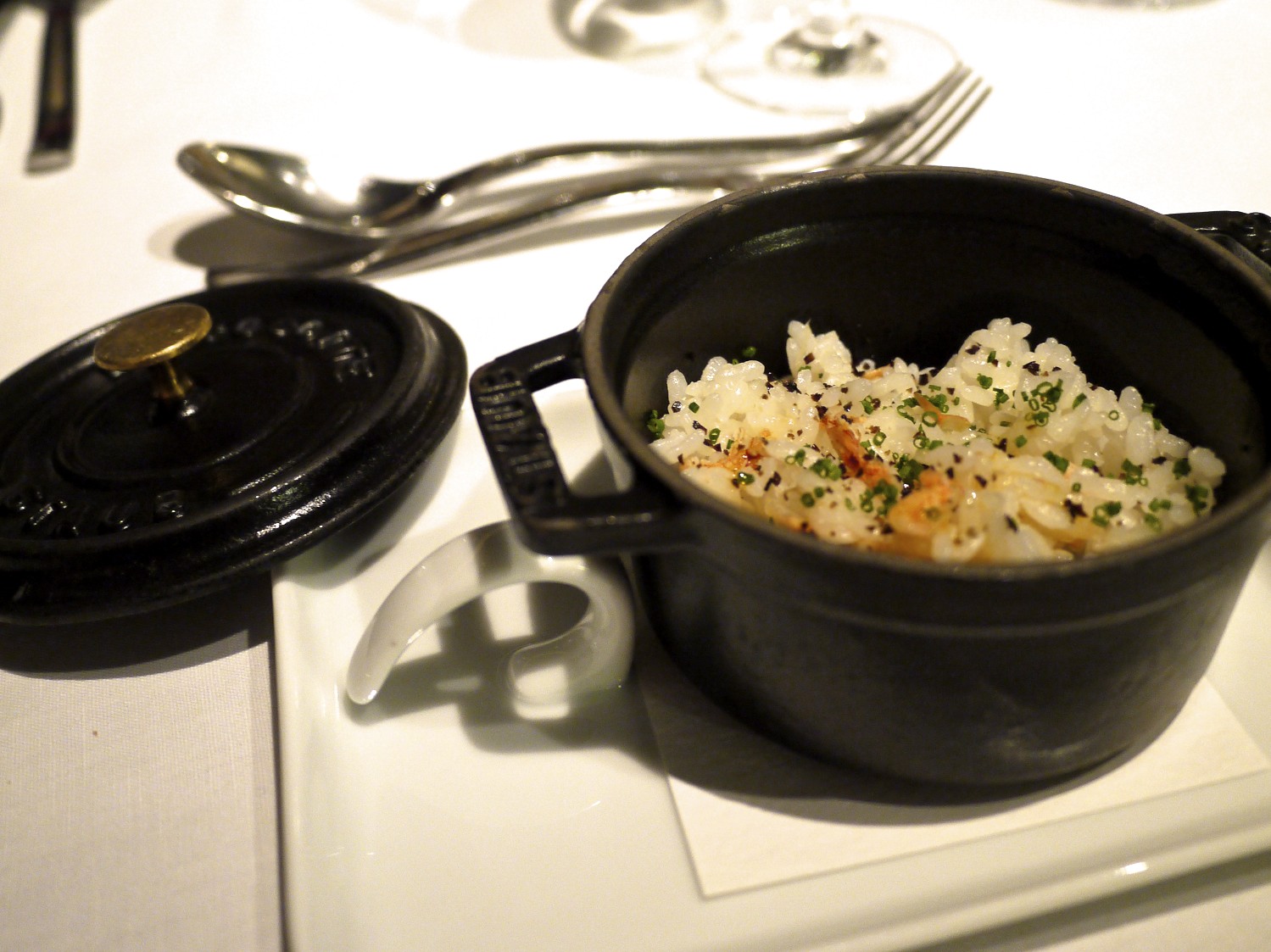
P1010325The rice, sakura ebi, konbu and shellfish oil had hardly any flavour and the delicate prawn was lost in the oily texture. What I found particularly odd was that this rice course was served after the steak course. This seemingly incomplete dish lacked substance and it was overshadowed by the preceding course. Perhaps this is why restaurants traditionally serve light and delicate dishes such as seafood before the meat course.

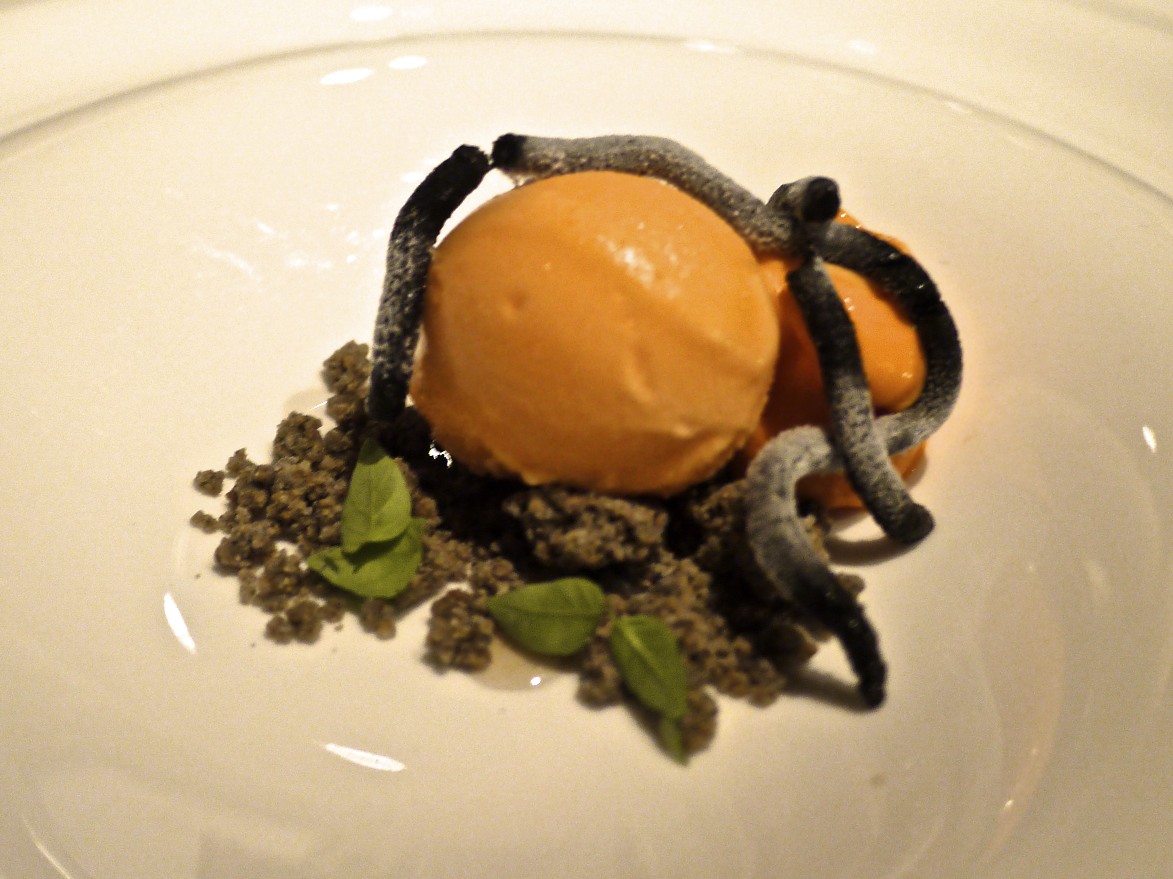
P1010328When I order a tasting menu I am almost always full by the time the dessert arrives. In this case however, I was looking forward to the dessert course, as I was still very hungry! The irony was that the carrot, pineapple and black sesame dessert course was possibly the only dish where I could not get beyond a mouthful. The pineapple sorbet was delicious and refreshing on its own but the liquorice praline and black sesame that accompanied it was just plain wrong. This was worst flavour combination I’ve ever come across, yet I enjoyed all the components on their own.

It pains me to think that this highly unoriginal restaurant was voted as the best that Asia could offer. How could this be considered superior to the vast number of remarkable restaurants in Japan like Kikunoi or Ryugin, or Amber in Hong Kong? Evidently the hefty price tag of $250 SG for the tasting menu is necessary to cover the cost of importing luxury ingredients like black caviar and wagyu beef. However, it is clear from this experience that expensive ingredients do not necessarily produce great or even good dishes. At a time where locality, seasonality and ethical sourcing has taken centre stage, it’s quite a statement to heavily rely on foreign products. When I was there two years ago, it appeared to me that Iggys was lost without a culinary direction. I hope that they’ve finally sorted themselves out.

L’Atelier de Joel Robuchon, London

Entrance

Chef: Olivier Limousin     Website: www.www.joelrobuchon.co.uk    Cuisine: French

Part of the continuously expanding empire of Joel Robuchon, L’Atelier’s concept is based on Japanese counter dining, but serving classic French food instead. As I was celebrating my 30th Birthday, I decided to go with the full tasting menu and matching wine after a couple of lovely cocktails upstairs in the bar.

P1110972

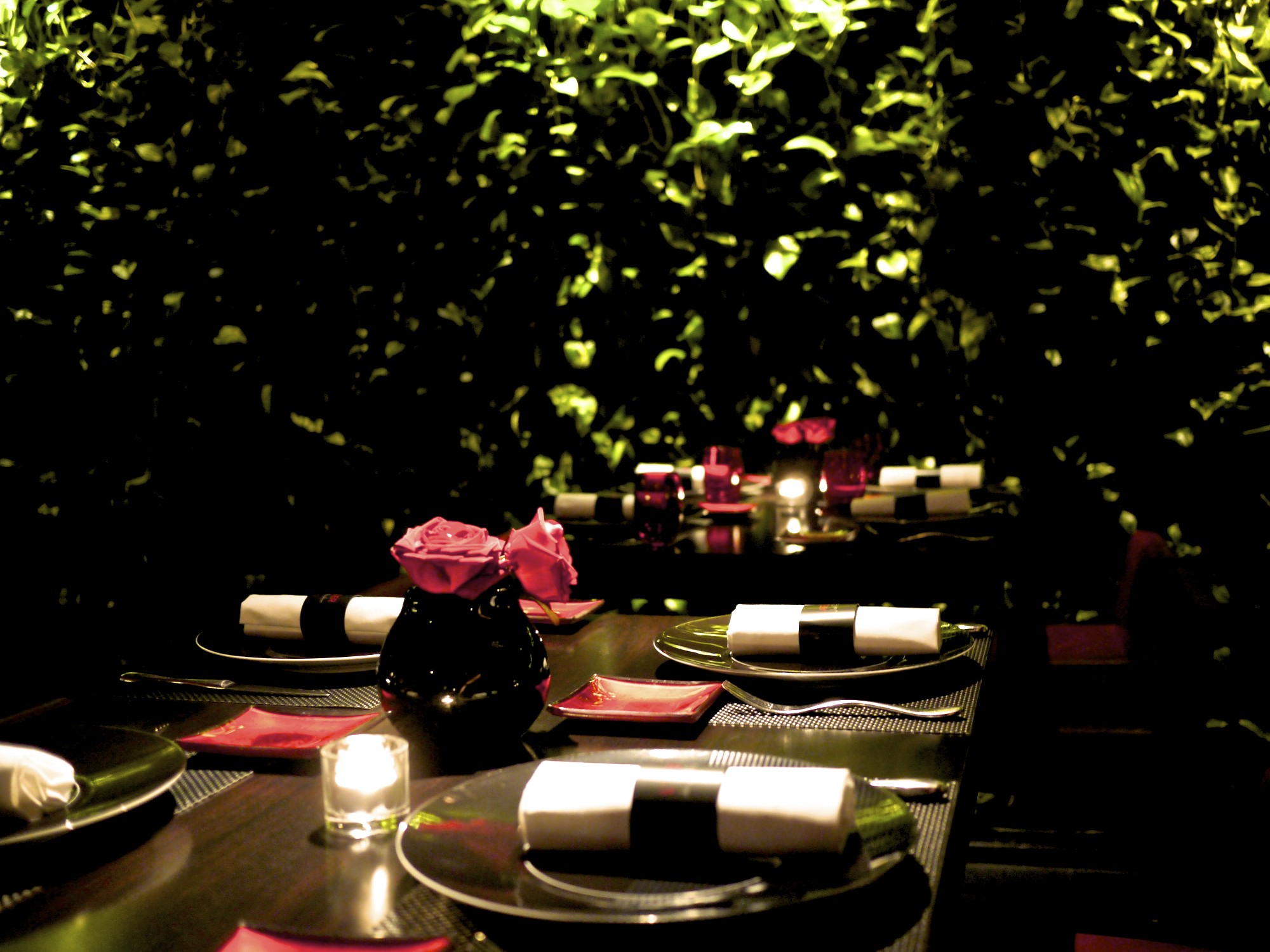
The decor is consistent with the other Robuchon branches consisting of an open kitchen in the middle of the room, dim lighting and red upholstery. The service was a bit slow to start with but picked up later on. The Head Sommelier was absent that evening and instead we had an apathetic sommelier pouring us our wine.

P1110912

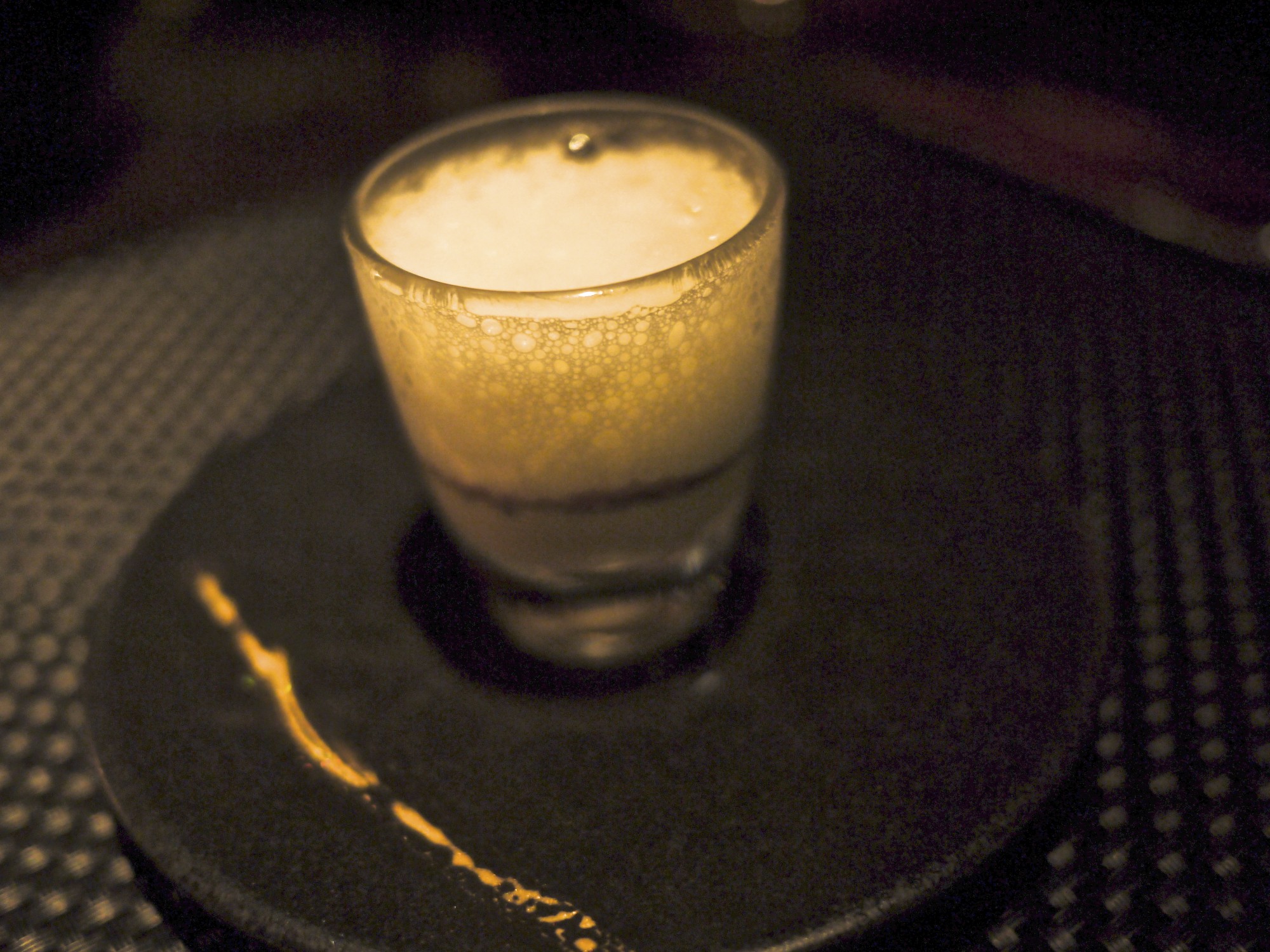
We started off with an amuse bouche of Parmesan cappucino with port, which was essentially foie gras royale, port wine reduction and parmesan foam. The foie was thick and rich whilst the parmesan added some seasoning and flavour to the dish. It certainly did whet my appetite.

P1110916

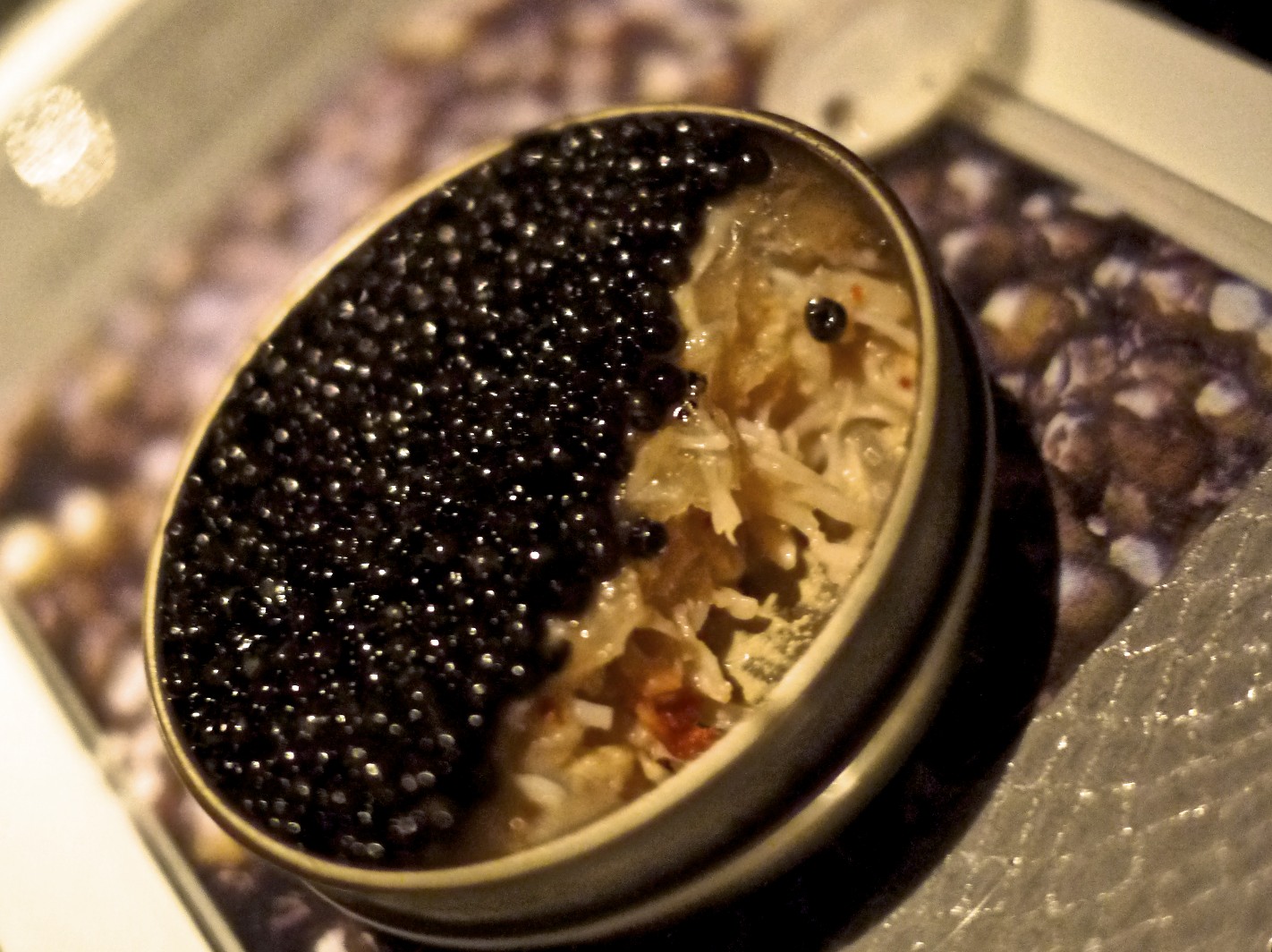
First up on the tasting menu was the Caviar served on a bed of crab meat and lobster jelly. The presentation was immaculate as always.

P1110931The flavour combination of the rich and fine Osetra caviar and crab from Normandy was further enhanced and brought out by the lobster jelly. What a great start to the meal with a taste of the ocean. A glass of 2011 “O Rosal” Bodegas Terras Gauda, Rias Baixas, Spain was poured to go with this course. It had a good balance of acidity and citrus flavour with fresh aromas of honeysuckle and citrus peel.

P1110935

The Scottish lobster salad with artichokes “barigoule” and citrus vinaigrette was the only hiccough of the meal. Granted, the flavours were light, delicate and the produce fresh, but whilst I could overlook the lack of seasoning, the slightly chewy texture from the lobster was disappointing. It was definitely not on par with some of the other dishes we had that night. Matching wine was 2011 Rivaner Domaine Mathis Bastian, Moselle Luxembourgeoise, Luxembourg.

P1110943

Unlike the last course, the Soft boiled egg with Japanese aubergine velouté flavoured with cumin was much more enjoyable, so much so that I forgot to take a photo of what was under the thin layer of crispy buckwheat galette! The smokey aubergine reminded me of baba ganoush and the overall texture and flavours of the dish was similar to chawanmushi, a steamed Japanese egg custard dish. Matching wine was from one of the newer wine estate of 2011 Ovilos Biblia Chora, Pangeon Greece. The seductive aromas of vanilla and peach, with the mineral palate, made it ideal for a creamy course like this.
P1110946

Seared Foie gras with quince and clementine marmalade. The foie was of a decent quality but I found the tartness from the marmalade was slightly overwhelming the balance of the dish, leaving a bitter aftertaste. Matching wine was 2011 Riesling Spatlese, Poulinshoff, Mosel, Germany, which, as expected, had a great balance of sweetness and fruitiness to go with the foie.

P1110957Another favourite dish of the evening was the Black cod with daikon and yuzu mousseline. I particularly enjoyed the dashi-soaked daikon and the sweet and delicate cod. The yuzu added the perfect acidic balance to complete the dish. The dry and soft 2011 Karmis Contini, Sardegna, Italy was a good match for this dish.

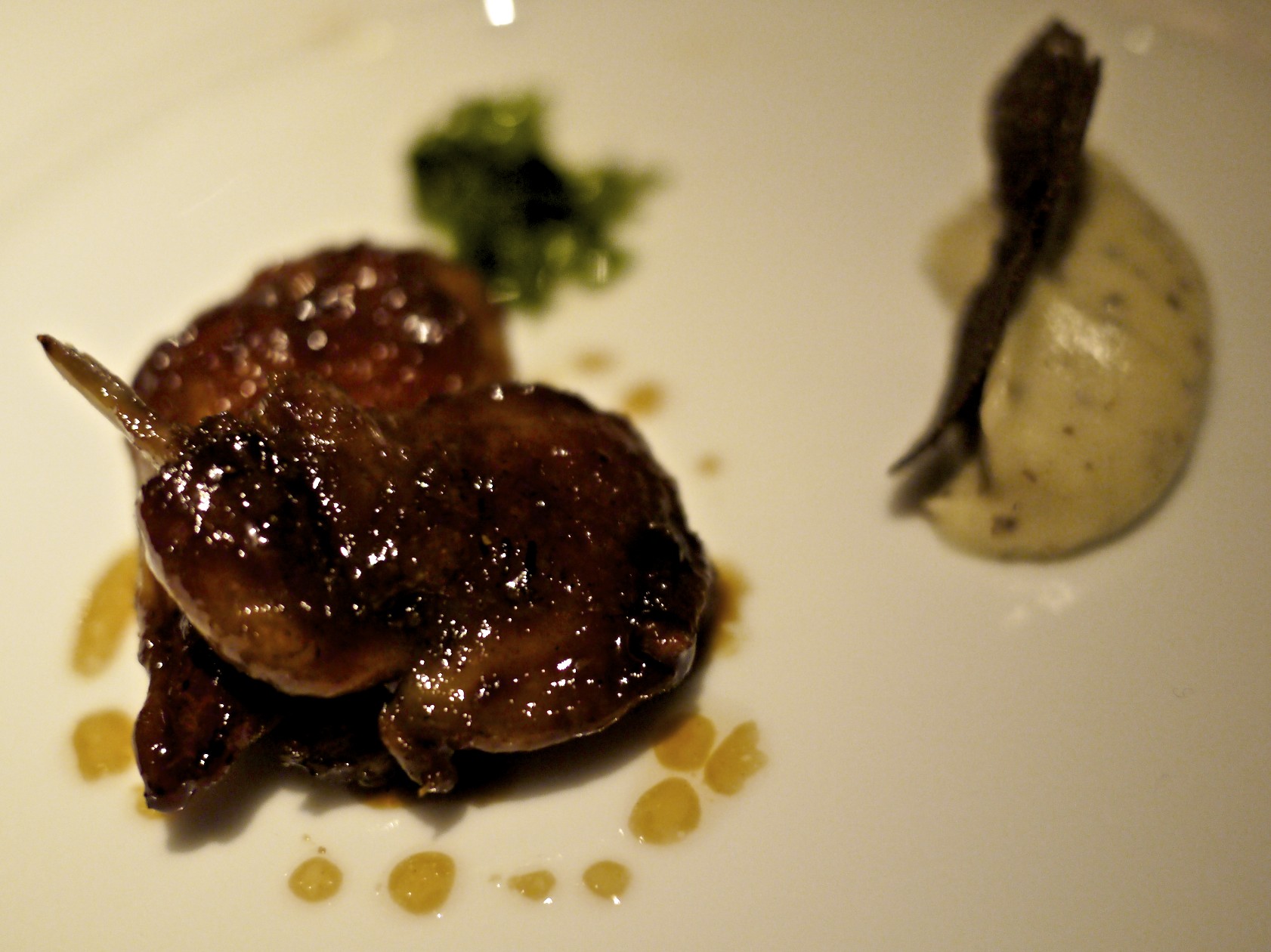
P1110964For the meat course I opted for the Free range quail stuffed with foie gras and truffled mashed potatoes, which consisted of the breast and leg of quail and a lovely black truffled mash potatoes. This course showed some great cooking as the foie gras had not overwhelmed the perfectly cooked quail. The matching wine of 2010 Saint Laurent Weingut Heinrich, Burgenland, Austria, was my favourite of the evening. The blackberry and chocolate aroma with the soft creamy tannins was delicious.

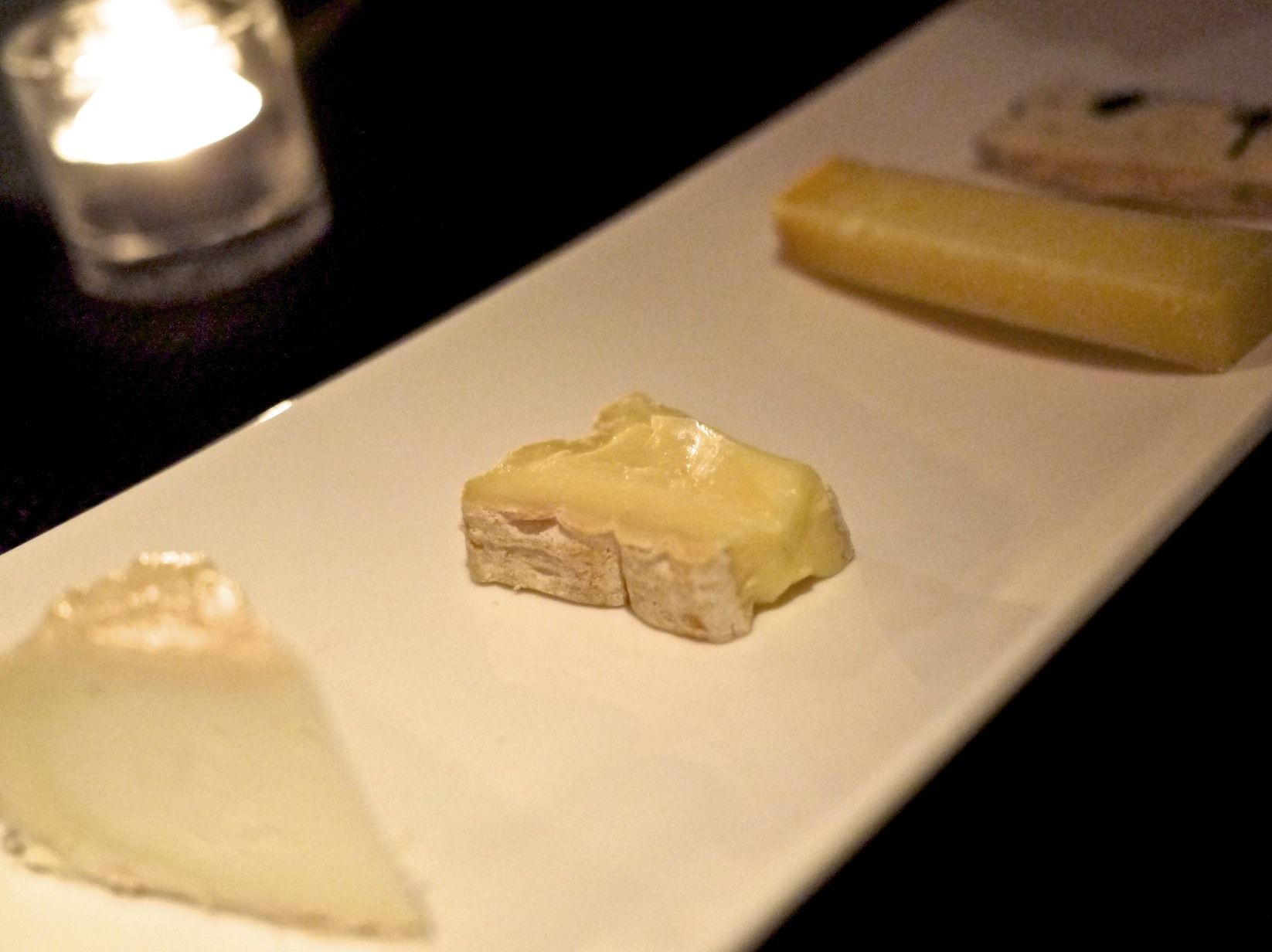
P1110967Cheese course including my favourite roquefort.

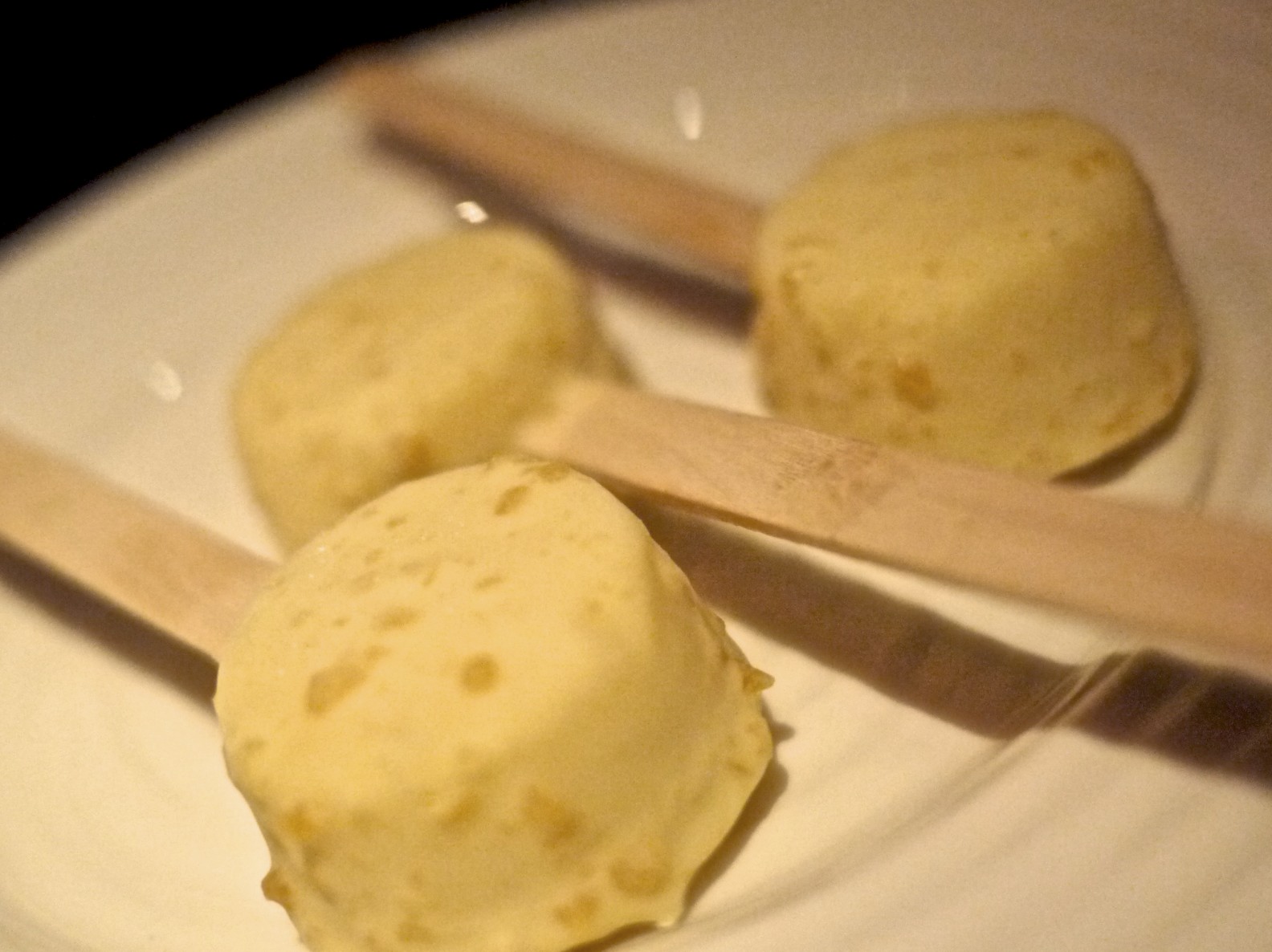
P1110973First part of Francois’s duo of desserts, which was a mandarin lollipop with white chocolate coating and popping candy. A nice palate cleanser with some vanilla seeds mixed into the mandarin sorbet centre.

P1110978For the second dessert dish we had a much richer chocolate mousse with oreo crumble and a fine chocolate disc. To conclude the evening, I was poured a glass of 2010 Maury Mas Amiel, Languedoc-Roussillon, France to which I remarked it had similarities to a Grenache. The sommelier’s looks of disgust did not go unnoticed and he was quick to put me down as according to him I could not have been more wrong. There’s no need to put down a customer if they’ve made a genuine mistake, but ironically the wine was predominantly of the grenache grape variety – shame I only found out when I got home!
P1110991Some chocolate mignardises to finish the meal.

P1110996The food on the whole was good and I enjoyed the flavour combinations. The matching wines were generally good and on the whole the service was alright, but perhaps too casual and inconsistent for what I would expect from a two michelin star establishment. For example, one of the staff escorted us on the lift to the bar area, but no one came to see us off at the end of the meal. Whilst I could overlook these flaws, the sommelier left me a bad flavour and a dent to otherwise an enjoyable evening. I would consider a return to try some of the other dishes, but I must admit I won’t be returning there in a hurry.


Ristorante Bovio, La Morra, Alba

P1110358Chef: Marco     Website: www.ristorantebovio.it    Cuisine: Piedmontese/Truffle in season

As part of out first trip to the annual Alba White Truffle Festival, we surely could not leave the region without indulging ourselves in an extravagant white truffle tasting menu!
P1110347Coming in at 200 euros a head, the tasting menu was a bargain, particularly given the quality and quantity received for each course.

P1110250We decided to have a delicious bottle of Italian Spumanti 2005, Alta Langa “Zero” Enrico Serafino which had a complex and elegant fragrance of lime blossom and honey.  It had a good acidity and aroma of flowers and fruit with a long mineral finish.

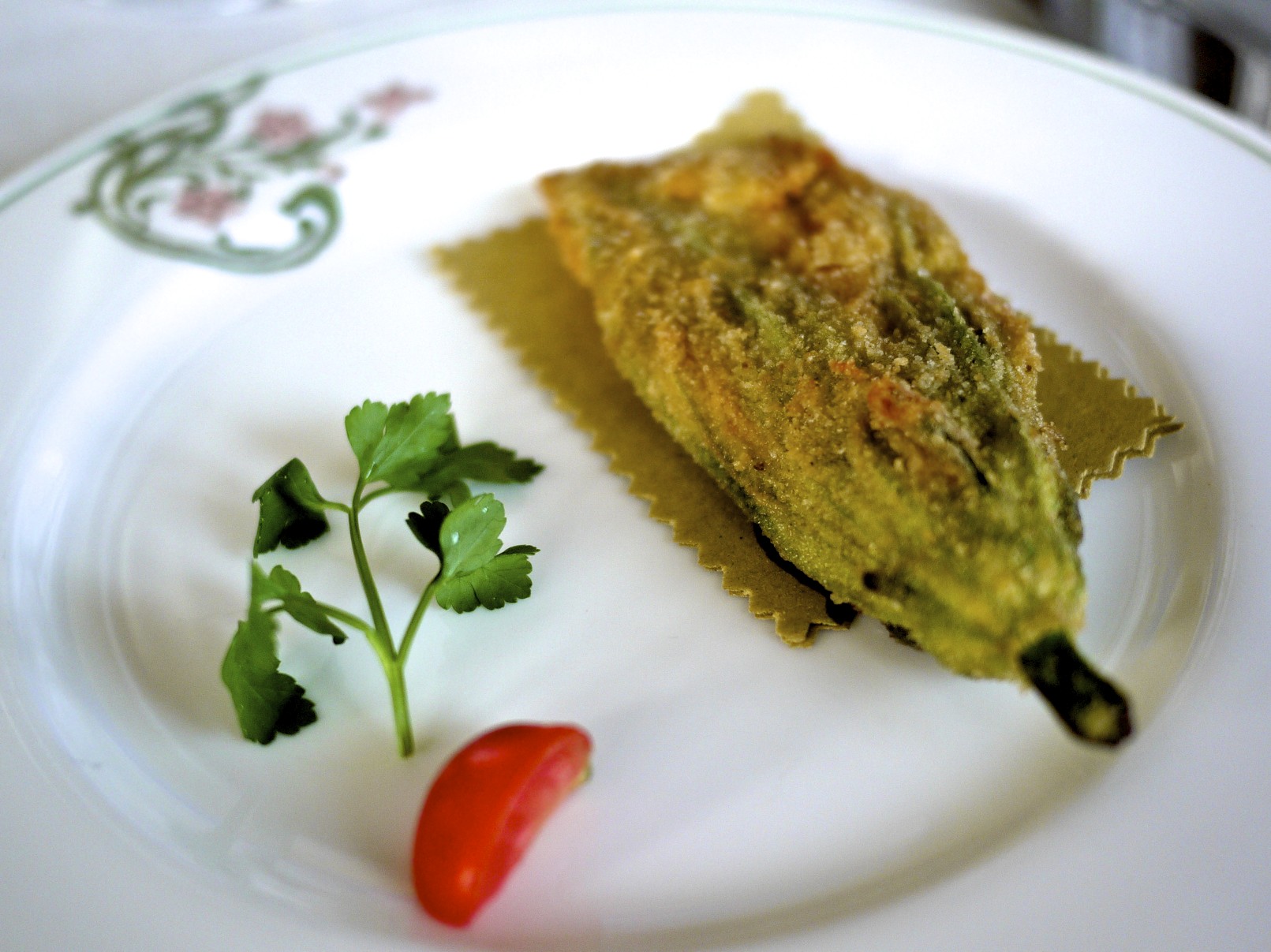
P1110268We started off with an amuse bouche of deep-fried zucchini flower. It had a lovely crunchy texture whilst trapping all the juice maintaining a moist centre that consisted of veal, spinach, parmesan and egg.  A good start.

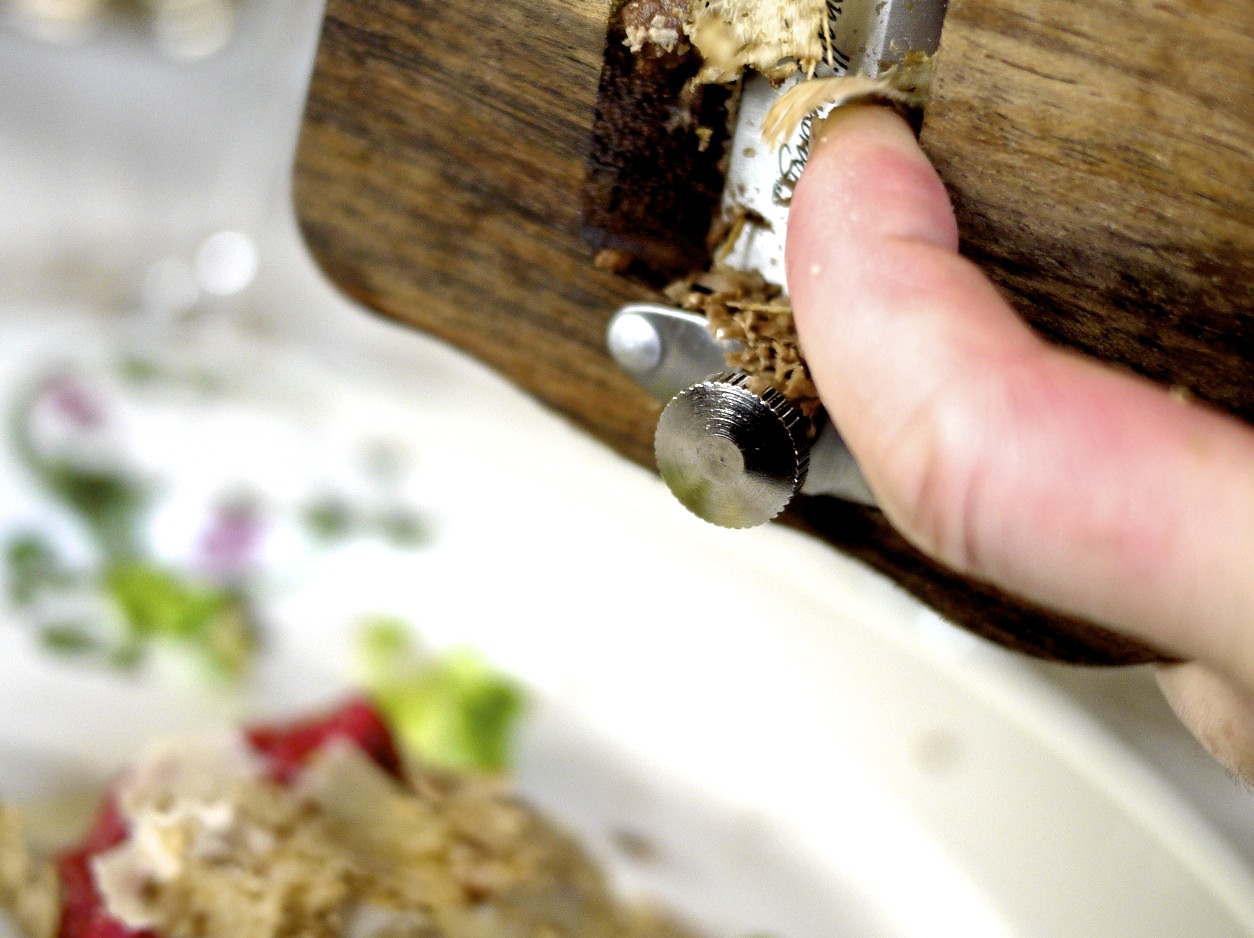
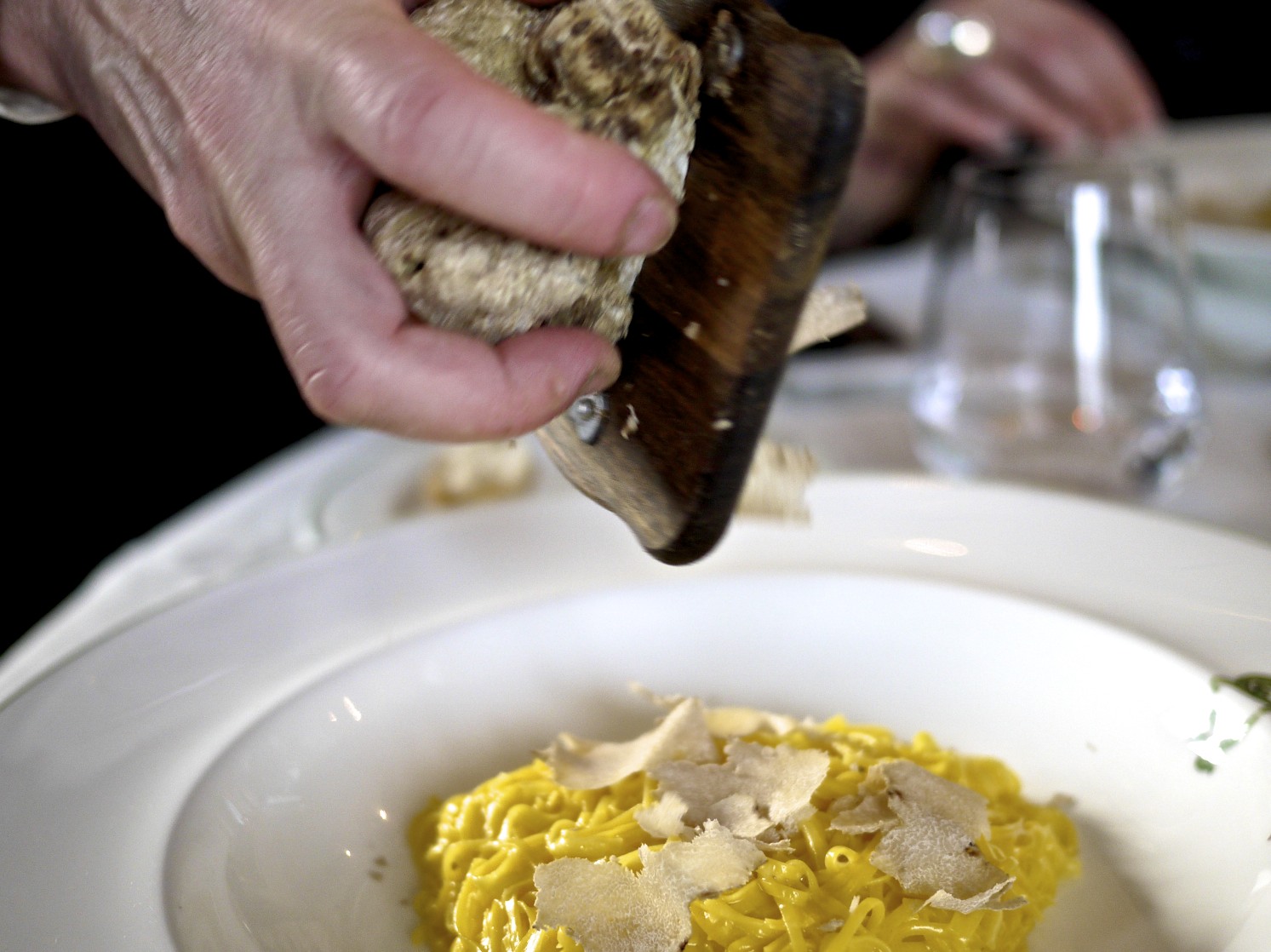
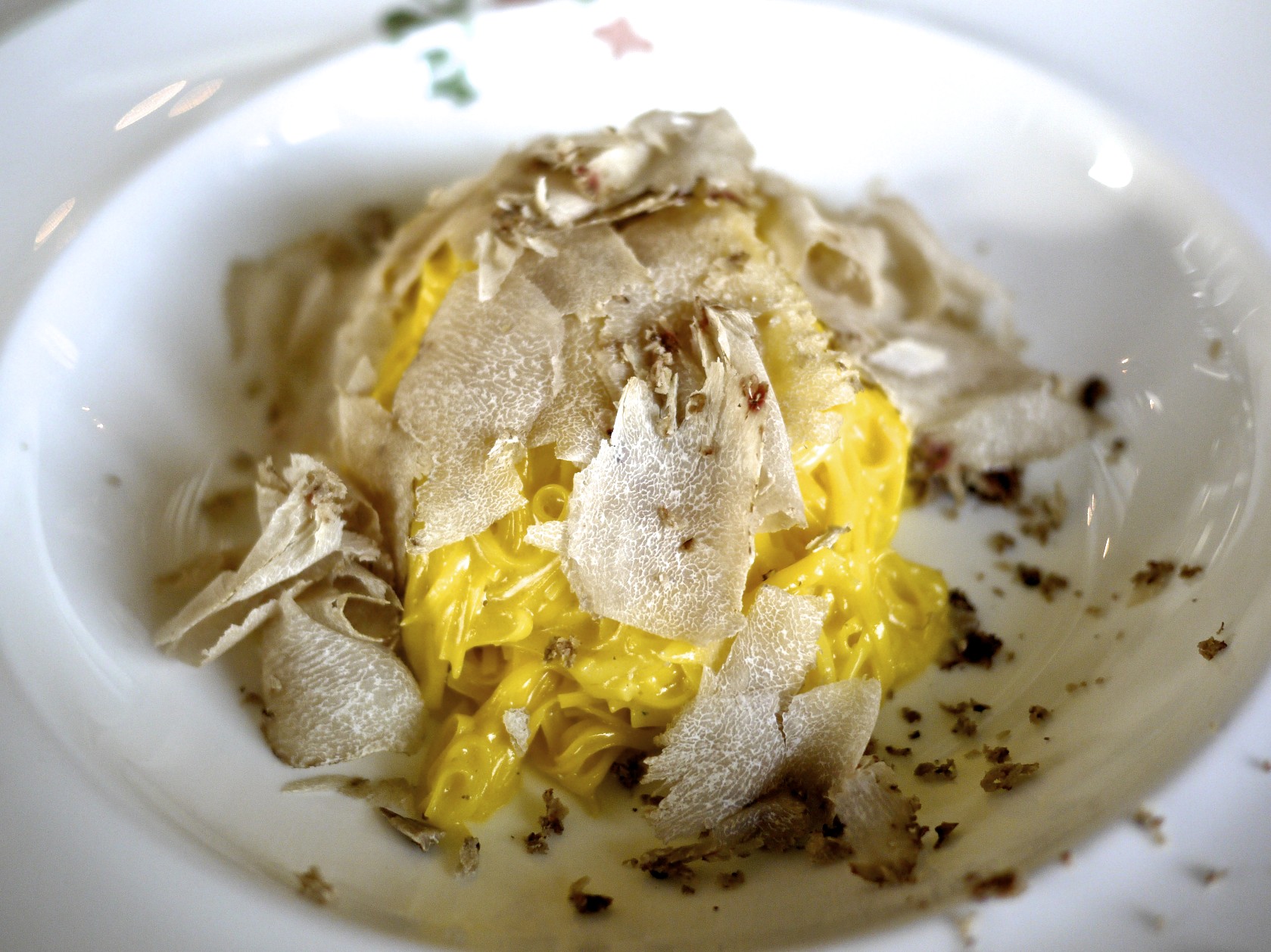
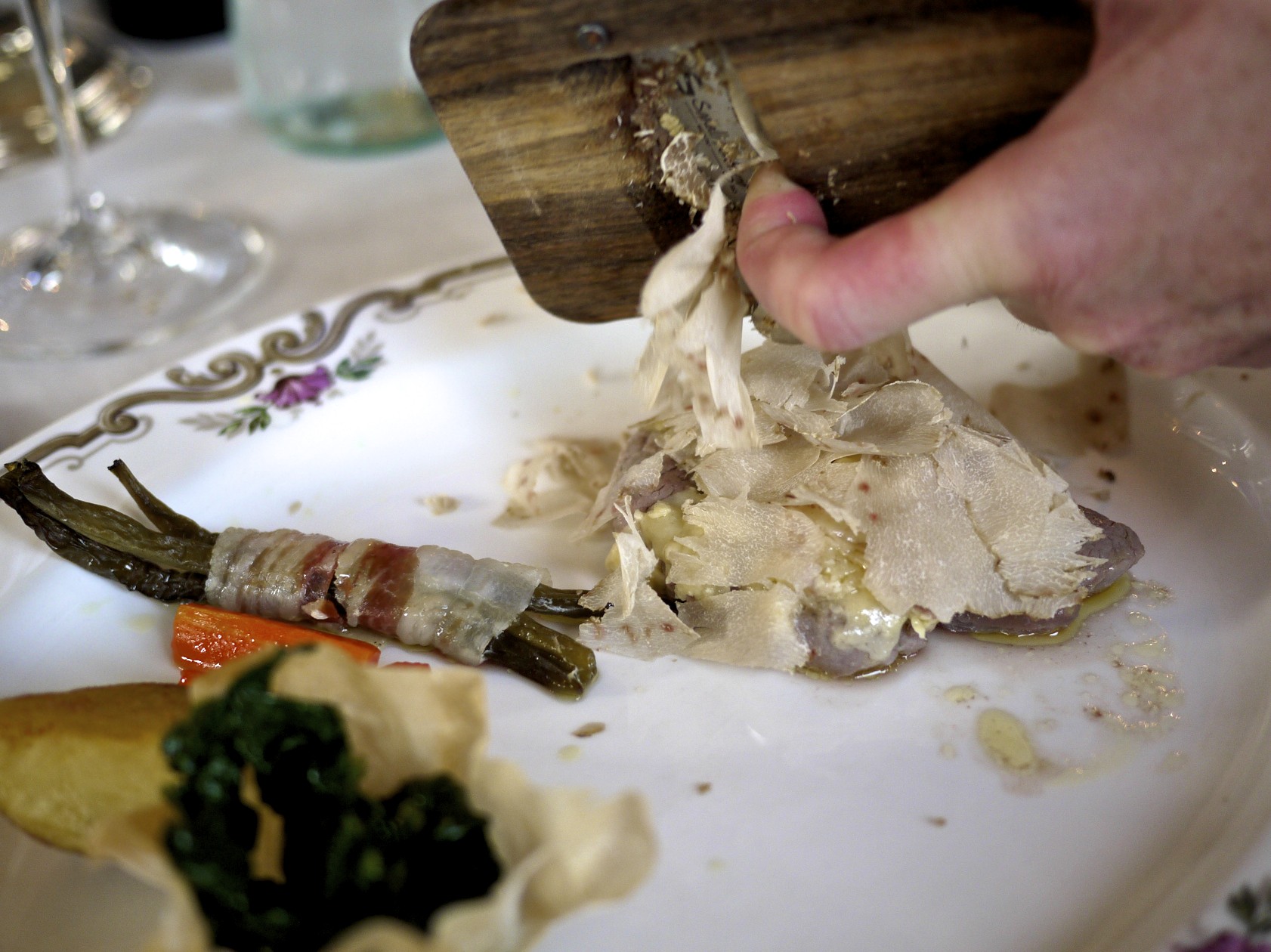
P1110277The beauty of Ristorante Bovio is that they give you a generous serving of top quality Alba white truffle with every course and shave the truffle at your table.

P1110272The first course was La battuta di fassone piemontese con tartufo bianco which was essentially a tartare made from a high quality regional veal (fassone), which is only reared in Piedmont, with shavings of white truffle. The meat is prized for it’s tenderness and leanness, making it ideal to consume raw, and the flavour of the truffle really came out. A great first course and certainly one of my favourite dishes of the meal.

P1110289Uovo in pasta alla Bergese con tartufo bianco.

P1110294It was an egg ravioli with a filling of spinach and egg yolk with a small amount of parmesan, and of course a generous shaving of white truffle! It had a lovely creamy texture and a good balance of bitterness and fruitiness from the virgin olive oil. The parmesan overpowered the truffle slightly, but produced a lovely aftertaste.

P1110295How could we continue our meal without having some of the superb local wine of Barolo?  The sommelier recommended a bottle of Elio Altare Barolo 2005, which had a medium ruby red color with a soft floral bouquet of rose with herbal notes. It was fine yet firm, with an intense palate of sweet cherry essence and awash with fine grain tannins.

P1110303Funghi porcini ala rosmarino con fonduta e tartufo bianco. Porcini sauteed with rosemary and garlic, laid on a fonduta base made from Raschera, a local Piedmontese cheese, with milk, butter and egg yolk, with more shavings of white truffle. The earthy flavour of the porcini was amplified by the white truffle and the saltiness of the cheese.

P1110310Tagliolini ai trenta rossi con tartufo bianco.

P1110311This dish was all about the white truffle! A simple thin cut tagliolini pasta made with a high egg-to-flour ratio mixture. The flavour and aroma of the white truffle really came through.
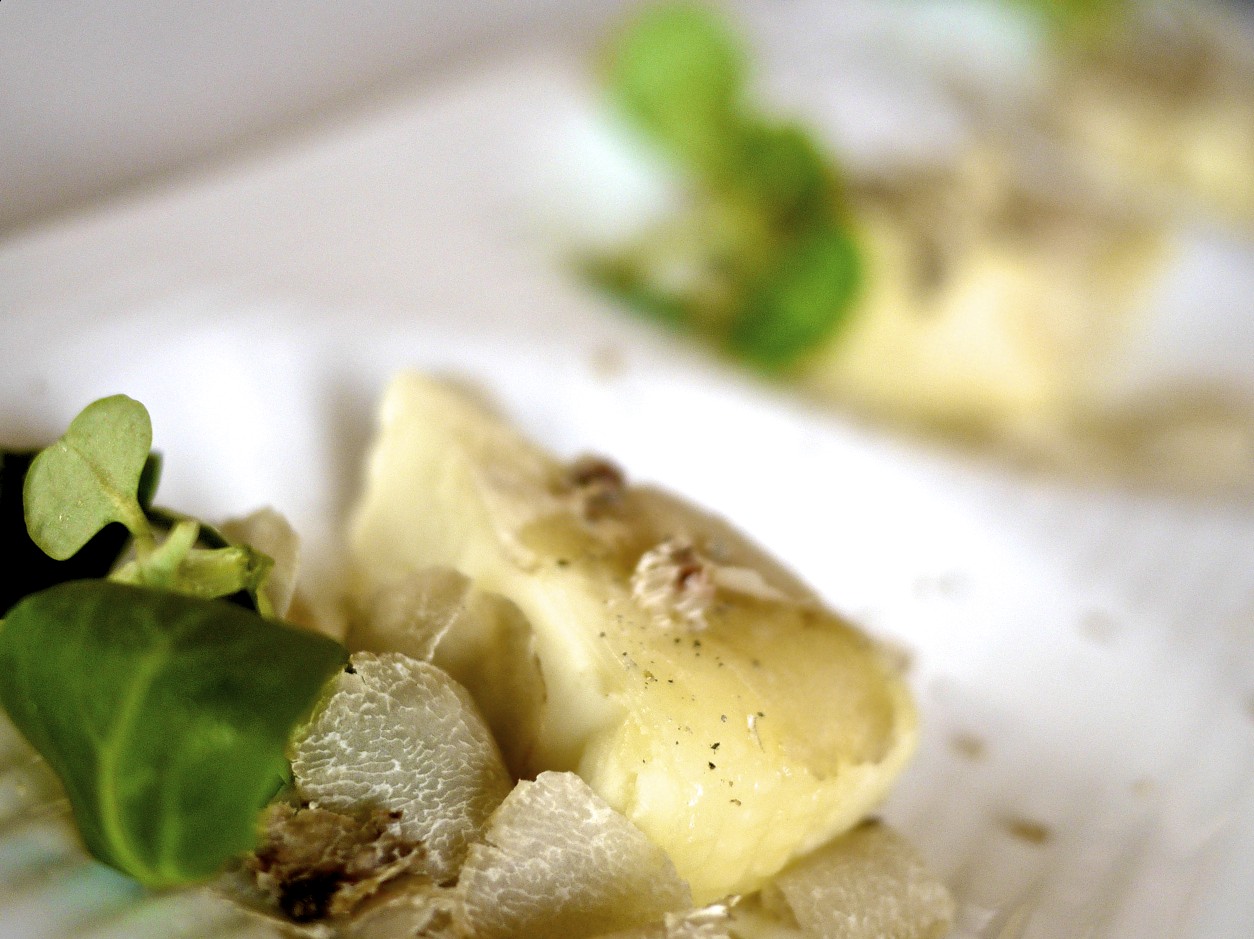
P1110319Filetto di vitella con tartufo bianco. This was perhaps my least favourite dish for a several reasons. Primarily, the cheese on the veal loin dominated the palate and I could hardly taste the white truffle. The veal loin was a little dry and I could only pick up a part of the flavour; overall I thought the addition of the filo pastry and asparagus with bacon was just too much.

P1110326La Panna cotta e miele di acacia con tartufo bianco. After a disappointing end to the main act of the meal, the chef managed to redeem himself with this beautiful simple dessert. The sugar work was very sticky and brittle, providing a nice contrasting texture to the Panna cotta. The Acacia honey added a floral note with a hint of vanilla. What amazed me was how well the white truffle married with the Panna cotta itself. This was the second time I had white truffle for dessert and it was yet again superb!

P1110331My partner opted for the Selexione di robiole con tartufo bianco, which was a selection of soft ripened cheese from the Langhe region made with varying proportions of cow, goat and sheep’s  milk. It was fresh and creamy, and admittedly I wished I could have had both the dessert and the cheese.

P1110339Some local petit fours finished off the meal with a glass of honey grappa. I was quite full at this point but much to my partner’s disapproving sigh, I couldn’t resist having a few of the baci di dama; another great discovery from my trip.

P1110254

This was by far the best white truffle feast I’ve ever had – both in terms of quantity and quality. The produce was far superior to the other truffle tasting menu we had during our stay. If you are lucky enough or book in advance, I strongly recommend you asking for the window seat as the view from our table was stunning. I’d definitely come back, but next time I will order a la carte and purchase the truffle separately in order to avoid some of the dishes I didn’t particularly like.

La Pergola, Rome

Main outdoor poolChef: Heinz Beck      Website: www.romecavalieri.com/lapergola.php       Cuisine: Italian

Occupying the top floor of the luxurious art-gallery hotel of Waldorf Astoria, La Pergola is no ordinary restaurant. For one, the interior décor of the restaurant is very bold but elegant.

(Photo courtesy of Roma Cavalieri Hotel)

La Pergola ViewThe view over the city of Rome is nothing but mesmerising, with St Peter’s Basilica lit up as your backdrop in the evening. It’s not hard to understand why Beck decided to stay after first arriving in 1994. It was certainly the most spectacular view of Rome that I have ever seen.

(Photo courtesy of Roma Cavalieri Hotel)

P1110808

An amuse bouche of Mussels and chickpea puree with pecorino foam. The saltiness and crunchy texture of the parmesan was very appetising and went perfectly with our glass of Dom Perignon 2003.

P1110814

First course of Amberjack marinated in white balsamic vinegar with pomegranate snow. The subtle sweetness of the pomegranate married well with the aromatic amberjack carpaccio, and slight touch of acidity from the balsamic vinegar, overall resulting in a very well balanced dish. I particularly enjoyed the cold component to the dish and the textural contrast created by the crispy violet potato garnish. Accompanying wine was a Planeta Caricante 2010, a mineral driven acidic wine that was refreshing.

P1110816A plate with three different types of sea salts. The yellow Norwegian salt was by far my favourite with a distinct smoky flavour. In contrast, the pinkish-brown volcanic Alaea salt from Hawaii was much more mellow in flavour whereas the white Italian salt from Trapani was rich in minerals. It was delightful to soak our bread in the light Trentino olive oil before dipping into the salt, allowing us to compare and contrast the dramatically varying flavours.

P1110822

His Grilled “La Perle Blanche” oyster on pumpkin cream with parsley puff was a much heartier dish. Despite my initial reservation over the parsley “foam”(as many chef’s have tendencies to add them for aesthetic reasons only) I must admit, that in this case, it added a lovely fragrance and freshness to the sweet and smoky pumpkin soup. I particularly enjoyed the natural seasoning from the grilled oyster, bringing all the components of the dish together in harmony.

P1110825

The Earth flavours consisting of a lovely canvass of mushroom powder, meat mushroom and cream of sweet foie gras. The parsley chlorophyll sponge and asparagus refreshingly lifted the dish, and the crunchy and wafer thing bread was critical in adding texture to what would have been a one dimensional dish. The glass of Marisa Cuomo Fiorduva 2010 revealed a hint of jasmine, orange blossoms, ripe apricots, a hint of fig and subtle toasted oak in a layered, with a smooth finish.

P1110830

The highlight of the meal, and that which was responsible for leading me here in the first place, undoubtedly was Beck’s signature dish, Fagotelli “La Pergola”. The visual simplicity of this dish was deceptive as the skills required for perfecting the remarkably thin and light parcels of pasta containing carbonara sauce, garnished with specks of crunchy bacon and zucchini, was truly remarkable. I was impressed with Beck’s ability to refine a traditional Roman dish and transform the humble pasta into a sophisticated dish, worthy of a place in a fine dining restaurant.

P1110837

It was difficult to follow the previous dish and I must admit I found the King prawns in tempura on puree of fried squids a little sweet for my liking. However, the celery did add some sharpness to this rich dish and the deep flavour of the fish and squid consomme cream was enjoyable.

P1110846

The Black cod with celery sauce and curry crust was the most aromatic fish course I’ve ever had. The delicate cod with perfectly seasoned potatoes had a lovely hint of lime and verbena but interestingly took the fishiness of the fish away, and the sweetness of the celery balanced the dish. Superb!

P1110849

The Venison in pistachio crust with chestnut puree and persimmon jam was a welcomed progression to a richer dish. The venison was cooked perfectly pink and the chestnut puree added a smoky and earthy flavour to the sweet pistachio, topped off with a thick jus. You could just about pick up the sweetness from the persimmon jam although it was possibly too delicate a component to this rich dish. The woodsmoke chocolate note from the Rivera Il Falcone 2007 was a perfect marriage.

P1110854

Of course we couldn’t say no to the cheese trolley! Of particular interest was the Bitto cheese from Lombardy that was produced from whole cow milk produced only in the summer months and aged for over 10 years. It was definitely something different and resembled closest to a very matured parmesan.

P1110871

After a quick napkin change we were served with one of the most memorable dessert from 2012. The Iced sphere of pomegranate on gianduia cream and cannelloni filled with salty pine-seed Chantillywas the best surprise of the night! I thought I had misheard pomegranate for cherry because the depth of sweetness from the sorbet sphere did not resemble that of any pomegranate I knew. Beck later explained that the sweet juice was extracted by delicately squeezing only the outer flesh of each seed, resulting in a concentrated sweet flavour similar but superior to that of cherry in season. It was a superb finish to a memorable meal.

P1110867

Obviously we thought it would be rude to turn down the lemon and lime macaron, lemon mousse on short biscuit with crunchy chocolate drop, Tiramisu cupcake and raspberry jam as they looked so pretty. The flavours yet again were clean and fresh, and we could have easily managed another round.

P1110880

Luckily for us there was a final treat of hazelnut & mango ice cream to go with our espressos before partaking in the Cuban delights in their designated cigar tasting room!

HB Toscani

I never thought that classic Italian dishes like a plate of pasta could be elevated to such a sophisticated level. Achieving such feat is no ordinary matter and we could easily overlook the tremendous amount of determination, skills and hard work that went into refining every dish. I also appreciated Beck’s extra attention to detail to his dishes, ensuring his diners have a light and healthy meal whilst delivering high notes on the all-important flavours.

(Photo courtesy of Oliviero Toscani)